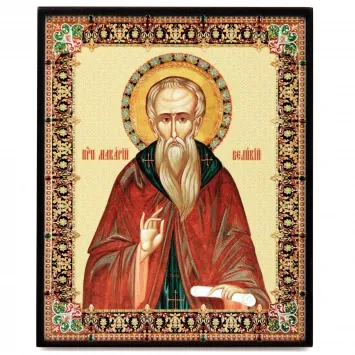
Venerable Macarius the Great of Egypt (+390–391)
Macarius the Great of Egypt was born in the village of Ptinapor in Lower Egypt. At his parents’ request he married, but was soon widowed. After burying his wife the saint thought: “Take heed of what has happened, Macarius, and care only for your own soul, for departure from earthly life awaits you too!” God granted His chosen one a long life, but from that day the remembrance of death accompanied him inseparably and inspired him to the labour of prayer and repentance. He went to church more often and went deeper and deeper into Holy Scripture, but he did not leave his aged father and mother, and kept the commandment to honour one’s parents. After his parents’ death the Venerable Macarius (“Macarius” means “blessed” in Greek) gave away all his property as alms for the repose of their souls, and then with fervent prayers besought the Lord to show him a worthy guide on the path of life. And God did indeed point the young man to such a person: an experienced elder living in the desert near the village, who received him with love, trained him in vigil, fasting and prayer, and gave him a craft too, teaching him to weave baskets. Then the hermit built a cell nearby and settled his beloved disciple in it.
Once the local bishop came to Ptinapor and, learning of the venerable father’s devout life, enrolled him against his will among the clergy of the village church. Macarius, inclined to solitude and silence, found serving in the world very hard, and secretly withdrew from the place. The enemy of the human race began a relentless struggle against the ascetic: he tried to frighten him, shook his cell, and surrounded him with sinful thoughts. The blessed father drove off the deceiver’s attacks by the power of prayer and the Cross. Wicked people accused the saint of seducing a maiden; the venerable father bore the trial with wonderful meekness and, without murmuring, supported the woman with the money he got from selling baskets. The venerable father’s innocence became clear when the time came for the pregnant woman to give birth. She was in torment, but the child would not be born. Then she confessed that she had slandered the saint and named her real seducer. Her parents were horrified; they were about to go to the blessed father to ask his forgiveness, but the Venerable Macarius withdrew from those parts by night and moved to the mountain of Nitria, into the desert of Pharan. Here he lived for three years, and then went to the father of Egyptian monasticism, Anthony the Great. The saint received the zealous monk with love. He soon became his teacher’s beloved disciple and follower. Macarius lived for a long time under his guidance, and then, on his advice, settled in the desert of Scetis (in the north-west of Egypt). When he was nearing thirty, the ascetic was already so experienced and valiant and shone so with his labours that he was nicknamed “the old young man”.
The Venerable Macarius experienced many attacks of the demons: once, when he was carrying palm branches from the desert to weave baskets, the devil stood in his way. The evil one wished to strike him with a sickle, but could not, and only said to him: “Macarius, I suffer terribly because I cannot overcome you. The weapon with which you beat me off is your humility.” When the saint turned forty, he was ordained priest and appointed superior of the monks living in the desert of Scetis. At this time the Venerable Macarius often met Anthony the Great and received spiritual instruction from him.
The Venerable Macarius worked many healings. People hastened to him from every side to ask for counsel or for prayer and blessing. All this disturbed the saint’s quiet, so he dug a deep cave beneath his cell and withdrew there for prayer and contemplation of God’s providence. The Venerable Macarius gained such boldness before the Lord that a great many miracles took place through his prayers. Once the holy father found a thief in his cell. The saint calmly helped him load the goods onto a donkey, and did not let on that he himself was the owner of these things. After the robber had gone, he thought: “We brought nothing into this world, and naturally we can carry nothing out of it. Blessed be the Lord unto the ages!”
Once the Venerable Macarius found a skull lying in the desert and asked it: “Who are you?” The skull answered: “I was a chief pagan priest. When you pray for those in hell, our torment is eased a little.” The venerable one asked: “What are the torments there like?” “We burn in a terrible fire,” the skull answered, “and cannot see one another. When you pray, we dimly glimpse one another, and this calms us a little.” With tears Macarius asked: “Are there worse torments?” The skull replied: “Below, deeper than we, are those who knew God but fell away from Him and did not keep His commandments. They are tormented more terribly.”
Once, during prayer, the blessed father heard: “Macarius, you have not yet attained such perfection as two women living in the city have attained.” The humble ascetic took his staff, went to the city, found the house where the women lived, and knocked at the door. The pious housewives received him with joy. The venerable father said to them: “I have come from the distant desert on your account. I want to learn about your good works; tell me everything and hide nothing from me.” The astonished women answered: “We live with our husbands and have no virtues at all,” but the saint insisted, and his hostesses began: “We are the wives of two brothers by blood. In all the time we have lived together we have never said one harsh or hurtful word to each other, and we have never quarrelled. We asked our husbands to let us go to a convent, but they did not agree. Since then we have vowed not to utter a single idle word until our death.” The holy ascetic glorified God and said: “Truly, the Lord does not look for virgins or married women, monks or laymen; He values a person’s free will, and leads by the grace of the Holy Spirit those who have set out on the path of salvation.”
In the reign of the Arian Emperor Valens (364–378) the heretic bishop Lucius persecuted Macarius the Great and the Venerable Macarius of Alexandria. Both monks were seized, put on a ship, and exiled to a desolate island inhabited by pagans. Here, through the saints’ prayers, the daughter of the pagan priest was healed, after which the priest himself and the inhabitants of the island were baptised. When the Arian bishop learned of what had happened, he was overcome with shame and returned the monks to their deserts.
The venerable father’s meekness and humility transformed people’s souls. “An evil word,” said Abba Macarius, “makes even the good evil, while a good word turns even the evil towards good.” To the monks’ question how they should pray, the venerable father answered: “In prayer there is no need of many words; it is enough to ask: ‘Thy will be done, O Lord!’ If the enemy attacks us, we should say: ‘Lord, have mercy on us!’ God knows what is best for us and will look on us with the eye of mercy!” When the brothers asked him, “How are we to become monks?”, the venerable father answered: “Forgive me, I am a poor monk; but I have seen solitaries labouring in the depths of the desert, and when I put the same question to them they answered: ‘If a man has not renounced everything of this world, he can never become a monk.’ I said: ‘I am weak and cannot be such as you are.’ ‘Then sit in your cell and mourn for your sins!’”
The Venerable Macarius advised one monk: “Flee from men and you will be saved!” He asked: “What does it mean to flee from men?” The venerable father answered: “Sit in your cell and think about your own sins.” Saint Macarius used to say: “If you want to be saved, become like a dead man, who is not angered when he is insulted and does not grow proud when he is praised.” He also said: “If you count reviling as praise, poverty as wealth and want as abundance, you will not perish; for it is impossible that one who is Orthodox and labours in piety should fall into foul passions and demonic delusions.”
The Venerable Macarius’s prayer strengthened many in trials, and turned calamity and temptation away from many.
The venerable father lived ninety-seven years. Shortly before his death he saw in a revelation the venerable fathers Anthony and Pachomius, who told him the good news that he would soon inherit the blessedness of the Kingdom of heaven. Macarius instructed his disciples for the last time, said farewell to everyone, and with the words “Into Thy hands, O Lord, I commend my spirit” fell asleep in the eternal sleep.
Abba Macarius shared his abundant spiritual experience with us in his theological works. The Venerable Macarius’s prayers are also included in the morning and evening prayers used by all.