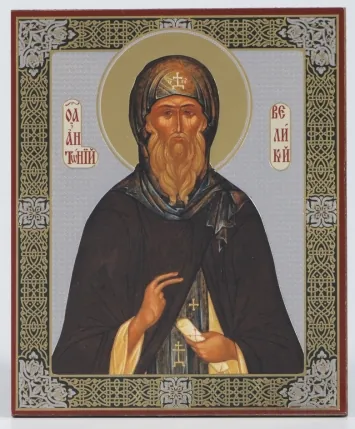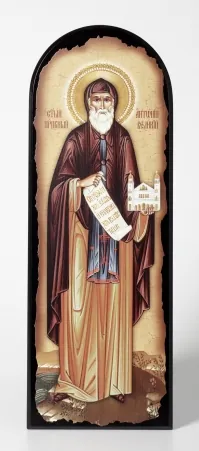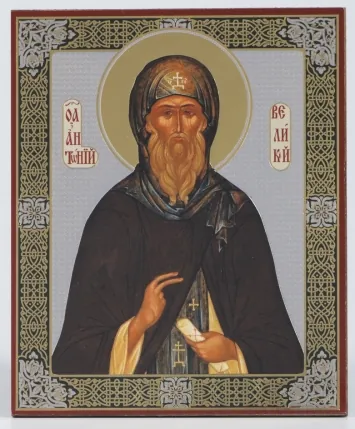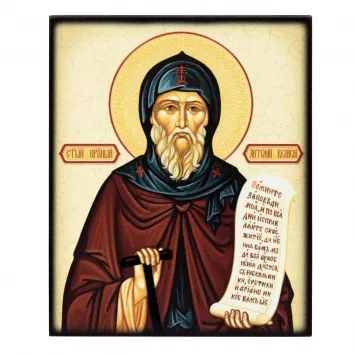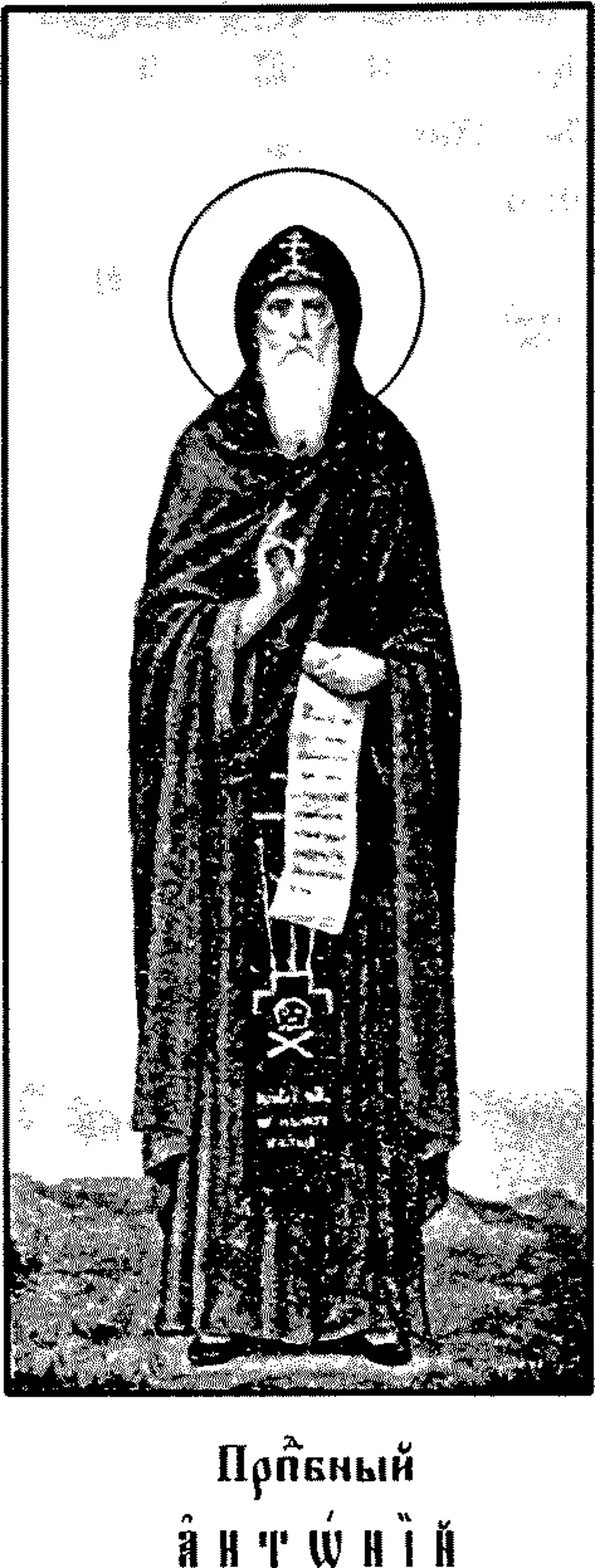
Our Venerable and God-bearing Father Anthony the Great (+356)
Saint Anthony the Great was born in 251 into a family of noble and pious Christians living in the Egyptian village of Coma. After his parents’ death he distributed all his property to the poor, and his younger sister he “entrusted to faithful virgins of his acquaintance, and gave her to be brought up in virginity”; he himself shut himself up in a hut near his village and began the ascetic life. Anthony earned his living by the fruit of his own labour and gave alms as well. He tried to keep the Lord’s commandments diligently, “for he so listened to the Scriptures that nothing written fell from him, but he learned it by heart”. From time to time Anthony also went to other monks to gain spiritual experience, and tried to become a gathering of every virtue. He gave joy to everyone and troubled no one. The villagers and his friends loved the God-loving father too; “some greeted him as a son, some as a brother”. The good-hating and envious devil “could not bear it, seeing such zeal in the young man”, and began a fierce struggle against him, bringing terrible trials upon him.
Anthony had heard from the Scriptures “that many are the wiles of the enemy”, and tried to bring his flesh into subjection, “lest I overcome in one thing and he deceive me in another”. The saint made his labours stricter: he took food once a day, and sometimes once in two or three days; he spent his nights in prayer and slept very little. “And his bed was a rush mat, and more often he lay upon the ground.” He always remembered the Apostle’s words: “When I am weak, then am I strong.”
After this the saint settled in a tomb far from the village. Here the demons tried to kill God’s chosen one; they fell upon him and beat him cruelly, “so that it was impossible for such torment and such blows to be inflicted by men”. God did not allow Anthony to die: the next day a young man who came to bring him food found the ascetic half dead and carried him to the village. The villagers thought the saint was dead and began to prepare for his burial; but at midnight Anthony came to himself and begged his friend “to lift him up and carry him back to the tomb, and to wake no one”: his steadfastness surpassed the enemy’s strength. The demons still did not calm down; they turned themselves into wild beasts and reptiles and tried to drive the monk from the place he had chosen. The holy father drove them off with the weapon of the Cross. Suddenly a radiant light descending from heaven appeared. Anthony was healed of his wounds, stood up, and cried blissfully to the Lord: “Where wast Thou? Why didst Thou not appear at the beginning, to stop my pains?” In answer came: “I was here, Anthony, but I waited to see thy courage. And now, since thou hast endured and not been overcome, I will be thy helper always, and will make thee renowned in all the earth.” At that time the holy father was thirty-five. Now well equipped with experience in the struggle with demons, he decided to go into the depths of the desert of the Thebaid and continue his labours there all alone, in complete silence. The devil tried to stop the monk, who had undertaken labours never seen before; he strewed jewels and gold before him, but Anthony passed them by indifferently and went on his way. Near a mountain the venerable father noticed an abandoned idol-temple; he settled here and blocked the entrance with stones. A disciple brought him food twice a year, and he took water from a well inside the walls. The Venerable Anthony spent twenty years in complete silence. By the Lord’s will his dwelling became known; many who wished for spiritual labour came to the desert, and the venerable father instructed his spiritual children with love.
In 311 a time of trial came upon the Church: the Emperor Maximian began to persecute the Christians. Seeking a martyr’s end, Anthony went to Alexandria. He openly served the imprisoned Christians and was present at their trials and interrogations, but the tormentors did not even touch him: the Lord did not will his death this time either.
After the persecution had ceased, the blessed ascetic returned to the labour of a hermit. God granted His chosen one the gift of wonderworking: he cast out demons and healed the sick. The multitude of visitors disturbed the holy father’s quiet, so he went still farther, into the “inner desert”, and settled on the top of a mountain. The monks searched out their beloved teacher and asked him to visit them at least sometimes.
Once more the Venerable Anthony had to leave the desert to defend the Orthodox faith against the false teaching of the Manichaeans and Arians. The Arians knew how great an authority Anthony the Great enjoyed, and spread rumours that he was a follower of their teaching. To dispel this slander the blessed father went to Alexandria and publicly anathematised the foul heresy. Pagan philosophers came to the Venerable Anthony and tried to break him with their vain wisdom, but the saint put them to shame with his simple and convincing answers.
The Emperor Constantine the Great, Equal to the Apostles (+337; commemorated 21 May), and his sons were fervent venerators of Anthony the Great. They invited the holy father to the capital, but he did not wish to leave his brother hermits, and in a letter of reply warned the emperors not to grow proud of their high position and always to remember the judgement to come: “Know that Christ is King.”
The Venerable Anthony spent eighty-five years in the desert. Shortly before his death he called the brothers and instructed them thus: “Strive rather to join yourselves always first to the Lord, and then to His saints, that after death they too may receive you as friends and acquaintances into the eternal habitations.” Then Anthony asked that his body be buried there in the desert, and that no glorious translation of it to Alexandria be arranged. The Venerable Anthony reposed in peace in 357, at the age of a hundred and five. In accordance with their teacher’s will, two disciples committed his body to the earth in a secluded place in the desert.
The life of the Venerable Anthony was described in detail by the holy hierarch Athanasius of Alexandria. This work is the first and one of the finest monuments of Orthodox hagiography. John Chrysostom wrote that every Christian should read it.
Saint Anthony left us a rich literary legacy, which still nourishes the souls of Christians today.
In 544 the incorrupt relics of the venerable father were translated to Alexandria. And in the fifteenth century they were placed in Arles (France), in the church of Saint Julian.