
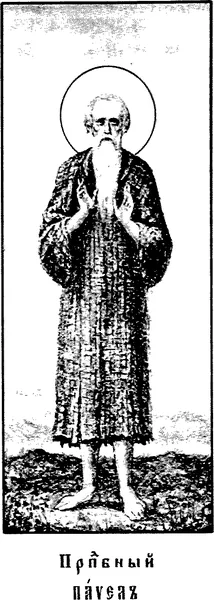
Venerable Paul of Thebes (+341)
Paul of Thebes was born in the Egyptian city of Thebes. After the young man’s parents died, a money-loving relative decided to take his property for himself. His mind darkened by greed, he began to oppress the orphan, and at last, during the persecution under the Emperor Decius (249–251), he even planned to hand him over to the lawless. When Paul learned of this scheme, he left the city and went out into the desert.
The venerable father settled in a cave at the foot of a mountain and spent ninety-one years here in unceasing prayer and fasting: his only food was dates and bread, which a raven brought him, and only a garment of palm leaves protected him from cold and heat. When the saint’s end drew near, God was pleased to make him known to Anthony the Great (commemorated 17 January). Once the thought flashed through Anthony’s mind that surely no other hermit like him was to be found anywhere; but suddenly he heard a voice: “Anthony, there is a servant of God who is more perfect than you and settled here before you. Go into the depths of the desert and you will find him.” The blessed hermit followed the Lord’s call and came upon Saint Paul’s cave. The venerable father came out to meet his guest, thereby showing him an example of humility. The monks greeted each other by name and kissed one another, and then talked for a long time. Meanwhile a raven flew up and brought bread for them both. The Venerable Paul told Anthony that the hour of his repose had come and asked him to bury him. The blessed father reposed on his knees, in prayer. Anthony saw his soul ascend to heaven, accompanied by angels, prophets and apostles. Two lions came out of the desert and dug a grave for the saint with their paws. The Venerable Anthony committed the body of the God-pleaser to the earth, took with him the garment made of palm leaves, and returned to his monastery. Anthony kept this garment as the greatest holy relic, and wore it only twice a year, at Pascha and Pentecost. The Venerable Paul of Thebes died in 341, at the age of a hundred and thirteen. The saint founded no monastery, but after his repose his imitators multiplied and covered the whole desert with monasteries. The Venerable Paul is regarded as the father of Orthodox monasticism.
In the twelfth century, by order of the Emperor Manuel (1143–1180), the saint’s incorrupt relics were translated to Constantinople. Later they were taken to Venice, and from there to Hungary. Part of the Venerable Paul’s precious head is kept in Rome.



