
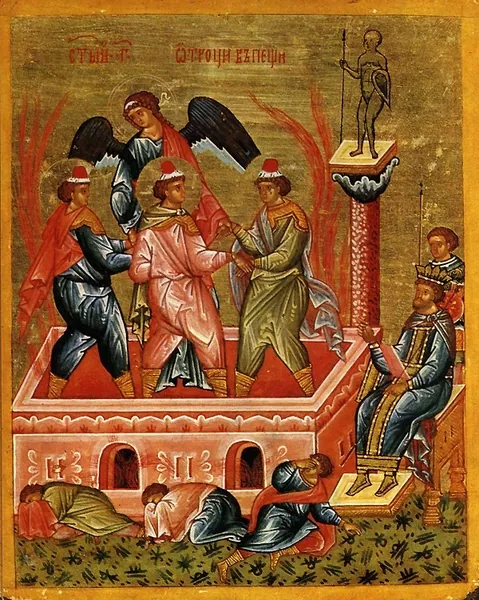
Prophet Daniel and the Three Holy Youths Ananias, Azarias and Misael (600 Before the Nativity of Christ)
The Prophet Daniel and the three youths Ananias, Azarias and Misael. In 600 before the Nativity of Christ, Nebuchadnezzar, King of Babylon, captured Jerusalem, destroyed Solomon’s Temple, seized great spoil and carried the people away captive. After this he chose from among the captives young men “well favoured” and of good understanding, assigned special guardians to them, and ordered them to be instructed in Chaldean learning and brought up in luxury at the king’s court. Among the captives were the noble youths Daniel, Ananias, Azarias and Misael, whom the chief of the eunuchs named Belteshazzar, Shadrach, Meshach and Abednego. So as not to be separated from the true God, the youths strictly guarded themselves against temptations: they took only vegetables and water, prayed in secret, and kept faith with the law of Moses. For this the young men were granted wisdom from on high. Once Nebuchadnezzar had a terrifying dream, but forgot it as soon as he woke. The wise men of Babylon proved powerless to learn what the king had dreamed. The holy Prophet Daniel glorified before everyone the almighty power of the true God, who revealed to him not only the content of the dream but also its symbolic meaning. The king rewarded Daniel generously and appointed him ruler over Babylon. Soon King Nebuchadnezzar had a golden idol cast, set it up in the plain of Deira, and commanded his subjects to offer sacrifice to it. For not obeying this decree the three youths, Ananias, Azarias and Misael, were thrown into a red-hot furnace. In the fire, which rose forty-nine cubits above the furnace, the holy young men walked calmly about and glorified God in song. An angel of the Lord came down from heaven and cooled the flames, and the youths remained unharmed. At this sight the king commanded them to come out of the furnace, and himself confessed the true God. In the reign of King Belshazzar, Saint Daniel interpreted the strange inscription (“Mene, Tekel, Peres”) which appeared on the wall during a great pagan feast held in the palace and foretold the fall of the Babylonian kingdom. In the reign of Darius, King of Persia, Daniel, denounced by envious men, was shut up in the lions’ den, but the beasts did not even touch the Lord’s chosen one. Darius rejoiced at the saint’s deliverance and commanded that throughout the kingdom men should worship the God of Daniel with trembling and fear, “for He is the living God, and stedfast for ever, and His kingdom that which shall not be destroyed, and His dominion shall be even unto the end”.
The Lord revealed to the blessed Daniel the future of the people of Israel and of the whole world. With the utmost exactness he foretold the time of Christ’s becoming man as well: seventy times seven, that is, 490 years from the time when the Jews would receive permission to rebuild the walls of Jerusalem. Saint Daniel interceded for his people with Darius’s successor, King Cyrus, who greatly esteemed the blessed one and set the captive Jews free; but the prophet himself died in captivity. The holy Empress Helen translated his relics to Constantinople.
According to one account, Ananias, Azarias and Misael ended their lives as Daniel did; but according to the testimony of Cyril of Alexandria (commemorated 9 June), they were beheaded by order of the Persian King Cambyses. The Georgian manuscripts of Mount Sinai have preserved for us an account that the incorrupt relics of Ananias, Azarias and Misael were revealed in the reign of Varam, King of the Persians: a Jew living in Babylon, who knew by tradition where these holy relics were buried, worked a great many healings by their power. By God’s providence the Christians took the incorrupt relics from the Jew and translated them with honour to a martyrs’ shrine for the Orthodox to venerate.



