
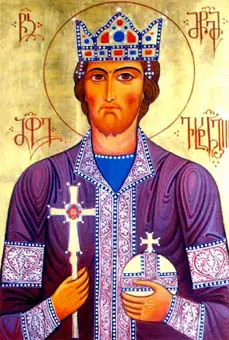
Holy Martyr King Vakhtang III (+1308)
The holy King Vakhtang III was born in 1257. Vakhtang’s father was Demetre the Self-sacrificing, king of Georgia, and his mother a daughter of the emperor of Trebizond. By this marriage King Demetre had five children: David, Vakhtang, Manoel, Lasha and Rusudan. By another marriage Demetre had further children: Baadur, Iadgar, Jigda-khatun and Giorgi.
After the martyr’s death of Demetre the Self-sacrificing, Vakhtang was taken for refuge to Mtiuleti, and there he grew up. In Demetre’s place Vakhtang, son of David Narin, was set on the throne of the united kingdom of Georgia, and after his unexpected death the royal throne was taken by the son of Demetre the Self-sacrificing, David VI. Vakhtang stood loyally at his brother’s side and tried in every way to lighten for David the heavy cross of kingship.
David “sent his younger brother Vakhtang as envoy to the son of the great Batu”. The aim of the embassy was to make use of the enmity that existed between Georgia, Iran and the Mongols, and against the background of their rivalry somehow to settle the country’s internal and external problems.
King David could not keep peace in the land; he lost the confidence both of the conquerors and of his own people, and terrible suspicions took hold of him. David was not sure even of the loyalty of his own brother, the holy Vakhtang; by his order the holy Vakhtang was seized and thrown into a dungeon.
Vakhtang managed to escape from the fortress; he “slipped away and came to Ivane Barseli”, who enjoyed King David’s special trust, and complained to him: though “I have done no evil” to my brother, he still imprisoned me; and even now that I have fled, “I will not go to the Horde, to his enemies”. So tell my brother the king of “my coming to thee”, and intercede for me, that “if he assure me by oath” that “he will not harm me nor seize me”, I will go back to him, and that he may “give me a small living” as well to live on.
King David “assured Vakhtang by oath”, but the accord between them did not last long. After Vakhtang’s marriage, when “Vakhtang took to wife the daughter of Shaber’s son”, David’s attitude to Vakhtang grew sharp again. Once more the “dishonourable treatment” of Vakhtang began, and the people’s unrest over King David’s policy increased. Vakhtang was forced to “go to the Horde, to the khan”.
The khan “received Vakhtang kindly” and “gave him the kingship”; but in the situation of the time the mere grant of the kingship meant nothing: in Tiflis sat the young prince Giorgi, while David VI ruled over the whole northern highlands. Military force was needed to set Vakhtang on the throne, and Ghazan Khan “sent Khutlusha noyon with Vakhtang III with a most mighty army”.
In 1302, “when Vakhtang, son of Dimitri, sat as king, all Georgia was given to him”. Every Georgian rejoiced, “for Vakhtang was perfect in all things, firm in faith, God-fearing, honouring the clergy, giving honour to the churches, meek and lowly, quiet, merciful, untroubled, perfect in every good, and envious of none”.
Vakhtang III had to govern the land in a terribly grave situation: “There was in those times no sowing, nor any building at all… we were given over, first, to bitter captivity, and second, to slaughter and killing by the barbarians, and third, there came a lack of bread… so fierce did the famine grow that they ate unclean carrion without shame… children sucked at the breasts of their dead mothers, corpses… they laid Kartli waste most wickedly… and the land was given over to corruption, for our sins.”
King Vakhtang tried in every way to mend the land’s most grievous state. Yet for the most part he was forced to take part, outside Georgia, in the Mongols’ distant campaigns, and in such campaigns the bodily and spiritual strength of the Georgians was spent.
During King Vakhtang’s campaigns in Palestine with the Georgian army, the Mongols granted the Georgians special rights in Jerusalem, and at that time Vakhtang gave a great donation to the Georgian Monastery of the Cross in Jerusalem. Through Vakhtang’s labours the standing of the Georgian monasteries in Jerusalem grew still greater. Vakhtang’s wife was tonsured a nun, with the name Rhipsime, in the Georgian convent in Jerusalem. By decree of the Monastery of the Cross in Jerusalem, on the day of the Annunciation “as many priests and deacons as there be shall vest for the king of kings Vakhtang and for his wife Rhipsime (tonsured a nun)”.
During one of these recurring campaigns of the Mongols, in Gilan, in which the Georgians usually took part too, the Mongols were defeated. King Vakhtang himself was wounded in the battle, and a great many Georgians fell in it.
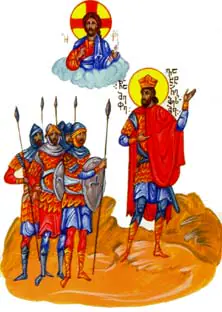
As Vakhtang III was returning home from the campaign, a Mongol noyon sent by the khan to Georgia overtook him near Nakhchivan. He had the khan’s order to destroy, lay waste and wipe out the holy houses of Georgia. By their demand, moreover, the Georgians were to abandon Christianity and accept Islam. “But King Vakhtang was not afraid, but took courage, and the more did he call to mind the valour and labours for Christ God, and said to his soldiers: ‘Men, brethren and fellow-believers, and true confessors of Christ God! Ye know the law from our fathers, and ye have heard the preaching of the holy apostles, and ye know the labours and the valour of the martyrs, and have seen with your eyes countless miracles in their temples, and have heard in the Gospel from the mouth that cannot lie: “Whosoever shall confess me before men, him will I confess also before my Father which is in heaven.” And again: “Come unto me, all ye that labour and are heavy laden, and I will give you rest.” Now be not dismayed, and let us go before the khan, and lay down our lives for Him who laid down His life for us. First let us give ourselves up to death, and then let the will of God be done. And He shall guard His flock’… Straightway they went to the Horde and to the gate of the khan, and bent the knee, and the king said with a loud voice: ‘Hear, O high and mighty khan: an order has come that all Christians should forsake our faith. Now hear: our grandfathers and fathers served and ministered to your blessed grandfathers and fathers in this faith, and never have we heard that the faith of the Georgians is evil; rather we have been the most distinguished of all. And the faith of the Persians was reckoned most loathsome by the former khans. For this they cut them off, for they were torturers and sodomites and murderers. And now, if thou hearkenest to the word of the Persians, O khan: I am the king of the Georgians, and all the princes of Georgia are before thee, and I am ready to die for the faith of Christianity, and after me all these Christians that are here; behold our heads, cut them off.’ And he stretched out his neck.”
According to Vakhushti Batonishvili, King Vakhtang’s end is related thus: “When they came before the khan, the khan marvelled at the king’s coming. Then King Vakhtang stood against the forsaking of Christ and the laying waste of the churches. And Georgia too rejected that noyon who had been sent. For this the khan put King Vakhtang to death for Christ with torments, or else exiled him with his army and killed him there.”
According to a note in the margin of Vakhushti’s “Kartlis Tskhovreba”: “But it is known there, below and above, and from the khans, just as we have written; and his end too we hold to have been by martyrdom, as the Life plainly shows. And there is also a saying that King Vakhtang is a martyr; and though they think of Vakhtang Gorgasali, yet Gorgasali was counted worthy of martyrdom, while this Vakhtang is a perfect martyr through torments for Christ.”
No other material on the life of King Vakhtang III is known. As for his resting place, the “Kartlis Tskhovreba” points to the Sioni of Dmanisi, to which the body of the king was brought after his death.
King Vakhtang’s descendants too settled at Dmanisi, in the person of his elder son Demetre and his family, who are buried there as well.



