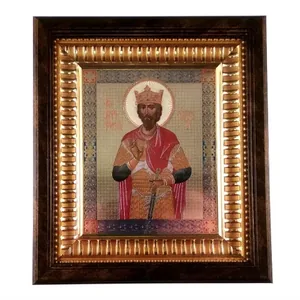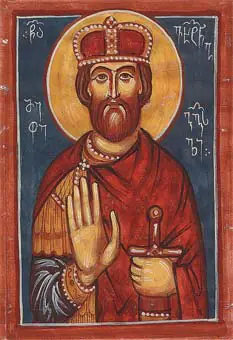
Holy Great King Vakhtang Gorgasali (+502)
Mirdat, king of the Georgians, was taken captive by the Persians and carried off to Baghdad, where he died. In Kartli the Christian faith died down, and in the churches the fire of the fire-worshippers was lit.
Three years later an enemy from the east invaded the king of Persia. The aznaurs of Kartli took advantage of this and set up as king in Mtskheta Archil, son of Trdat, who until then had taken refuge in Kakheti. Archil became kin to Jovian, king of the Greeks, and with their help restored Christianity in Kartli once more; some of the fire-worshippers he destroyed and others he drove out, and on his return he preached to all Kartli to give thanks to the Lord Jesus Christ, by whose help the land had regained its freedom.
Archil’s son Mirdat was, like his father, a believer and devout, valiant and bold. For the safety of the land he asked Barzabod, eristavi of Ran, for his daughter’s hand. Barzabod gladly agreed to the proposal.
Queen Sagdukht, as soon as she came to know the Christian teaching, renounced fire-worship of her own will at once, received the law of Christ and, in thanksgiving to the Lord, built the Sioni of Samshvilde.
King Mirdat and Queen Sagdukht had three children: two daughters, Khvarandze and Mirandukht, and one son, whose name in Persian was pronounced Varang-Khvasrotang, and in Georgian Vakhtang.
Vakhtang was given to the spaspet Saurmag to be brought up. He was seven years old when King Mirdat died. Frightened and left helpless, Queen Sagdukht went to her father, Barzabod, knelt before him and begged him with tears not to bear a grudge for what her husband and father-in-law had done for the land, not to take the Christian faith from her by force as well, and to be a helper and protector to little Vakhtang.
Barzabod, it is true, was angry with the king of the Georgians and was already meaning to march against Kartli, now left without a king, but his daughter’s tears softened his heart; he agreed to everything she asked and set a condition of his own: I will send fire-worshippers to Kartli; they will force no one to change the law of Christ, but if anyone should wish it of himself, do not you hinder him either.
For some time Queen Sagdukht governed the kingdom with her father’s help and strength; then Barzabod died, and in his place the king of Persia set Barzabod’s son, Varaz-Bakur.
Meanwhile the spaspet Saurmag also died, and Vakhtang’s upbringing was entrusted to the spaspet Juansher.
Queen Sagdukht saw how Binkaran, the bishop of the fire-worshippers, deceived the Georgians, how he led them astray and turned them from the path of the true faith. Little by little the number of Georgians grew who had forsaken Christ and acknowledged fire as a god. In alarm, Sagdukht had a priest named Mikael brought from Greece, appointed him bishop, and with his help set about bringing back to Christ the Georgians whom Binkaran had led astray.
Vakhtang would have been about ten when the Ossetes invaded Kartli, laid the country waste, carried off a great many captives, among them Vakhtang’s three-year-old sister Mirandukht, and went back again. At the same time the Greeks too invaded Abkhazia and seized it from the river Egristsqali as far as Tsikhegoji.
Mourning and grief multiplied in Kartli, and so the land remained without a guardian until Vakhtang was fifteen years old.
The fifteen-year-old king summoned all the nobles to the royal city, seated Juansher and two bishops beside him, stood up and, like a man mature and wise, addressed the assembly:
“God sends trials and afflictions on kings and people alike for their sins. We have deserved this wrath of the Lord: when believers give up the service of the Lord and forget His commandments, God sends them a trial to bring them to their senses. Let us give thanks to the Lord for it. Let us carry the precious Cross before us, and with its help take vengeance on the Ossetes. Had the Persians or the Greeks done the same, we might yet have borne it for some reason; but for every one of us death is better than to bear this insult from the Ossetes. The shaming of my country and pity for my sister have wounded my heart; I will trust in the Cross of the Lord, I will ask help of the all-merciful God, and He will not forsake me; He will give me the victory over the enemy.”
Together with Juansher, all received the proposal with enthusiasm. The king spent a week in prayer, fasting and night vigil, and then set out towards Tianeti with a hundred thousand Georgians and twelve thousand horsemen sent to his aid by Varaz-Bakur. There another fifty thousand horsemen joined them, and the king, calling on the name of God, passed through the Gate of Darialan.
The Ossetes called on the Khazars for help and stood against the Georgians on the far side of the Aragvi of the Ossetes (the Terek).
After seven days of fighting a giant, the Khazar Tarkhan, came out of the Ossete camp and insolently challenged someone from Vakhtang’s army to single combat. On the Georgian side there went out a Persian warrior famed throughout the world, Nijapharukh, but at the very first clash Tarkhan split his head in two.
Vakhtang’s army was shaken. Filled with grief, Vakhtang spent the whole night in prayer, and the next day, when Tarkhan again called for someone to fight him face to face, he offered himself, and calmed his frightened army thus:
“Not in my own strength nor in my own courage do I trust, but, trusting in God without beginning, the consubstantial Trinity, Creator of all, I go forth to single combat with Tarkhan.”
And indeed, at the very first clash the king made an end of the insolent man; at once he leapt from his horse, fell on his knees and bowed down to God for His help. He cut off Tarkhan’s head and returned victorious to the army.
The next day another came out from the Ossetes, a giant named Baqatar, and shouted to the king from across the river: “King, do not grow proud: it happened by chance, or how could such a boy as you have killed Tarkhan? Come out to this side of the river and you will see what I do to you!”
Mounting his horse, the king called proudly to Baqatar: “Not by my own strength did I overcome Tarkhan; by the strength of my Creator I overcame him. Therefore I do not fear you either. Besides, it is not for me to come out there; you must present yourself to me here, for I am a king and you are a slave, you dog!”
After a short fight Baqatar, cloven from the shoulder to the heart, fell at the king’s feet; the king mounted Baqatar’s horse in place of his own wounded one and, turning, cried aloud to his army:
“Be of good courage and be strong, for God is on our side!”
Vakhtang crushed and levelled with the ground all Ossetia, carried off a great many captives and took immeasurable booty. The Georgians subdued the Qipchaqs as well, shut the gate of Ossetia, Dariali, built towers and set the local mountaineers to guard them. From then on the Ossetes and Qipchaqs were forbidden to enter Dariali without the leave of the king of the Georgians. After this King Vakhtang subdued the land of the Pechenegs and Jiketi and turned back into Ossetia. The frightened Ossetes took refuge in their strongholds and sent envoys to Vakhtang, asking thirty thousand Ossete captives in exchange for his sister. Besides his sister the king ransomed the rest of the Georgian captives, sent them off to Kartli, and marched with his army on Abkhazia, which the Greeks had seized.
Three years later Vakhtang had wholly cleared Abkhazia of the Greeks and, weary of battle and victorious at last, returned to his house, to the royal city of Mtskheta.
Vakhtang took as his wife Balendukht, daughter of the king of Persia. The king of Persia gave his daughter as her dowry “Somkhiti and all the kings of the Caucasus”, and sent a letter too, “from Urmizd, king of all kings, to Vakhtang Varan-Khvasro-Tang, the valiant king of ten kings”, in which he asked him to help in the war against the Caesar.
The king was by then twenty-two years old. He summoned his army and all the kings of the Caucasus and set out to campaign in Greece. After three months of battles and victories Vakhtang was already before Constantinople. Wherever the Persians found servants of Christ, they killed and destroyed them without mercy. But Vakhtang declared to his army from the very start, to Georgians and non-Georgians alike, that they should leave off killing the servants of the Church, and asked them simply to take them captive, or even to let them go unharmed.
“When my father’s father went out, just as we have, with the Persians to fight against the Greeks, their army too set about killing the servants of the Church. Christ is the true God of all, and that is why the Lord did not forgive the invaders what they had done to His servants; that is why the Greeks’ small army destroyed the countless army of the Persians.
“Have you not heard of the miracle concerning Constantine? Or concerning Julian, the idol-worshipping king, whom an arrow shot from heaven took out of this passing world? It was just after that that the Greeks chose Jovian as king, the very one who shattered the idols with his own hand and raised up crosses. The angel of the Lord set the crown on his head with his own hand, as on a true king.
“Or you, Armenians, do you not remember how God converted Gregory the Parthian and King Trdat, and how after this Gregory became a servant of the Church and King Trdat the builder of a great church?
“Or you, natives of Kartli, kinsmen of the kings of Kartli, who are exalted today by us, the Georgian kings of the lineage of the hero Nebrot: have you not heard of the miracles concerning Nebrot? Do you not remember what miracles Nino worked? Or do you think God will abandon the Greeks who glorify Him? The Caesar is already preparing to attack; quiet your passions against the churches.”
King Vakhtang had his soldiers release all the servants of the Church, and sent a herald as well, to announce to the servants of God hiding in their refuges that no one would touch them and they might go wherever they wished.
When the Greek priest Peter and the monk Samoel came to Vakhtang to thank him, the king asked them whether God would be pleased with what he had done.
Peter told the king that, if he would not take offence, he would tell him the truth; and when he had received his consent, he said:
“The Lord has two kinds of church in this world: churches of flesh and churches of stone. If a church of stone is destroyed, it can be built again with the same stone; but a church of flesh cannot be rebuilt, and moreover God forgives no one its destruction, for to the Lord that is the foremost temple. Now picture to yourself how many virgins, temples of God, your army has corrupted and defiled. I do not want you to be the kind of man who builds with the left hand and destroys with the right. I want you to inherit the Kingdom of Heaven, like the kings of blessed memory: David, Solomon, Constantine and Jovian. But how can I compare you to Jovian? What have you done such as he did? Know that God will repay you for the evil, unless you repent.”
“I wish to justify myself,” the king said to him; “and do you judge me justly for my fault.”
“Since you seek the way of salvation, your sin shall depart from you. It was not ignorance that stirred you to fight against the Lord’s children; you came to help your kinsmen the Persians, but you forgot that the Greeks are kinsmen of God Himself.”
“What would you have of me now?” the king asked.
“I would have you yourself quench this fire that you have kindled, and show friendship to the Caesar who shares your faith, and not to the Persians.”
The king asked Peter: by your prayer show me the Caesar tonight, and let me know as well what Christ Himself wants of me.
And indeed, that night King Vakhtang saw a vision: Saint Nino came to him and said:
“Arise, O king, and go reverently to meet them, for two kings, of heaven and of earth, are coming to thee!”
Vakhtang looked round and saw two thrones. On one throne sat a young man in armour, wearing a crown, and on the other an old man clothed in white, on whose head was a crown of light. Saint Nino sat there too, at the old man’s feet. Vakhtang’s right hand was held by Peter the priest and his left by Samoel the monk. Samoel said to Vakhtang:
“Bow down first to the prince of heaven, Gregory.”
The king went up and bowed down to Gregory.
And Gregory asked him:
“Why have you done such evil? Why have you laid waste my camp and given my sheep to the beasts to devour? Were it not for those who now stand beside you, and were it not for Saint Nino, who labours together with Mary for your land, I would have taken vengeance on you, as on your fathers and forefathers, who put their hope in fire and not in the Enlightener of all.”
Vakhtang kissed Gregory’s hand and embraced the Caesar.
“If you wish me to give you a crown, promise us that you will fight against the enemies of the Lord,” the Caesar said to him.
Saint Nino, Peter and Samoel stood surety for the king. Then the Caesar set on Vakhtang’s head a crown bearing a cross.
As soon as he woke, Vakhtang summoned Peter and Samoel and asked them what vision they had seen that night. When they began to tell exactly the same, the king stopped them and declared that he was ready to serve the true God. The three of them took counsel together as to what would be best, and Vakhtang drew his army back from the city it had been preparing to storm. Meanwhile Peter went to the Caesar and reported everything, and the Caesar, overjoyed, quickly entered Constantinople. Vakhtang wished to frighten the Persians with words about the invincibility of the Greeks and turn them back without a battle, but the Greeks demanded that he arrange things so as to have them wiped out. To this the king answered sternly that this would be a dishonourable deed and he would not do it; besides, in his army too there were many who confessed the law of Christ; it would be better for everything to be settled peacefully, as Jovian and the Persians had once done. And if the Greeks would not give up their own way, then the king would be blameless before them.
Meanwhile the Persian eristavi arrived too, and brought down terrible wrath on the head of his nephew:
“It is because you are Jovian’s kinsman that you betray us, is it not?! For the sake of a dead, crucified man you want to deliver us into the hands of the Greeks!”
To this Vakhtang answered:
“Behold thee and the Greeks, and thou shalt see the might of that dead man, and of that living thing, thy hope!”
The Persians, Armenians and Leks attacked the Greeks, while Vakhtang with the Georgian army stood aside and watched the battle from there.
In this battle the Persians were cruelly defeated. Among many great men the brother of Vakhtang’s mother also fell on the field of battle. All who were left alive the Greeks took captive.
Then King Vakhtang got down from his chariot and said that God had taken vengeance on the Persians. He had Peter bring a cross and proclaimed:
“Invincible is he who bows down to the Cross! Bow down to it. Whoever does not do so is to be put to death.”
Demetre the eristavi and Juansher the spaspet held the cross in their hands, while a herald proclaimed aloud:
“Whosoever worshippeth not the Cross, let him die!”
Only one fire-worshipper, King Borzo, did not bow down to the Cross, and the spaspet Juansher at once drove a lance into his heart. All the rest came forward, and all knelt reverently before the Cross.
At that moment part of the Greek army rushed up from somewhere under the command of Palekarpos, who began to insult Vakhtang and his army.
Vakhtang drew his sword and asked the Lord to help him humble and destroy the arrogant man who insulted the Cross. After a short fight the king split Palekarpos’s head in two and threw one half of it before the Cross with the words:
“Be this the portion of every one that falleth away from Thee.”
Vakhtang’s army put the Greeks to flight. It hemmed them in against the sea, killed half of them and took half captive. The king wrote a letter to the Caesar, informing him: “Unfathomable is the wisdom of God. I know that it was not your fault that Palekarpos fell upon us, just as I am blameless in my mother’s brother’s attack on you. Both evildoers were caught by their own evil. God arranged all this, perhaps, in order to turn as many as possible to the true faith. I have eased the grief caused by the death of my mother’s brother by taking vengeance on his killers, and to you, for your consolation, I return the seven thousand and eighty captives whom God has delivered from death. If you wish to meet me, hasten to see me, for it is already time for me too to return to my homeland.”
The Caesar, glad at the release of the captives, met the king; they confirmed their loyalty to each other by oath, and in gratitude the Caesar gave back to Vakhtang “the border of Kartli, the fortress of Tukharisi, and all Klarjeti from the sea as far as Arsiani, and the valleys that adjoin Ghado”.
On his way back Vakhtang passed through Klarjeti; he left his foster-brother Artavaz there and charged him to build the fortress of Artanuji and a monastery. And Artavaz did build there the monastery of Opiza and three churches: at the township of Merisi, at Shindobi and at Akhizi.
Some time later Queen Balendukht died. The king was left with a son by her, little Dachi. The king was expecting an invasion of the Persians, and so he set about building fortresses and cities, and was also making his army ready for battle. He threw Binkaran the fire-worshipper into prison and drove out of the land all who worshipped fire.
When the king of Persia marched on Kartli to make war, King Vakhtang asked the king of the Greeks for help. Vakhtang’s envoys did not find the Caesar in Greece, for he had gone on campaign, and so Vakhtang was forced to begin the war against the enemy alone. On the front of the king’s helmet a wolf was pictured, and on the other side a lion, and it was in this very war that the Persians named him Gorgasali. “Dur az gorgasar!”, “Beware of the wolf’s head!”: so they warned one another.
This war went on for four months. Meanwhile the Caesar too sent eighty thousand Greek horsemen to Vakhtang’s aid.
The king of Persia, as soon as he heard of the coming of the Greeks, was afraid and sent envoys to Vakhtang to make peace. Vakhtang sent him word: you have surely seen the power of the Cross. Until it appeared, we all paid you tribute, but now the Greeks, your own tributaries, lay you waste, you servants of fire. In vain do you fight us to make us abandon our faith: we are ready to die for it; He who was crucified for us will likewise raise us up. And as for you, if you abandon fire and confess our Christ, I will count you as a father.
Vakhtang and Khosrow, king of Persia, met on friendly terms; both, it is true, stood firm in their own faith, but at the same time they swore peace and love to each other. Khosrow told the king: ask of me what you will, and I will do it. Then the king asked: I want there to be peace between you and the Caesar as well.
Khosrow was troubled, because at that very moment he was meaning to march on Greece: he wanted to take advantage of the Caesar’s being in Khazaria and win back his own lands, which Greece had seized.
Leon Antipat, a bishop of the Greeks, was present at the conversation between Vakhtang and Khosrow, and as soon as he heard Khosrow’s intention he said gladly that Greece was willing to give back his lands without a war, and that he had a letter obtained from the Caesar for that purpose. Khosrow was very glad of this. At once he gave up the idea of marching on Greece, but asked Vakhtang: you know what a plight the elders will put me in if I go back to Persia without taking vengeance on the Greeks; so give me your sister as my wife, that I may justify myself by becoming kin to you. And come with me and help me in the war against the Abyssinians, Elamites, Indians and Sindhs, so that I may make them my tributaries and so calm the elders’ anger over the Greeks.
Vakhtang agreed to all Khosrow’s terms. Then Leon Antipat thanked King Vakhtang for saving the Greeks once again, and promised help, first ten thousand horsemen and afterwards the rest.
Vakhtang left his five-year-old son Dachi as king in Kartli. He left him seven nobles as guardians. He himself took with him Artvaz, Nasar, Bivritiani and Saurmag, and followed Khosrow to Persia with his army. On the way Khvarandze and his mother joined Vakhtang, since they wished to go to Jerusalem on pilgrimage. Vakhtang took his mother and sister to Jerusalem and joined Khosrow again, who was waiting for him at Antioch. Leon Antipat and Artavaz, sent earlier to Greece, arrived with twenty thousand picked horsemen and presented Khosrow with gifts from the Caesar beyond all telling.
Khosrow held a great wedding in Persia. Six months later the combined army set out to war. They conquered Jorjaneti and India and entered Sindeti. In Sindeti Saurmag, Vakhtang’s chamberlain, was killed. The king took his death very hard; he stood over Saurmag and wept for him as for a beloved brother. At that moment the king of Sindeti came out of the city gate and called aloud to Vakhtang:
“You are like the crow, O king, that saw a hawk torn by an eagle, and instead of calling the other crows, as is their custom, and killing its weakened enemy with them, began to tend it and brought it locusts and snakes to eat. The hawk grew up and thought: what good will this food do me? Better that I eat the crow itself, so as to gain strength and fly away. It ate it, and did right, for by this it escaped death; while the crow, because it did not act according to its custom from the start, died for it.
“These Persians have been enemies of the Cross and its servants all their lives; now they have grown weak and craftily make themselves out to love you. With your help they will grow strong and begin again to slaughter the servants of the Cross. That is what you are preparing both for yourself and for other Christians!”
“Senseless man,” Vakhtang answered, “you are like a mouse that has seen nothing but the darkness of the earth. The brightness of the sun and the beauty of the field are beyond your understanding. You are blind and deaf; you neither hear nor know the spiritual life; you have no desire to come to the life eternal; you know neither the unending light nor God, Creator of all, by whom all things were made.
“By being here I have saved Jerusalem, the holy city. I have saved also the Christian lands that the king of Persia was preparing to lay waste. I have delivered many souls by coming here, and if, as you say, the Persians ever attack me, then it is precisely by the power and help of Christ that the Christians will help me and deliver me from the trial. And even were it not so, I would still have come here, because the Persians are my kinsmen; and secondly, though they do not hold the true faith, they do at least believe in a spiritual life, unlike you, who are as ignorant as hawks.
“It is because of this very ignorance that your minds are vile. That is why you praise the ungrateful hawk that ate the one who reared it. But our nature is this: for a benefactor we ought to lay down our life, and so win grace from God, find life eternal, and in this world win praise from men.”
The king of the Sindhs threatened Vakhtang: I will come out and kill you, and make you a sharer in the glory to come here and now, since you believe in it so; and armed with a spear he came out against Vakhtang.
Vakhtang struck the king of the Sindhs with his spear in the right shoulder. He did not swing at him a second time, but dragged him before the king of Persia, asking only that a physician be brought for him, and that he then be pardoned and let go alive.
The king of the Sindhs thanked King Vakhtang with love for his life, and also because Vakhtang had not let the enemy lay waste his four cities.
In the eighth year King Vakhtang returned to Kartli, and sent Leon the Greek to the Caesar to ask for his daughter’s hand and to bring back Peter and Samoel.
When the bishop of Kartli heard that an envoy had been sent to bring Peter and Samoel, he grew bitter and, unable to think of anything else, slandered the king, saying that he had abandoned Christ and taken up fire-worship. He would not listen to the king’s explanations, and grew so insolent that he even struck him and knocked out a tooth.
The king did not raise his hand against the bishop, but told him that he had done this out of envy, called him Judas, and sent him to the Patriarch of Constantinople to be judged, where he was sent into exile.
The patriarch sent twelve bishops to Kartli, and consecrated Peter as catholicos. The Caesar sent the king his daughter Helena as his wife as well.
The king set Peter as catholicos in Mtskheta, and Samoel there too as a bishop, and distributed the rest: to Klarjeti, to Artaan of Erusheti, to Tsunda, to Javakheti, to Manglisi, to Bolnisi, to Rustavi, to Ninotsminda, to Cheremi, to Cheleti, to Khornabuji and to Agaraki.
Afterwards he built the church of Nikozi and set a bishop there too.
By his Greek wife Vakhtang had three sons and two daughters. To Dachi he gave the cities of Cheremi and Nekresi and the city of Kambechovani, while he himself settled at Ujarma.
Meanwhile Khosrow, king of Persia, died, and his son Khosrow ascended the throne; he sent word to Vakhtang: I am preparing to march on Greece; come with me, and give me your daughter in marriage besides.
At that time King Vakhtang, sixty years old, was building Tiflis. When he was told Khosrow’s message, he said: “Tell Khosrow first to make ready for war with us, and then to enter Greece! Now let our life be in the hope of the Crucified.”
The king sent swift runners all over the land and began to make ready for war, and he sent word to the Caesar to help him as well.
King Khosrow came and destroyed the city of Kambechovani, the fortress of Cheremi and Velistsikhe. By the Iori the Persians and the Georgians met, and a fierce battle flared up.
The king summoned the catholicos and said to him:
“Know that it is not for tribute that the Persians fight us; they fight us to make us give up Christ. Rather than live without Christ, I would die a Christian and be in the Kingdom of Heaven, for He teaches us: ‘Whosoever will lose his life for my sake shall find it.’”
Vakhtang’s army consisted of two hundred and forty thousand men, and that of the Persians of seven hundred and eighty thousand. The king divided his army into three, took a hundred thousand himself, and by night fell upon the place where the king of Persia was. At dawn he broke into the king’s tent. The king escaped on horseback; Vakhtang killed his son and cut off his head, and at that very moment some Persian drove an arrow into his breast.
The Georgians fought with self-sacrifice, but could do nothing against the multitude of the enemy. Meanwhile Vakhtang’s wound festered, for the arrow had gone in as far as the lung. He himself went to Ujarma, ordering his commanders not to leave the field of battle.
Vakhtang understood that he was dying. He called the catholicos, his wife, his children and all the nobles, and said:
“I am going to my God. I thank His name that He has not denied me a place among His chosen saints. Stand firm in the faith and seek death for Christ, that you may win glory that does not pass away. You, nobles of Kartli, remember my good deeds, for from my house you received the eternal light. Do not dishonour my name, and love the Greeks who share your faith.” Then he looked at Dachi and said that he was his firstborn, and therefore he gave him the kingdom. He called the eristavis and in the name of God asked them to protect his wife and children.
All Georgia mourned; the earth shook with lament and wailing; the faithful people wept for the king slain for Christ.