
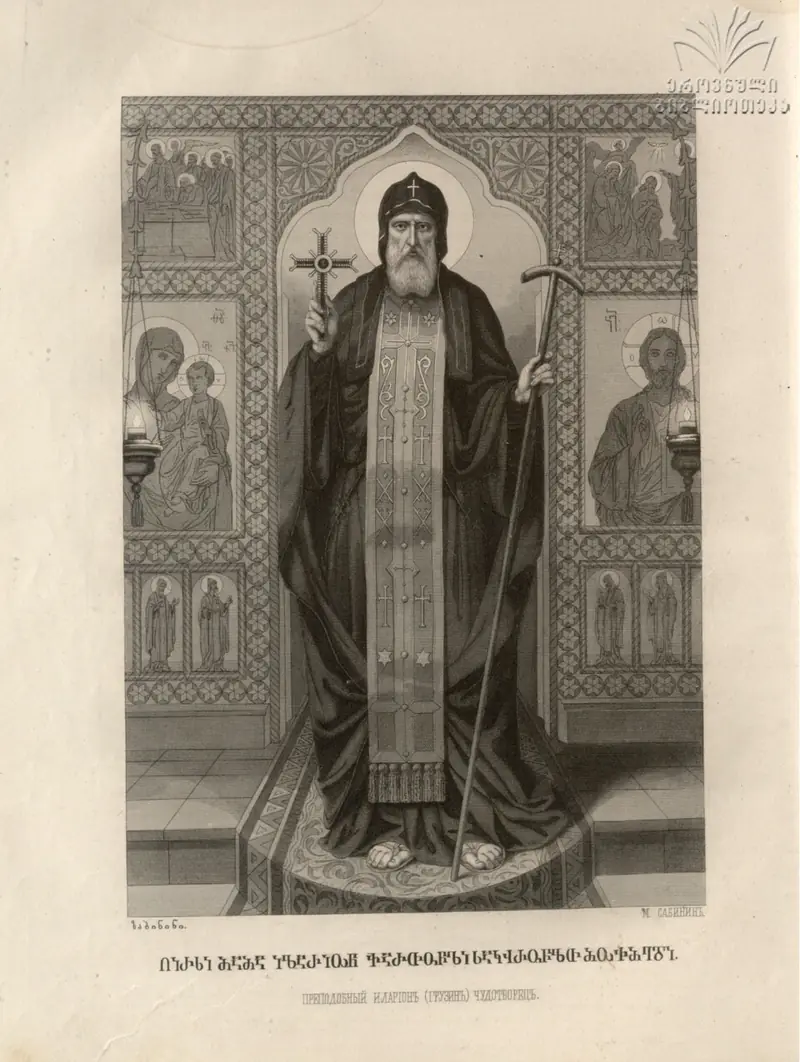
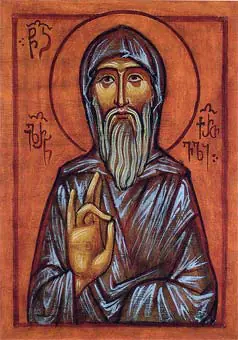
Venerable Hilarion the Georgian, Wonderworker (+875)
The Venerable Father Hilarion was the son of an aznaur of Kakheti, of the Donauri family. At six the boy was given to a worthy and God-loving monk to be taught. Hilarion was distinguished by exceptional gifts. When his father saw his son’s zeal and love for God, he built a monastery there in the village.
At fourteen Hilarion resolved to escape his father’s excessive attention; he left the monastery, made his way to the desert of Gareji, found a small cave and shut himself away in it.
Hilarion began a wonderful labour. “By fasting and vigil he withered the age of youth, by prayer and constant contemplation of God he became like the bodiless ones, until he surpassed in labours all who were in that place in the desert, for all marvelled at his so great toil and patience.”
The young monk won the love and respect of the desert-dwellers. “All the brethren were edified by his teaching and fell at his feet, that they might dwell with him.” So there settled with the Venerable Hilarion “eleven brethren, ascetics, meek and humble”.
All Kartli and Kakheti heard of the monk who fasted like an angel and prayed without ceasing. A great many people came to see him and to receive his blessing and counsel. When the bishop of Rustavi, who had come to him, saw the pale, humble monk dressed in wretched clothes, he reverently asked him to receive the honour of the priesthood from his hand. Hilarion, who renounced earthly glory, begged the hierarch not to burden him with the honour of the priesthood, but in the end he obeyed.
After his ordination the venerable father’s name was clothed with new glory. He resolved to withdraw from his homeland; he left one of the brethren as superior of the monastery, and himself set out for Jerusalem to worship at the holy places.
On the way robbers fell upon the Venerable Hilarion and bared their swords to kill him. Suddenly their hands stiffened. The frightened and astonished robbers understood that God’s punishment had struck them; they fell at the saint’s feet and asked forgiveness.
The holy father made the sign of the cross over the robbers, healed them and let them go in peace. Those who had been healed again asked the venerable father’s forgiveness, and one of them accompanied the saint as far as Mount Tabor.
Hilarion worshipped at Jerusalem, then made his way to the desert of the Jordan and shut himself away in a cave (according to tradition, this was the cave where the holy Elijah the Tishbite (commemorated 20 July) took refuge). One night he saw in a vision that he was standing on the Mount of Olives, from which the Lord ascended in glory, before the all-holy Theotokos, who stood accompanied by twelve men, and the Ever-Virgin said to him: “O Hilarion, go and hasten to thy house and prepare a supper for the Lord, My Son.” On waking, Saint Hilarion understood the vision, gave thanks to the all-holy Theotokos and hastened back to his homeland.
When he returned to Georgia, the Venerable Hilarion found that his father and brothers had died. His mother handed over to her son all his father’s treasure and said: “Spend it, son, as seems good to thee.” The blessed Hilarion built a convent, gave it villages and a rule, then gathered seventy-six venerable ascetic monks and built a monastery of fathers as well, and distributed the rest of his property to the poor and needy.
The devil, hater of good, stirred up the venerable father’s uncle to burn the monastery and kill its teacher. Hilarion’s uncle had thought that his kinsman’s property would be left to him, but when he saw the good monk’s generosity he flew into a rage, and one day wrote on the monastery door in charcoal: “So let all see this monastery for three days more.” At dawn Father Hilarion saw the writing and was greatly grieved at the ruin of his uncle’s soul. All night he prayed and fervently besought the Lord to turn the trial away. When he closed his eyes, a shining man appeared to him and said: “Fear not, O Hilarion, for this very day that enemy of thine shall be taught a lesson and shall fall at thy feet.” And indeed, when day broke, Hilarion’s uncle fell to the ground, rolled about and wailed with strange cries. The servants brought the man tormented by the evil one to the saint. Saint Hilarion made the sign of the cross over him and healed him. The uncle came to himself, wept in repentance, made his confession, gave all his property to the monastery, and himself was tonsured a monk.
Saint Hilarion’s name spread over all Georgia; many wished to see the holy monk and receive his counsel and instruction. Soon they resolved to consecrate him bishop as well. The venerable father, who loved stillness, thought: “This glory of the world is a deceiver leading to that eternal dishonour”; he appointed as superior of the house one of the brethren of the monastery, distinguished for wisdom and holiness, commended everyone to the Lord, and set out for Constantinople with two brethren.
After a long journey Hilarion and his companions reached Mount Olympus, found a small abandoned church and settled in it.
At Vespers on the Saturday of Cheesefare a monk came from the great lavra to light the lamp, saw the brethren sheltering in the church, and brought them a little food.
The next Saturday, the commemoration of Saint Theodore the Recruit, the monk came again to the little church and saw that the brethren had spent the whole week without food, having eaten only a little vetch. The monk asked Saint Hilarion what he needed. He asked only for altar bread and wine. The superior of the great lavra learned that some stranger, ignorant of the Greek language, had celebrated the Liturgy in the church; he was filled with anger and ordered the steward and some of the brethren to drive the strangers out of the monastery’s grounds.
When the steward came to the church, Saint Hilarion spoke to him in Greek and asked leave to stay the night, promising to leave the church the very next day.
That night the superior saw a vision: the all-holy Virgin stood over him in wrath and said to him: “O wretched one, why didst thou wish to drive out those strangers, who have come for love of My Son and God and have left their own land, and didst not keep the commandment about receiving strangers and the poor, as My Lord and My Son says to the rich man? Knowest thou not that many who speak their tongue are to settle on this mountain and to live unto God? And those who will not receive them are enemies to Me, for that nation has been given to Me by My Son for their unshaken Orthodoxy, since they believed in the name of My Son and were baptised.” The frightened superior fell at Saint Hilarion’s feet, asked forgiveness for his presumption, and begged him to stay and turn away from him the wrath of the all-holy Queen.
Saint Hilarion lived for five years on Mount Olympus; then he went to Constantinople, worshipped at the holy places and hastened to Rome to venerate the tombs of the holy Apostles Peter and Paul.
As he drew near to Rome, Hilarion saw a paralysed man sitting by a vineyard and asked him for a bunch of grapes. The paralysed man said to him: “Here, father, is the vineyard; eat what you wish; but I ‘cannot rise because of my sins’.”
The Venerable Hilarion took pity on the paralysed man, prayed and said to the sick man: “Rise, brother; the Lord has commanded it, and bring me with thine own hand of the fruit of this paradise.” The man, healed, rose at once, went into the vineyard and came out with a bunch of grapes, but Saint Hilarion was no longer there. The owner of the vineyard went into the city to look for his benefactor, telling everyone of the miracle.
Saint Hilarion lived for two years in Rome an angelic life. Then he returned again to Constantinople.
On the way Saint Hilarion passed through Thessalonica, venerated the martyrium of the holy Great Martyr Demetrius (commemorated 26 October) and rested by the door of the governor of the city. A maidservant brought out of the house a paralysed boy of four and laid him in the sun. The venerable father asked the woman to bring water. When the woman had gone, Saint Hilarion made the sign of the cross over the boy and said: “In the name of the Father and of the Son and of the Holy Spirit I say to thee, child, rise up whole.” The boy at once jumped to his feet and ran to his mother. And Saint Hilarion went away from that place, so that no one should see him.
When the father of the healed boy, the governor of the city, saw this miracle, he ordered the gates to be shut and the wonderworker to be sought, that they might venerate him. And indeed they found Saint Hilarion, fell at his feet and asked his blessing. Then the governor begged the saint to stay in Thessalonica and to choose for himself a place to labour.
The saint, seeing the governor’s love of God, granted his request: he chose a quiet place for his labours, where the governor built a church.
All Thessalonica heard of Saint Hilarion’s labours; many came to him for his blessing or to hear his God-inspired conversation. His virtuous life woke a godly zeal in many, and they received monasticism from the venerable father’s hand.
Once the pagans captured a deacon of Thessalonica. The captive servant of God besought the saint for help in prayer. That same night Saint Hilarion appeared to the deacon in his sleep and said: “Rise, O deacon, and fear not, for it is I, to whom thou didst pray.” On waking the deacon saw that he had been freed from his fetters; he passed unnoticed among the pagans and came to Thessalonica. As soon as he arrived in the city he visited the saint and fell at his feet in gratitude. Saint Hilarion said to him: “Son, God willed thy salvation. For this He sent His angel in my likeness, since thou didst call with faith on the name of me, a sinner, and He delivered thee from bitter captivity. Therefore give thanks to God, who works wonders.”
Saint Hilarion spent the rest of his life in Thessalonica. His end was made known to him beforehand by the Lord; he called the governor of the city, thanked him for everything, and left him as his testament love for the poor and for monks, justice and mercy.
The grieving governor had a marble shrine made for the saint’s remains. Those who came to Saint Hilarion’s tomb with faith were healed of every disease. The governor and the archbishop of Thessalonica informed the Byzantine emperor, Basil the Macedonian (867–886), of these miracles. The emperor told the fathers who had come to him from Olympus of what had happened at Thessalonica. Among the fathers was that very superior who had meant to drive Saint Hilarion from Mount Olympus, and he told the emperor in detail what he had seen and heard. Basil became interested in Hilarion’s disciples, his fellow countrymen. Three old monks were brought to him. The emperor, amazed at the fathers’ holiness, sent them to the Patriarch of Constantinople for his blessing.
The patriarch greeted the guests with brotherly love, blessed them and received their prayer too. He understood that great grace dwelt in these three old men, and advised the emperor to show them honour.
The emperor proposed to Saint Hilarion’s disciples: “Let your worthiness choose a monastery wherever you wish, for yourselves and for your nation.” The fathers declined, for it was not right to settle in what another had built. Then the Emperor Basil had the fathers choose a site for a monastery themselves, and soon built a great church. There he also made a cell for himself: “Let this be my dwelling near these venerable fathers, that through their prayers God may be pleased to deliver me from the reward of my sins.” The monastery was called Romana. The emperor brought his sons, Leo and Alexander, to the venerable fathers to be brought up.
The Emperor Basil wished to translate Saint Hilarion’s relics to the royal city; he sent his people to Thessalonica and sent a letter with them: “Basil the king, sinful servant of the King of heaven, beseeches thee, holy father Hilarion: come up to the royal city; though I was not counted worthy to see thee face to face, yet now make me worthy to kiss thy holy relics, and let this royal city rejoice at their coming, and may thy grace be with us, amen.”
The people of Thessalonica would not agree to give up Saint Hilarion’s relics. The emperor’s courtiers were obliged to open the shrine secretly by night and carry off the saint’s relics in secret.
The emperor, the patriarch and all the people received Saint Hilarion’s relics with singing, procession and the burning of incense. The emperor laid them for a time in his own palace, until he could build a special tomb for them.
On the third night the king was woken by a fragrance. When the king closed his eyes again, Saint Hilarion appeared to him in priestly vestments and said: “Thou hast done well, O king, to receive me, a stranger and a poor man; but this fragrance which thou hast smelt I did not acquire in cities, but in deserts. Now, if thou wilt have grace in full, carry me away to a desert place.”
The emperor told the patriarch and the lords everything, and then with great honour carried Saint Hilarion’s relics to the monastery of Romana and entrusted them to his disciples.



