
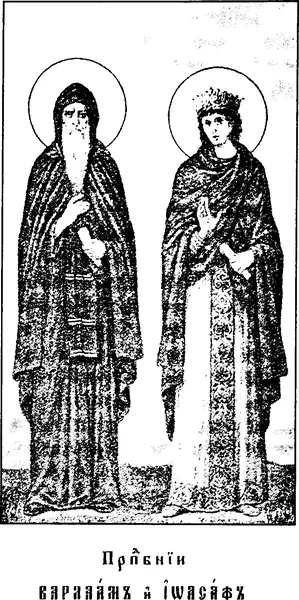
Venerable Barlaam and Joasaph, Son of the King of India, and His Father Abenes (IV)
The Venerable Barlaam (Balahvar) and Joasaph (Iodasaph), son of the King of India, and his father Abenes. In India the holy Apostle Thomas had preached the Christian faith and founded the holy Church, but the country still remained for the most part captive to pagan thinking. In the fourth century India was ruled by the pagan King Abenes. For a long time he suffered from childlessness, but at last the all-good Lord granted him an heir. The overjoyed Abenes named the newborn child Joasaph (Iodasaph), glorified the pagan gods still more, and summoned astrologers, philosophers and soothsayers “that they might tell him what lay before his son”. The wisest of those gathered told the sovereign that Joasaph would accept the law of Christ, hateful to his father. When Abenes heard this, his joy turned to grief, and he ordered all Christians to leave his kingdom within three days.
For his son the sovereign built a palace, where he was to be brought up in seclusion, so that he should not hear a single word about the Saviour and His teaching. When Joasaph had grown up, he asked his father for permission to leave the palace and see the country, and Abenes granted his heart’s wish. Then Joasaph learned that there is suffering, sickness, old age and death; he understood “that this life of the passing world is sweet no more”, and gave himself up to tormenting thoughts.
At that time there laboured in a distant desert a God-wise elder, Barlaam (Balahvar), to whom the Lord revealed that the king’s son, who was pondering the nature of truth, needed a spiritual guide. The saint left the place of his labours, put on a merchant’s clothes, came to the palace and sent word to the prince’s tutor: “I have a precious stone, and if thou wilt, take it for the king’s son; for it openeth the eyes of the blind, and maketh the deaf to hear, and the dumb to speak, and healeth the sick, and enricheth the needy, and maketh victorious over enemies, and bringeth to pass every desire of the heart.” By God’s will he gained access to Joasaph and explained the Christian teaching to him, first in parables and then with passages drawn from the holy Gospel and the Apostle. From Barlaam’s counsels the youth understood that the precious stone is the faith of the Saviour; he received it with his heart and was baptised. Before leaving, the holy teacher charged his spiritual son: “Keep unto God His law, which He hath given thee through me. Take heed that thou transgress not His commandments and fall into the pit of perdition.” And in answer he received: “Thou callest me a king’s son, yet I am no king’s son, but the servant and son of the immortal King.”
“From that time forth Iodasaph began to fast and to pray unto God. And when men slept, he would begin to keep vigil through the night, and with weeping and sighing he fulfilled his prayers.”
When Abenes learned that his son had become a Christian, he was seized with anger and grief. Then one of the nobles told him about a sorcerer, Nachor, who in appearance closely resembled Barlaam, and advised him to use him to turn the king’s son back to paganism. The king’s horsemen sought out Barlaam’s fellow ascetics in the desert, killed them, hacked them to pieces and scattered the pieces along the road. In place of Barlaam, whom by God’s will they could not find, they brought Nachor into the city. After this, by Abenes’s order, the Christians and the pagans were set against each other. In the debate, on the side of the Christians, besides Joasaph, Nachor, taken for Barlaam, was to take part and admit himself defeated. By God’s providence the sorcerer, having come to know the Christian teaching, not only defeated the pagans but believed in Christ with a sincere heart, repented, was baptised and went out into the desert to labour.
After this the king summoned the most beautiful maidens and promised Joasaph in marriage to whichever of them could seduce him. The maidens “went before him and sang his praises with pipes and harps”. To quench his passions the saint would put his hand in the flame of a candle and, pained by the burning, would wisely rebuke himself: “O wretched Iodasaph, if thou canst not now endure a fire that thou thyself hast kindled and that shall be quenched again, how wilt thou endure that eternal fire that is never quenched, and how wilt thou bear that outer darkness? Cease now from evil and from sin.”
For her wisdom and good sense Joasaph was much taken with one of the maidens set before him, a king’s daughter whom Abenes had brought back as a captive. This woman begged the blessed one to lie with her for just one night, if he wished to save her soul and convert her to Christianity. And Joasaph “inclined to the woman’s will, for the sake of saving her, and the thoughts of his heart pressed upon him too”. Meanwhile he fell asleep, and in a vision in his sleep he saw the “many-coloured delights of paradise” prepared for the righteous, and the torments of hell, the eternal reward of sinners. On waking he understood the heavenly admonition, glorified the Lord, and drove all the women out of the palace.
On the advice of his nobles the king made Joasaph king over one half of his realm. The blessed prince did not oppose his father’s will, “not for love of kingship, but for obedience”. After ascending the throne he distributed to the poor the gold and silver his father had granted him, restored ruined churches, built new ones too, and ordered divine worship well. Abenes saw “the waning of his own kingdom” and the wonderful flourishing of Joasaph’s kingdom, and he believed in Christ, was baptised and baptised his whole people.
A little time passed, and Abenes fell ill and died. His last words were: “Now, my son, I too charge thee, as thou didst charge me, and I rebuke thee, as thou didst rebuke me: despise the world and all that is in the world, and gain God alone, and remember me in thy prayers, my son!” The loving son gave countless alms for the remembrance of his father’s soul, and then secretly left the royal throne and, clothed in rags, set out on the road to the desert; but his subjects brought him back and reminded him of the responsibility he bore before the kingdom, to which the Lord’s chosen one replied: “What profit is it, if a man gain the whole world and lose his own soul, or suffer loss?” In his place the king appointed the pious Barachias, and “went swiftly into the desert”. After two years of wandering full of dangers and trials, he found Saint Barlaam, who was in the struggle of silence. “They fell upon each other’s necks, and embraced tenderly, and wept, and kissed one another.” Before his departure from this world Saint Barlaam celebrated the Divine Liturgy, communed himself and communed his disciple too of the holy Body and Blood of Christ, after which, his face shining with an unearthly light, he committed his soul to the Lord. Saint Barlaam had spent seven decades of his hundred-year life in the desert. When, after burying his teacher, the grieving Joasaph fell asleep, he saw in a dream “certain men of light”, holding in their hands crowns set with precious stones. “These crowns are for them that through thy teaching were brought unto God,” they said, and went on: “This one is thine, for the labours thou hast borne, and one is thy father’s, for he turned unto God.” Joasaph wondered: “And what equality is there between him that repented a little and him that laboured?” Then Barlaam appeared to him and answered: “Remember, O king’s son, when I told thee that when thou becomest rich, thou wilt not wish to give to thy neighbour. And now thou enviest even thy father.” Strengthened in spirit, Iodasaph continued his labours in his teacher’s cave and, after thirty-five years of desert life, reposed at the age of sixty. At the direction of a monk, King Barachias found the incorrupt and fragrant relics of Barlaam and Joasaph buried in the cave, carried them back to his homeland, and laid them in the Church of the Holy Trinity built by the prince Joasaph.
The Life of Barlaam and Joasaph is one of the most widely spread monuments of the world literature of the Middle Ages. The work was translated into Georgian from Arabic in the ninth century. It has come down to us in two redactions, a long and a short one.
At the turn of the tenth and eleventh centuries, according to George the Athonite, Euthymius the Athonite translated the Georgian “Balavariani” into Greek. And by way of the Greek the work spread to Western Europe.



