
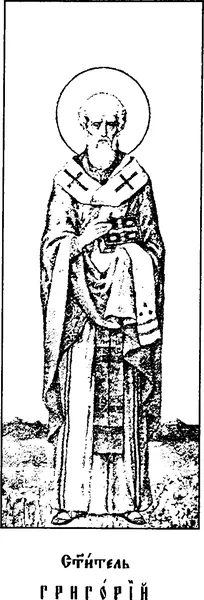
St Gregory the Wonderworker, Bishop of Neocaesarea (+c. 266–270)
Saint Gregory the Wonderworker, Bishop of Neocaesarea (before baptism, Theodore), was born into a pagan family in the city of Neocaesarea (in the north of Asia Minor). He received a brilliant education, and then set out with his brother Athenodorus for Berytus, to complete his studies at the famous school of law there. On the way the young men passed through Caesarea, where at that time the great teacher of the Alexandrian school, the presbyter Origen, was teaching philosophy. After getting to know Origen, Theodore and Athenodorus decided not to continue their journey but to become his disciples. Under his guidance the youths came to know the Lord, Creator of heaven and earth, understood that wisdom and truth are found only in the saving teaching of the Gospel, believed in Christ and were baptised. At baptism Theodore was named Gregory.
Gregory’s ascetic life, prudence, purity and unselfishness filled his pagan companions with envy, and so they decided to stain the blessed one’s name with slander. Once, when Gregory was talking with his teachers in the square, a harlot well known in the city came up to him and demanded payment, as if for a sin committed with her. At first the saint answered the woman calmly: you are mistaken, you are confusing me with someone else; but she would not stop. Then Gregory asked a friend to give the harlot money. As soon as the woman had received her unrighteous payment, a demon fell upon her and threw her to the ground. At last the slanderer, tormented by the evil one, confessed her lie, and Saint Gregory prayed for her and delivered her from the demon.
On returning to Neocaesarea, Gregory renounced a worldly career and went out into the desert. The holy father grew accustomed to the life of the desert and wished to labour in solitude to the end of his life, but the Lord judged otherwise.
When Phaedimus, Bishop of the Cappadocian city of Amasea, learned of Gregory’s ascetic labours, he resolved to make him Bishop of Neocaesarea. The Lord’s chosen one foresaw the hierarch’s wish in spirit and hid from the messengers sent to look for him. Then Phaedimus appointed the saint Bishop of Neocaesarea in his absence. The blessed Gregory regarded this extraordinary event as a manifestation of God’s will and did not dare to disobey. This episode from the venerable father’s life has been preserved for us by the account of Saint Gregory of Nyssa (commemorated 10 January). He also tells us that Saint Gregory of Neocaesarea received the rank of bishop from Bishop Phaedimus of Amasea.
Before his consecration, at which he was to pronounce the Creed, the blessed Gregory prayed fervently to the Lord and to the All-holy Theotokos, beseeching them to reveal to him the true way of worshipping the All-holy Trinity.
During his prayer the All-holy Virgin, shining like the sun, appeared to the saint together with John the Theologian. With the blessing of the Theotokos the Apostle John taught the blessed one how we must confess the mystery of the All-holy Trinity. The Creed handed down to us by Gregory of Neocaesarea is one of the greatest divine revelations in the history of the Church. On it rests the teaching on the Holy Trinity in Orthodox theology. It was later developed by the holy fathers of the Church: Basil the Great, Gregory the Theologian and Gregory of Nyssa. The Creed of Saint Gregory of Neocaesarea was examined and approved at the First Ecumenical Council (325).
After his consecration as bishop, the hierarch Gregory set out for Neocaesarea. On the way, in Amasea, he drove the demons out of a pagan temple, after which the priest of the idol-house was converted to Christianity. Saint Gregory’s preaching was strengthened by the miracles worked in the name of Christ. When an inheritance was being divided, a quarrel arose between two brothers over a lake on their late father’s estate. Each of them was gathering friends and supporters around him, and the matter looked as if it would end badly. The hierarch Gregory urged them to put off settling the matter until the next day, while he himself spent the whole night in prayer on the shore of the lake that had become the cause of the quarrel. When day broke, everyone saw that the cause of the strife was gone: the lake had sunk beneath the earth. Once, during a flood, the saint prayed, set a boundary with his staff for the river that had burst its banks, and stopped the flow of the water. Another such occasion is known too: the blessed Gregory decided to build a church and commanded a mountain in the name of Christ to move back so as to free a place for the foundations. And the hill obediently did as the saint commanded.
When the Emperor Decius (249–251) began to persecute the Christians, the hierarch Gregory took refuge with his flock on a mountain some distance away. Soldiers surrounded the mountain. The hierarch came out into an open place, lifted up his hands to heaven, commanded his deacon to do likewise, and began to pray. The horsemen searched the whole mountain, passed by the praying men several times, but did not see them, and went back again.
After the persecution had ceased, Saint Gregory returned to Neocaesarea. With his blessing church feasts were established in memory of the martyrs who had died for Christ. At that time the heresy of the heretic Paul of Samosata (Samosata is a city in Syria) spread widely; by his preaching and letters he darkened the minds of many Christians. The heresy of Paul of Samosata was condemned at the first Council of Antioch in 264, which was led by Gregory of Neocaesarea.
By his God-pleasing life, his inspired preaching, his miracles and his wise governance of his flock, the holy chief shepherd increased the number of Christians more and more. By the time of the blessed one’s repose (+c. 266–270) only seventeen pagans were left in Neocaesarea, whereas when he ascended the hierarchical throne there had been only seventeen Christians in the city.



