
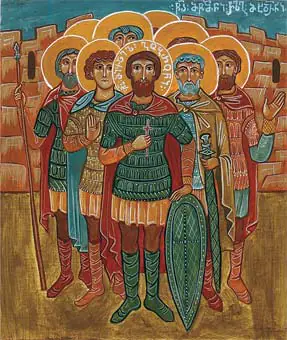
Great Martyr Michael, Called Gobron, and His 133 Warriors (+914)
In 914 the Arabs invaded Transcaucasia for the last time. The countless host of the emir al-mu’minin was commanded by Abu’l-Qasim. The Saracens laid waste “all Somkhiti, Signeti, Vaedzori and Aspuragan”.
From Armenia Abu’l-Qasim invaded Georgia “with a great and countless host, which the land could not contain”.
In Tbilisi Ja‘far, son of Ali, sat as emir. He received his fearsome countryman well. From here Abu’l-Qasim crossed into Kakheti, and after a siege of many days he laid waste Ujarma. The men of Bochorma left their fortress of their own accord and fled.
Kvirike the chorepiscopus, eristavi of Kakheti, offered Abu’l-Qasim terms of peace. The commander accepted the profitable bargain and fell upon Kartli again. The Georgians themselves demolished Uplistsikhe, so that it should not fall into the enemy’s hands. The Saracens spread over Samtskhe and Javakheti; they attacked the fortress of Tmogvi but could not take it, and turning back they laid siege to the fortress of Kveli.
At that time the lord of the fortress of Kveli was Gurgen, eristavt-eristavi. The fortress was well fortified, but the defenders within were few. “In that fierce battle the men of the fortress were brave, and they slew the attackers and cast down their bodies like the dung of the earth.” Among the fighters the blessed Gobron stood out: “the power of his fighting was plain to be seen above all that multitude.”
The fighting lasted twenty-eight days. At times the Saracens stormed the fortress; at times the defenders, led by Gobron, sallied out against the enemy, fell on them with fury and returned again to the fortress.
The enemy made a last assault on the fortress of Kveli, took it, and seized the surviving defenders, Gobron among them. Abu’l-Qasim, astonished at the Georgian warrior’s valour, ordered that “the blessed Gobron be guarded more carefully than all the rest”.
King Adarnase paid a great sum and ransomed some of the prisoners. Gobron was not among them, for the Arabs refused to release him. The Georgian knight foresaw his future and “made himself ready for torments for the sake of Christ”.
The Saracens led out for punishment the hundred and thirty-three horsemen captured with Gobron; “like wicked, raging beasts they fell upon them pell-mell and vied with one another: some struck with the sword, some pierced and cut them with lances and arrows, they ripped open their bodies with knives and snatched their livers with their mouths like dogs”.
Abu’l-Qasim resolved to overcome the invincible knight by temptation, and said to the blessed Gobron: “I have pity on thee, for thy goodness is renowned before us; and now, as a beloved son, I teach thee: confess the true law of our dominion.” In return he promised him command, palaces, halls and slaves.
Saint Gobron answered the emir calmly: “I beseech thee, sovereign, do not compel me to forsake Christianity, in which my parents brought me up and with which I have been sealed by the Holy Spirit… Know for certain that neither by the promise of thy good things nor by bringing thy many evils upon me canst thou part me from my Lord Jesus Christ.”
Enraged by the saint’s answer, Abu’l-Qasim ordered that Gobron be taken outside and shown on one side his slain comrades, and on the other the riches he had been promised: “Who knows but that the fear of death or the gaining of good things may bend his heart.” When Gobron was brought back, to the emir’s question, “What hast thou chosen for thyself?”, he answered: “I told thee at the first that I would not turn from Christ my Lord.”
The emir prepared a worse trial for the saint: “He knows not the pain of death; take him away and destroy before his eyes the Christians who are left, and a little water him, and bring him back again.”
The saint was set among his surviving comrades, and a merciless slaughter began. The blood of the slain spattered Gobron, the bodies rolled at his feet, but the horror could not shake his heart. Then they bent the saint’s neck, struck him twice with the sword and wounded him lightly. Gobron made the sign of the cross on his forehead with his blood and said: “I thank Thee, Lord Jesus Christ, who hast counted me worthy, unworthy and sinful as I am and the last of all, of this portion of the inheritance and of martyrdom.”
The Saracens again brought Saint Gobron before Abu’l-Qasim. The emir tried for the last time to bend the saint, but the bleeding martyr answered firmly: “Do what thou wilt; I am a Christian and will never deny His name.” Abu’l-Qasim, losing patience, ordered the saint to be beheaded and thrown among the slain.
By the emir’s order three great graves were dug; the martyrs’ bodies were thrown into them and covered with earth, and the Christians were forbidden to approach them. By night a heavenly light would stand over the graves.



