
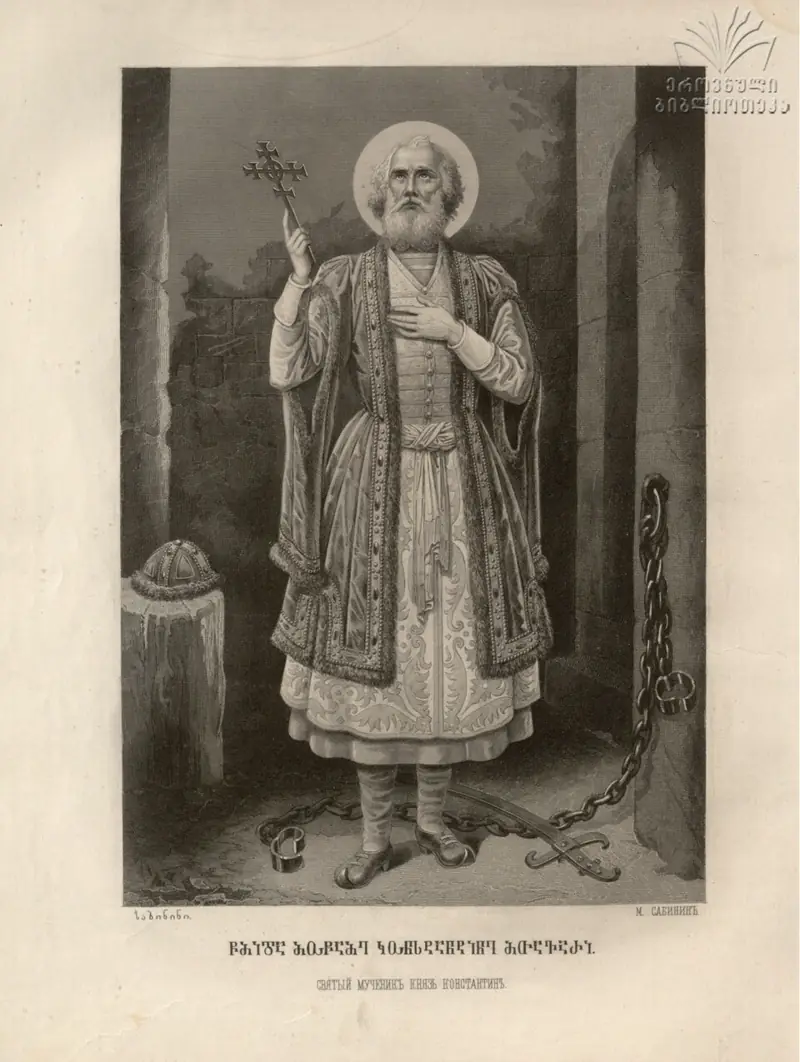
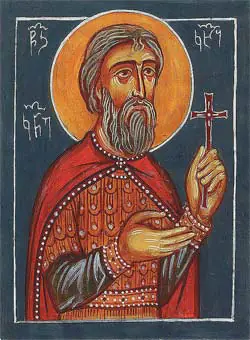
Great Martyr Constantine-Kakhi, Prince of the Georgians (+852)
The holy Great Martyr Constantine was born around 767. He lived in Kartli. He was given the byname Kakhi (the Kakhetian) because of his Kakhetian descent, “from that land of his fathers”.
The possessor of great wealth and every earthly good was well known not only in Georgia and the Caucasus but at the imperial court of the Greeks too as a God-fearing and exceedingly charitable man.
The Christ-loving prince counted himself the most sinful of all, and often said: “I hope in nothing for the forgiveness of my sins, save in the shedding of my blood for Him who shed His blood for us.”
Constantine greatly desired to worship at the holy places of Jerusalem. Having come to Jerusalem, he gave a great sum to the churches, went round the deserts of the Jordan, received the blessing of the desert fathers and the superiors of the churches, and returned to his homeland full of joy. After his return to Georgia Constantine sent thirty thousand pieces of silver every year to Jerusalem for the holy places there.
In 853–854 an Arab army many thousands strong, led by Bugha the Turk, invaded Kartli. In this campaign fifty thousand people died in Tbilisi alone; then they laid waste Kartli, Kakheti and the highlands.
The eighty-five-year-old prince, together with his son Tarkhuj, took command of the army of Kartli. On the approaches to Gori an unequal battle took place between the Arabs and the Georgians. Despite stubborn resistance the Georgians were defeated. The enemy took Constantine and Tarkhuj captive.
The inscription of the Sioni of Ateni tells of this horrifying episode in the life of Kartli briefly and strikingly: “On the 5th of the month of August, on a Saturday, in the koronikon 73, in the year 239 of the Ishmaelites, Bugha burned the city of Tbilisi, and seized the emir Sahak and killed him; and on the 26th of the same month of August, also on a Saturday, Zirak seized Kakha and his son Tarkhuj.”
The captive prince Constantine was brought before Bugha the Turk. He asked Constantine in surprise: “Didst thou not know that thou couldst not escape from my hands by thy flight?.. Behold, God has given you this day into our hands to be destroyed.” Saint Constantine answered calmly: “God has given us into your hands not for love of you, nor for your deeds, but because we did not keep His commandments; for this He has struck us down by that disobedient race.” The obedient and penitent prince saw that the sins of the Georgians were the cause of the country’s misfortune. In prison the saint bore his trial bravely. He wrote letters to the desert fathers and the superiors of the churches and asked them to pray for him.
A little later Constantine-Kakhi, in fetters, was sent to the Babylonian city of Samarra to the caliph Ja‘far. Ja‘far knew how important a person he was for the Georgians and for all Christendom; he greeted him courteously and proposed that he change his faith, promising him honour and glory in return, and at the same time he threatened him: “If thou wilt not heed me, thou shalt die by the edge of the sword, and I will give thy flesh as food to the birds of the air.”
The aged prince, strengthened by Christ, said to him boldly: “I fear not thy sword, but I fear Him who is able to destroy both soul and body, and has power to make alive as well as to kill; therefore I will endure with joy for His name, for He is the true God, the mighty Sovereign and Prince of peace, the Father of the age to come.”
Hearing this, Ja‘far had Saint Constantine thrown into a dungeon; then he sent to him two Armenian nobles who had denied the faith and been exalted by the caliph. Saint Constantine answered the Armenians: “Say thus to your king: think not that I will do any such thing, even though the custom of the kings of Babylon urges thee, for they too opposed the truth; but command to be done what thou art minded to do, and do it. And you, why do you press upon me and assail me, that I too should become like you? Depart from me from now on, that I may search the commandments of my God.” Then he raised his hands and began to pray: “I sing to Thee, O Lord God of hosts, God of the ages, who hast given me strength to withstand this wicked judge, as Thou didst foretell: ‘Give Me your hearts, and I will give you My strength.’ Make me worthy of the light of Thy face, for I flee to Thee, O Christ, Son of God.” As Saint Constantine stood in prayer, “streams of tears ran down from his eyes… and those standing round him struck his face and tormented him with many torments, but they could not stop his tongue from singing”.
The caliph ordered the executioners to cut off Saint Constantine’s head. A foreigner cut off the head of the martyr as he stood in prayer, and “brought it to his king, as the head of John the Baptist to Herod”. This took place on 10 November, the day of the commemoration of the holy Great Martyr George.
The saint’s body was hung on a high post to frighten the people, and afterwards it was buried. A few years later the Georgians brought the remains of Saint Constantine-Kakhi back to their homeland.



