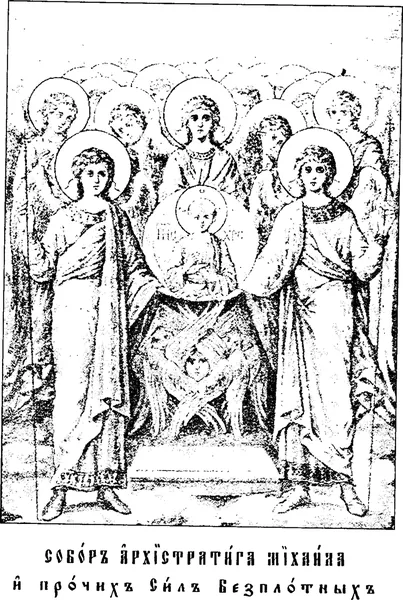
Synaxis of the Holy Archangel Michael and the Other Bodiless Powers of Heaven; the Archangels Gabriel, Raphael, Uriel, Selaphiel, Jegudiel, Barachiel and Jeremiel
The celebration of the Synaxis of the Archangel Michael and the other bodiless powers of heaven was established at the local Council of Laodicea, held at the beginning of the fourth century, a few years before the First Ecumenical Council of Nicaea. The Council of Laodicea condemned and rejected the paying of divine honour to angels and confirmed their Orthodox veneration.
The feast is kept in the ninth month from March (with which the year was counted in ancient times), that is, in November, corresponding to the nine orders of angels. The eighth day of the month points to the gathering of all the bodiless powers of heaven on “the eighth day”, as the holy fathers call the Second Coming of the Lord and the dread Judgement. The holy fathers link the age of the world’s existence symbolically with the seven days of creation, and after seven thousand years (“For a thousand years in Thy sight, O Lord, are but as yesterday”; Ps. 89:4) “the eighth day” is to come, “when the Son of man shall come in His glory, and all the holy angels with Him” (Matthew 25:31).
The orders of angels are divided into three hierarchies. The highest hierarchy is made up of the Seraphim, the Cherubim and the Thrones. Nearest of all to the All-holy Trinity stand the Seraphim (the burning, fiery ones) (Isa. 6:2). They kindle people with the flame of divine love.
After the Seraphim, the Cherubim stand before the Lord (Gen. 3:24); their name means an outpouring of wisdom, enlightenment.
The Cherubim are followed by the Thrones (Col. 1:16), who serve the justice of God.
The middle hierarchy of the angels is made up of the Dominions, the Powers and the Authorities.
The Dominions (Col. 1:16) rule over the lower orders of angels, help earthly rulers appointed by God to govern wisely, and help us to curb sinful desires.
The Powers (1 Pet. 3:22) by the will of God send down on the Lord’s chosen ones the grace of obedience, patience, wonderworking and insight.
The Authorities (1 Pet. 3:22; Col. 1:16) turn people away from the temptations of the devil, help them in the struggle against evil desires, and strengthen and guard the ascetics.
The lowest hierarchy includes three orders: the Principalities, the Archangels and the Angels.
The Principalities (Col. 1:16) stir up the Archangels to carry out God’s commands. The governing of the universe and the protection of countries, nations and tribes are entrusted to the Principalities. They teach people to give each one the honour due to his dignity.
The Archangels (1 Thess. 4:16) announce the Lord’s will to us. They reveal to us the mysteries of the faith and the prophecies.
The Angels (1 Pet. 3:22) stand closest of all to people. They make known to us the purposes of God. They never leave us and are always ready to help us.
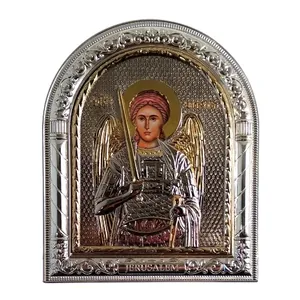
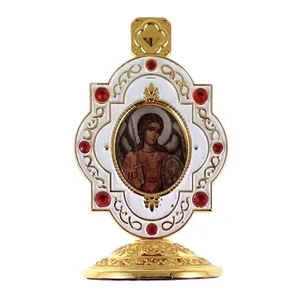
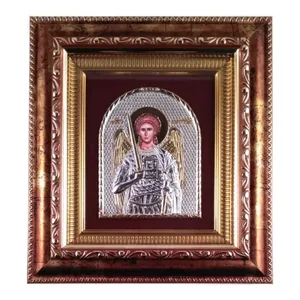
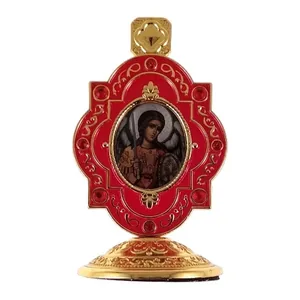
The Archangel Michael (his name in Hebrew means “Who is like God”) is appointed chief of the host of angels: the faithful servant of God who conquered the forces of Satan.
The Archangel Michael, conqueror of all hostile powers, is painted on icons clad in armour, that is, in divine grace. He tramples a demon underfoot, and in his left hand holds a green olive branch or a triangular shield. In his right hand he holds a spear with a white banner (sometimes a fiery sword), on which a crimson cross is depicted. On some icons the commander of the heavenly powers pierces with his sword the serpent coiled round the earth.
People pray to the Archangel Michael in times of demonic temptation.
From Holy Scripture and holy Tradition other archangels are also known, who have been given various ministries by God: Gabriel, the strength (power) of God (Dan. 8:16; Luke 1:26), the herald of the mystery of God, the messenger and servant of the Lord’s almighty power. On icons the Archangel Gabriel is depicted with the branch of paradise that he brought to the All-holy Virgin; often he holds a fiery lamp in his hand.
Raphael, the healing of God (Tob. 3:16; 12:15), is the deliverer of people from illness; on icons Raphael holds in his right hand a vessel of healing medicine, and with his left he leads the youth Tobias, son of the righteous Tobit, who carries a fish.
People turn to the Archangel Raphael in times of illness, before a journey, while staying in a distant foreign land, and in times of sorrow, hopelessness and despair.
Uriel, the fire and light of God, the enlightener (3 Ezra 5:20), is regarded as the protector of monastics and theologians. He enlightens our minds so that we may understand the divine mysteries and Holy Scripture. The Archangel Uriel is also the protector of penitents: according to church tradition, he prayed with Adam and Eve after their expulsion from paradise and carried their tears of repentance to the Lord’s altar. On icons he is depicted with a fiery or drawn sword.
Selaphiel means “one who prays”. He helps people invisibly during prayer. He is also the healer of shaking illnesses (malaria, epilepsy). On icons Selaphiel is depicted in an attitude of prayer, with lowered eyes and hands folded on his breast; sometimes he holds a lighted candle and incense.
Jegudiel means “glorifier of God”. He glorifies the Lord, strengthens those who labour and intercedes for them. He is also regarded as the protector of travellers and the helper of those in distress. On icons Jegudiel holds a golden crown in his right hand, and in his left a whip with three red (or black) thongs. The whip signifies that the lazy and negligent will meet many sorrows and punishments in this life before they come to their senses, while the crown is meant for the diligent.
Barachiel means “blessing of God”. He asks God’s mercy for people. Barachiel is regarded chiefly as the protector of martyrs, confessors and ascetics. In iconography many pink flowers are depicted on the Archangel Barachiel’s garments, a symbol of the gifts of the Holy Spirit.
Holy Scripture mentions Jeremiel, which means “exaltation towards God” (3 Ezra 4:36). He stirs up divine love and helps us overcome passions and sins.
The Archangel Jeremiel is depicted on icons with a pair of scales in his hand.