
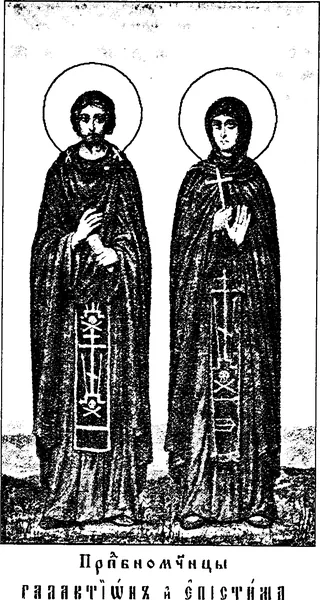
Holy Martyrs Galaction and Episteme (III)
The holy Martyrs Galaction and Episteme. The rich and noble but childless Clitophon and Leucippe lived in the Phoenician city of Emesa. They gave gold generously to the pagan priests, but still no heir was given them.
In the third century the city of Emesa was governed by the Syrian Secundus, appointed by the Roman Caesars. He was a merciless persecutor of the Christians, and to frighten them he ordered hideous instruments of torture to be displayed in the streets of the city. In spite of this, many Christians who longed to endure torments for Christ gave themselves up to the executioners of their own will.
At that time there lived in Emesa a hieromonk, Onuphrius, who hid his priestly rank under the rags of a beggar and went from house to house asking alms. Wherever he saw a chance of freeing people from the error of the pagans, the blessed one preached the faith of Christ. Once the old man came to Leucippe’s rich house as well. As he received alms from the woman, Onuphrius sensed that she was sad and asked the cause of her sorrow. Leucippe did not hide her misfortune. The monk comforted the childless woman, told her of the one true God, and assured her of the almighty power and mercy of Christ. Leucippe was filled with hope, believed in Christ and was baptised. Soon it was revealed to the pious woman in her sleep that she would bear a son who would become a true follower of the Saviour. At first Leucippe did not tell her husband of her joy, but when the boy was born she revealed the secret to him and persuaded him to be baptised too.
The newborn was named Galaction. His parents brought him up in faithfulness to the commandments of Christ and gave him an excellent education. The saint could have made a brilliant career in the world, but he longed for a pure life of solitude and prayer.
When Galaction turned twenty-four, his father decided to marry him off and found him a bride: a beautiful and noble maiden named Episteme. The young man did not oppose his father’s will, but by the providence of God the wedding was put off for a time. Galaction, who often visited his bride, gradually converted her too to Christianity and secretly baptised her. Together with Episteme one of her slaves, Eutolmius, was also baptised. The new converts, following Galaction’s example, resolved to take up the monastic life. They left the city and made their way to Mount Publion, where there were secretly two monasteries, one of men and one of women. The inhabitants of both houses were old and infirm, so the newcomers took on all the necessary physical work. For several years they laboured in work, fasting and prayer. Once Episteme saw a vision in her sleep, as if she and Galaction were standing in a wonderful palace before a radiant King, who held out golden crowns to them. This was a foretelling of the blessed ones’ approaching martyrdom.
The pagans learned of the monasteries and sent a troop of soldiers to seize their inhabitants, but the monks and nuns managed to escape into the mountains. Only Galaction would not flee, and stayed in his cell reading Holy Scripture. When Episteme saw that the soldiers were leading the blessed one away bound, she fervently begged the abbess to let her go too: she wished to suffer for Christ together with her betrothed and teacher. The superior, in tears, blessed her for the labour of martyrdom.
Saints Galaction and Episteme endured the most grievous torments with prayer and the glorifying of Christ. At last the godless flayed them alive, and so took their lives.
Eutolmius, Episteme’s former slave, her brother in Christ and fellow ascetic, secretly committed the bodies of the holy martyrs to the earth. For the instruction of his contemporaries and of later generations he also wrote down the Life and martyrdom of the Lord’s chosen ones.



