
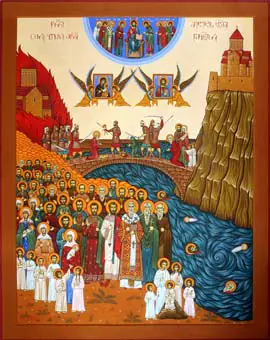
The Holy 100,000 Martyrs, Martyred in Tbilisi by the Khwarazmians (+1227)
The holy 100,000 martyrs (icon painter: Shota Tsintsadze)
The Church of Georgia is called a Church of martyrs; the Georgian nation carries within itself a hidden and subconscious love for Christ God, often covered over by the thorns and brambles of this world’s good and evil. The storms of history and the clashes between empires seem to pass through a sieve the blend of our religious and national holiness and traditions, and out of the whirl of this world there is separated the pure flour — the qualities of “the peculiar people” — and the chaff, that worthless admixture which is neither offered up to God nor good for the nation.
“O Lord, rebuke me not in thine anger, neither chasten me in thy wrath. Sweet art thou, O Lord, and in thy sweetness teach me thy righteousness,” we read in the psalm. In the reign of the right-believing sovereign of Georgia, Saint Tamar, the Georgian nation learned God’s justice “in sweetness”; after Tamar’s death a time of hardship came upon the country. The Chronicler tells us: “The land of Georgia was given over to corruption for this reason: because the kings and lords forsook justice, mercy, love, sincerity and righteousness, and in their place acquired pride, guile, envy, fornication and lawlessness.” God sent a cruel punishment on the nation that had forgotten His law: “He rebuked us in anger and taught us in wrath” God’s righteousness: Jalal ad-Din, sultan of Khwarazm, defeated by Genghis Khan, set out with his whole household and came to the borders of Georgia. At that time Rusudan, the daughter of King Tamar, was ruling Georgia. The Georgian host gathered at Rusudan’s command was defeated in the battle at Garnisi.
Jalal ad-Din, who had settled in Adarbadagan and Nakhchivan, summoned Avag Mkhargrdzeli, then atabeg of Georgia, and proposed: “Now I wish that we unite by a firm oath and fight our enemies (the Mongols). Since your sovereign is a woman, make me her husband and king over you, and we shall overcome all our enemies. If you do not do this, your kingdom shall be laid waste.”
Jalal ad-Din’s insolent intention astonished the queen and the court. Rusudan sent word to Avag: “Not even to hear of such a thing, but to reject it utterly.” The atabeg Avag informed Jalal ad-Din of Rusudan’s anger and refusal.
The sultan broke camp and moved towards Tbilisi.
On the first day of battle “the Georgians showed a brilliant victory” and sorely defeated the sultan of Khwarazm, but in the night the Persians of Tbilisi betrayed the Georgians, opened the city gates and let the enemy into Tbilisi.
“Who could tell the words and deeds and trials of that time that came upon the Christians?” asks the Chronicler, and tells of one of the terrible, bloody days in the life of Kartli: “They snatched babes from their mothers’ breasts and dashed them against the stones before their mothers; of some they put out the eyes, and of others they spilled out the brains”… A river of blood flooded the city. The slain lay in heaps; horses’ hooves trampled the helpless; young men were castrated; mothers were made to kill their children. “The whole city shook with shouts and cries and dreadful voices of lamentation.” The streets of Tbilisi and the Mtkvari were filled with bodies.
Jalal ad-Din had the dome of the Sioni cathedral torn down and ordered his “foul throne” to be set up on it. Then evil went beyond every limit: by Jalal ad-Din’s order the icons from the Sioni cathedral were laid on the bridge, and the people of Tbilisi were commanded “to trample the precious icons and forsake their faith”. Whoever would not do this faced “the cutting off of heads”.
A hundred thousand Georgians gave their lives that day for the veneration of the holy icons and the defence of the faith; a hundred thousand severed heads and a hundred thousand headless bodies the lawless gave to the river Mtkvari. From that day Georgia gained a hundred thousand protectors, whose commemoration is always “kept with praise”.
“Lives of the Georgian Saints”, Tbilisi, 2004.
The extended version of the martyrdom of the holy 100,000 martyrs



