
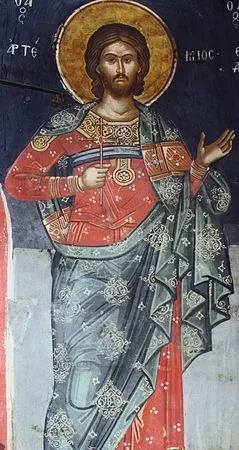
Holy Great Martyr Artemius (+362)
The holy Great Martyr Artemius, one of the outstanding military commanders, lived and served in the reign of the Emperor Constantine the Great, equal to the apostles (306–337, commemorated 21 May), and then of his son and heir Constantius (337–361). For his loyal service and courage the saint was often decorated, and at last he was appointed viceroy of Egypt. In this post the blessed Artemius laboured much to strengthen Christianity in Egypt.
Meanwhile Julian the Apostate (361–363), who wished to revive paganism in the empire, ascended the throne. He declared an implacable war on Christianity. He mercilessly sent hundreds of Christians to their deaths. In Antioch the lawless man ordered the torture of the hierarchs Eugenius and Macarius, renowned for their holiness. Artemius, who had come to the city, witnessed their martyrdom and publicly rebuked Julian for his godlessness and cruelty. Then the enraged emperor handed him too over to the executioners. After torture Artemius was thrown into prison. While the martyr was praying, Christ Himself stood before him, accompanied by a company of angels, and said to him: “Be of good courage, Artemius! I am with thee. Already I am preparing for thee the crown of glory, for as thou hast confessed Me before men, so will I also confess thee before My Father which is in heaven. Be of good courage and rejoice: thou shalt be with Me in paradise.”
The blessed one bore his sufferings patiently. He foretold to Julian that he would soon be punished for the evil he had done to the Christians. This made the autocrat still more savage, and he increased the martyr’s torments; but when he saw that every effort to bend Saint Artemius was in vain, he ordered him to be beheaded.
The Christians committed the great martyr’s remains to the earth. After Saint Artemius’s death his prophecy about Julian’s approaching end was fulfilled: the apostate emperor set out from Antioch to make war on the Persians. Near the city of Ctesiphon an old Persian met him and promised to betray his countrymen and act as his guide. Julian trusted the old man, and he led him with his army into the trackless wastes of the Carmanitis desert, where neither water nor food was to be found. The army, exhausted by hunger and thirst and reduced by half, suffered a crushing defeat at the enemy’s hands. The emperor himself was overtaken by a punishment sent from God: an invisible hand struck an invisible weapon into his heart. Julian groaned heavily and said: “Thou hast conquered, O Galilean!”
After the death of the heretical emperor the remains of the holy Great Martyr Artemius were translated with honour from Antioch to Constantinople.



