
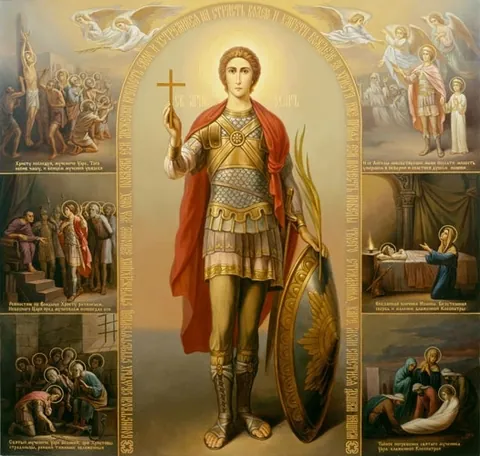
Holy Martyr Uar and the Seven Christian Teachers with Him (+c. 307)
In the Roman Empire, in the reign of the wicked Maximian (c. 307), there lived in Alexandria, the chief city of Egypt, a soldier named Uar. For fear of the idol-worshippers he hid his Christianity for a certain time, but afterwards he declared his faith before everyone.
At that time Maximian began a persecution of the Christians and issued an order throughout his dominions that all Christians who refused to offer sacrifice to the idols should be killed. This order reached Egypt too, and the innocent blood of many believers was shed without mercy. At that time Uar, by bribing the guards, used to go into the prisons at night; he kissed the fetters of the holy martyrs, washed their wounds, brought them food and asked them to intercede for him before God.
Once seven Christians who were teaching the people the true faith were seized in the desert and brought before the ruler of Egypt. After interrogation and torture, when by the tormentor’s order they had been thrown into prison, Uar, as was his custom, came to them by night, loosed their hands and feet, kissed them and said to them: “Blessed are you, faithful and good servants of God, who are to enter into the joy of your Lord, for you have stood firm unto the shedding of blood. Blessed are you, good strugglers, for whom a crown is being made ready by the hand of the Most High, for with patience you have run the race that is set before you. By morning, as I know for certain, your sufferings will be over. Blessed are you, sufferers for Christ, for whom the Kingdom of Heaven stands open, for with Christ, who suffered for us, you suffer together with Him, that you may be glorified together with Him. I beseech you, saints of God, pray the Lord for me that He may have mercy, for I wish to suffer for Him as you do, but because of my weakness I fear the torments you have taken upon yourselves.”
And the saints answered him: “No one can reach perfection if there is fear in his heart; no one can reap unless he sows; no one can win a crown unless he suffers. Remember the words of the Gospel: ‘Whosoever shall deny Me before men, him will I also deny before My Father which is in heaven.’ If you fear passing torment, you will not escape eternal torment. If you fear to confess Him on earth, you will not be able to see Him in heaven. Come, brother, and walk with us the way of suffering for the Lord, who sees what we do; suffer with us, for you will not soon see such another brotherhood.” Encouraged by these words, Uar was kindled with love for God and was ready for every trial. He spent the whole night with the martyrs.
In the morning the guards brought them before the ruler of Egypt. Since one of the martyrs had already died of the wounds inflicted on him, when asked where the seventh Christian was, Saint Uar, filled with divine zeal, fearlessly stepped forward before the tormentors and answered: “I am the seventh, for one has already gone to Christ and left me as heir of his martyrdom; and so whatever was owed him by you, I am ready to pay you; I wish to suffer in his place, for I am a Christian.”
Hearing these words, the enraged ruler accused the holy martyrs of having bewitched and led Uar astray, and said threateningly: “This very moment I will cut your bodies to pieces unless you worship the gods of Egypt.” And the saints answered: “We reject gods that did not make heaven and earth.” And the blessed Uar, to anger the ruler still more, said: “The fool speaketh folly, says the prophet Isaiah. Behold, their bodies are before you: do what you will.”
By order of the furious tormentor the cruel torture of Uar began there and then. They cut his body with iron claws and knives, then nailed him upside down to a tree and began to flay him, and beat him on the belly with a stick until his entrails fell out. Seeing this, the holy martyrs fervently besought the Lord and encouraged Uar: “Stand firm, Uar, for Christ stands beside you and invisibly helps you.” Uar answered: “Truly I have felt the help of the Lord, for I count the torture as nothing.”
After five hours of merciless torture Uar’s holy and righteous soul was given up to the Lord. The tormentors, who thought Uar was still alive, went on torturing him. Then his body was thrown out of the city for the dogs to eat, at the place where the carcasses of cattle were thrown.
A devout woman named Cleopatra, a native of Palestine, whose husband was a military commander in Egypt and who had a son, John, still a youth, watched Saint Uar’s sufferings with grief from a distance. By night she secretly took the martyr’s body and buried it in her house. The next day the rest of the holy martyrs were beheaded.
Some years passed. The persecution of the Christians died down, and Cleopatra resolved to return to Palestine, and she wished to take Saint Uar’s remains with her. After thinking it over she decided to act as follows: she asked the ruler of Egypt’s permission to translate to their homeland her husband, who had faithfully served the emperor. Having received consent, she carried Saint Uar’s remains in place of her husband’s and buried them in the village of Edra near Tabor, beside her ancestors. Every day she went to Uar’s grave, burned incense and lit candles. Following her example, many Christians began to come to this holy grave, bringing with them the sick, who were healed through Saint Uar’s prayers. The fame of Saint Uar spread through all the neighbouring villages. Seeing that many Christians came to pray at the saint’s grave, Cleopatra resolved to build a church, and set to work. At that time her son John was a youth of seventeen, and his mother had him enrolled in the king’s army, but decided not to let him go into the emperor’s service until the building of the church was finished. When the church was completed, Cleopatra called bishops, priests and worshippers, and the church was consecrated with great solemnity. Saint Uar’s remains were carried into the church and laid beneath the altar. Kneeling, Cleopatra besought Saint Uar with these words: “I beseech thee, sufferer for Christ, ask of the Lord for me what is pleasing to Him and profitable for me and for my only son; I have no other request than what God wills for us; He Himself knows what we need, and let His good will be done in us.” After the Liturgy she gave a great feast for all who were present, and served the guests together with her son. When all the guests had gone, Cleopatra saw that her son had suddenly fallen ill. The youth was burning with fever. Seeing this, his mother said: “I swear by the Lord that I will not put a single morsel in my mouth until I see how my son’s illness ends.” At midnight the youth died. Thunderstruck by this unexpected misfortune, the mother ran weeping to Saint Uar’s grave and cried out:
“Is this how thou hast repaid my service, O thou well-pleasing to God? Is this how thou hast helped me, when I neglected my own husband and placed all my hopes in thee? Thou hast let my only son die; thou hast destroyed my hope and taken the light of my eyes. Who will care for me in my old age? Who will close my eyes? Who will cast earth upon me? Better that I had died than seen my son plucked like an untimely flower. Raise up my son, as Elisha once did for the Samaritan woman; or else take me too from here, for my life has grown bitter with grief.” Exhausted by great sorrow and extreme weariness, the woman dozed off for a little while at the saint’s grave. In her sleep Saint Uar appeared to her, holding her son by the hand. Both shone like the sun; their garments were whiter than snow, golden belts were girded about their waists, and on their heads were golden crowns of unspeakable beauty. The blessed Cleopatra fell at their feet, but Saint Uar raised her up and said to her: “O woman, why dost thou reproach me? Dost thou think I have forgotten thy service in Egypt? Or dost thou think I felt nothing when thou didst take my body from among the carcasses of the cattle and lay it in thy chamber? Do I not always hear thy prayer and beseech the Lord for thee? And first of all I commended to the Lord thy kinsfolk, with whom thou didst lay me in the tomb. And now I have taken thy son for the service of the heavenly King. The all-merciful Lord in His unspeakable mercy has been pleased to receive thy son into His heavenly host. If thou wilt, take him back and send him into the service of an earthly and temporal king, since I see thou dost not wish him to serve the heavenly and eternal King.” But the boy embraced Saint Uar and said: No, my lord, do not listen to my mother; do not send me back to the world full of lies and every injustice, from which I have escaped through your intercession. Do not deprive me, father, of being near you and the saints. Then he turned to his mother and said: “Why do you weep, my mother? I have been granted to serve the Lord with the angels and the heavenly host, and you ask that I be deprived of this glory.” The blessed Cleopatra, seeing her son clothed in the garments of the angels, besought them: “Take me too, that I may be with you”; but Saint Uar replied: “Even while thou art there on earth thou art with us. Go in peace, and when the Lord wills, we will come and take thee.” At these words both became invisible.
When Cleopatra woke she felt unspeakable joy in her heart. She called the priests and with them buried her son with honour beside Saint Uar, no longer with mourning but with joy in the Lord. Then she sold all her property, and, withdrawn from this world, lived in the church of Saint Uar day and night in the service of the Lord. Every Sunday, during prayer, Saint Uar and her son appeared to her, clothed in radiant light. After seven years of labour the blessed Cleopatra went to stand before the Lord. Her body was buried beside her son, while her soul, together with Saint Uar and Saint John, ever intercedes for us before God, to whom be glory unto the ages of ages. Amen.



