
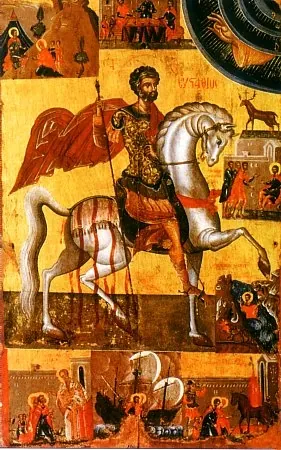
Great Martyr Eustathius Placidas, His Wife Theopistia and Their Sons Agapius and Theopistus (+c. 118)
The holy Great Martyr Eustathius Placidas, his wife Theopistia and their sons Agapius and Theopistus. Iconographer: Shota Tsintsadze
Before his baptism the holy Great Martyr Eustathius was called Placidas. He served as a commander in the Roman army in the time of the emperors Titus (79–81) and Trajan (98–117).
Eustathius was so valiant a warrior that the very sound of his name struck terror into his enemies. In his leisure the saint loved hunting. During one such hunt he pursued a stag for a long time; at last it ran up onto a high rock and stopped there. Suddenly between the stag’s antlers there shone the sign of the Life-giving Cross with the image of the crucified Saviour. “Placidas, why persecutest thou Me?” the Saviour asked him. The frightened general answered with a question of his own: “Who art Thou, Lord?” “I am Jesus Christ, who created all things out of nothing, and with Mine own hands made man, and have never until now withheld My love for mankind, but when he was broken by sin I renewed him again.” And He told him everything: His incarnation, crucifixion, death and burial, His rising on the third day, “through which He bestowed on our race freedom from the adversary”, and His ascension into heaven. The good seed fell on good ground: the Lord’s chosen one believed with a pure heart and besought the Saviour to show him what he should do next. The blessed one again heard the voice, and it commanded him to go into the city, to go to a priest, and to be sanctified by baptism together with his wife and children.
Placidas returned home rejoicing and told everything to his wife, who in her turn told him how the night before she had heard in her sleep: “Thou and thy husband and thy children, come to Me tomorrow, and know plainly that I am Jesus Christ, who am able to give life to them that love Me.”
The couple did as they had been commanded: they went to a Christian priest, who baptised their whole household and gave them communion of the holy Body and Blood of Christ.
The next day Eustathius made his way to the place of his miraculous conversion and in fervent prayer gave thanks to the Lord who had set him on the path of salvation.
Then the blessed one was again counted worthy of a wonderful revelation: the heavenly King Himself warned him of the trials to come: “Henceforth it is for thee to take upon thee the testing of thy faith, for in a little while the devil, the tempter, will come upon thee… but thou shalt win a glorious victory over him, as did Job of old… and at the end of thy martyrdom for Me thou shalt adorn thy head with a crown.” Eustathius answered humbly: “Thy will be done, O Lord!”
Soon a chain of misfortunes fell upon the blessed one: his servants died, his cattle perished… Impoverished but rich in spirit, Eustathius secretly left his native home with his family, to live in a strange land in humility and poverty. They boarded a ship and set off for Egypt. On the way the owner of the ship was captivated by the beauty of Eustathius’s wife, Theopistia; in the heat of passion he put the father and children ashore, and kept the woman with him. The former general, in terrible grief, went on his way and came to a raging river, which could not be crossed with both boys. He first took one son on his shoulders and carried him across the ford, then turned back for the other, but saw that a lion had seized the child and was running off with him into the wilderness. Nor could the saint keep the son left on the other bank: a wolf carried him off into the forest too.
Eustathius, who had lost everything, wept bitterly, but firmly believed that all this was happening by the providence of God. In the village of Vladisos the chosen one of God hired himself out as a labourer and spent fifteen years in unceasing toil. He did not know that by the unspeakable mercy of God one of his sons had been saved by shepherds and the other by farmworkers, and that they were now living close by him; nor did he know that God soon punished the lawless ship’s master: he died of a grievous illness, while his wife, undefiled, supported herself by honest work.
At this time the Emperor Trajan had to begin a very difficult war for Rome. He remembered the famous commander Placidas and sent his friends Antiochus and Acacius to seek out the saint.
After a long and fruitless search the soldiers came to the very village where Saint Eustathius lived. They met the former general in the fields and did not recognise him; they told him whom they were looking for and asked his help in return for a large sum. The saint recognised his friends but did not reveal who he was; he invited them into his master’s house and gave them food. When the travellers looked closely at their host, they noticed that he greatly resembled Placidas; then they noticed his particular mark on his neck, a battle wound, and understood that their friend stood before them. With tears of joy the soldiers embraced the blessed one and told him why they had been looking for him. Eustathius returned to Rome and again became the emperor’s commander. Many new recruits joined his army, and the saint did not know that the two young horsemen to whom he often gave tasks, and whom he loved dearly for their skill and valour, were his sons. Nor did they know that they were serving under their father’s command and were brothers to each other.
Once, on campaign, Eustathius’s cavalry camped in a certain village. The brothers sat in a tent and talked. The elder was telling of his lot: how he had lost his mother and father and his poor brother. The younger, overjoyed, realised that his brother was before him, and told him his own story.
The soldiers’ conversation was overheard by a woman near whose house the tent had been pitched: their mother. She understood that the Lord had brought her children to her door. The blessed woman revealed nothing to them, but she greatly wished not to be parted from her sons, and so resolved to go to the general so as to follow the army. She recognised her husband and told him about herself and about the two soldiers who had turned out to be her sons. So by the mercy of God the whole family was brought together.
Meanwhile the war was crowned with victory. Eustathius returned to Rome with honour and glory. Hadrian (117–138), who had ascended the throne in place of the late Emperor Trajan, resolved to mark this remarkable event with a solemn sacrifice. To everyone’s astonishment, Eustathius was not in the heathen temple. By the emperor’s order he was quickly sought out.
“For what cause wouldst thou not come with us to sacrifice to our fathers’ gods?” Hadrian asked the blessed one. “You owe them more gratitude than others, for the gods not only protected you in the war but let you find your wife and children as well.” Eustathius answered: “I am a Christian, O king, and to Him who gave me the victory and brought back my children and my wife from perdition I offer thanks. But apart from Him I neither know nor serve any other, and least of all these soulless and deaf things, lest I be found lacking in understanding.” The angry emperor stripped the valiant commander of his rank and brought him to trial together with his whole family. Eustathius, Theopistia, Agapius and Theopistus were thrown to the beasts to be torn apart, but the animals did not touch the saints. Then the enraged autocrat gave orders for the whole family to be shut into a heated bronze bull. Three days later, when the fiery sarcophagus was opened, the bodies of the holy martyrs were found completely unharmed: not a hair of theirs was singed, and their faces shone with an unearthly beauty. Many who saw this miracle believed in Christ. The faithful buried the martyrs’ bodies with honour, and afterwards, when the persecution of the Orthodox died down, “they built a house of prayer” to the glory of the Lord.



