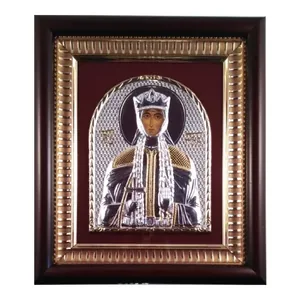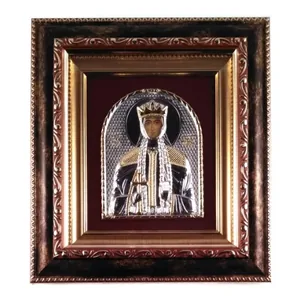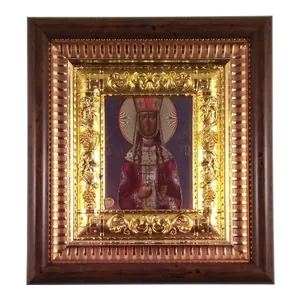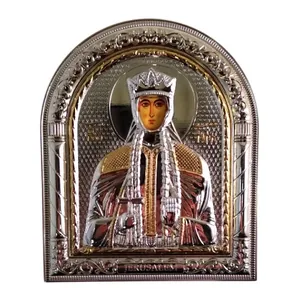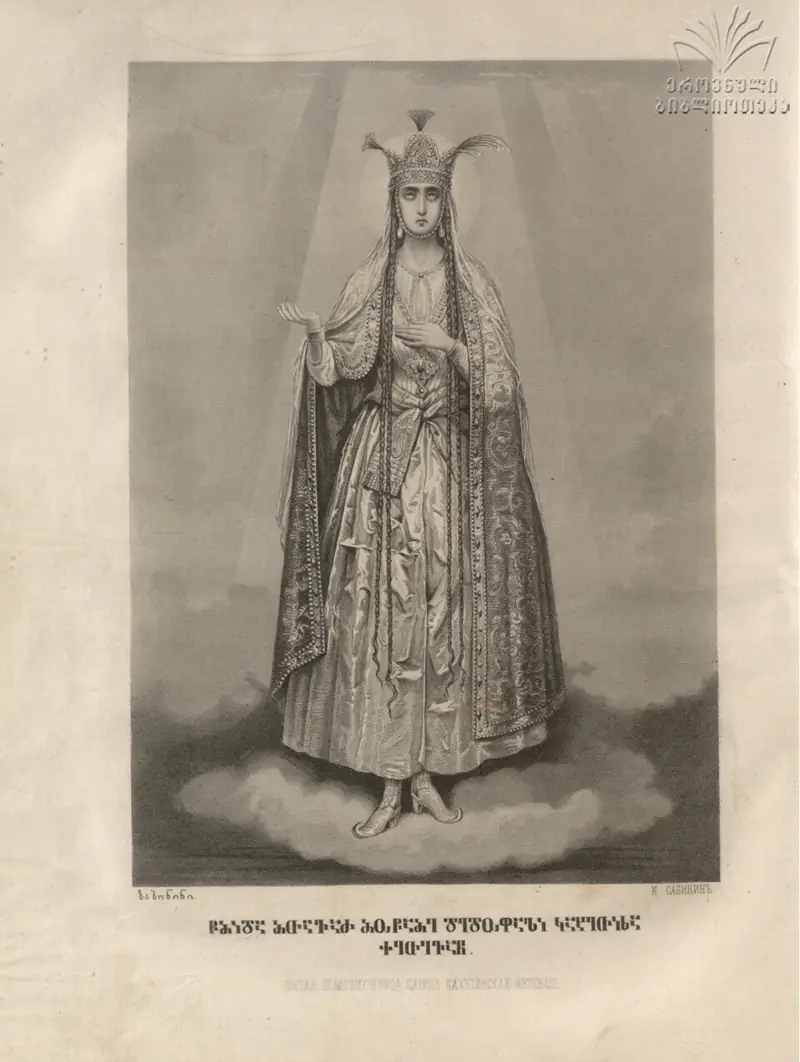
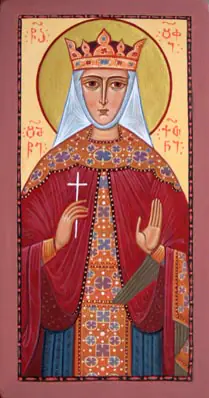
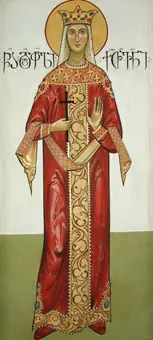
Holy Great Martyr Ketevan, Queen of Kakheti, Luminary of Georgia (+1624)
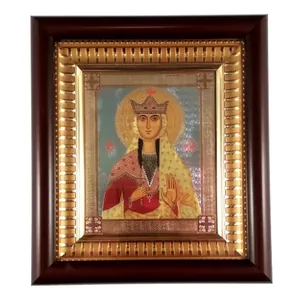
Holy Great Martyr Ketevan (icon painter: Giorgi Lashkhi)
Saint Ketevan, daughter of Ashotan Mukhranbatoni, was born around 1570. The wise and believing Ketevan was married to David, the eldest son of Alexander, king of Kakheti. King Alexander had two more sons, George and Constantine. Constantine had been brought up at the court of Shah Abbas from childhood and had changed his faith.
King Alexander was tonsured a monk in the cathedral of Alaverdi. David ascended the throne, but some four months later, in 1602, the young ruler of Kakheti died suddenly. The widowed Ketevan was left with a son and a daughter, Teimuraz and Elene. Alexander returned to the kingship. Because of the unrest in the country and various dangers, Ketevan sent Teimuraz to Shah Abbas.
As soon as Shah Abbas learned of David’s death and Alexander’s return, he ordered Constantine-Mirza, who had been brought up at his court and turned Muslim, to go to Kakheti, kill his aged father, kill his own brother George, and himself ascend the royal throne of Kakheti.
The brutalised Constantine-Mirza carried out the order, and then sent the severed heads of his father and brother as a precious gift to his “adoptive father”, while he loaded their bodies on a camel and sent them to Alaverdi for burial. Ketevan buried the bodies of her father-in-law and brother-in-law with honour.
Constantine, stained with blood, asked Ketevan to marry him: “I will take thee to wife, and be thou obedient to me, for such is the rule and custom of the law of Muhammad.”
Ketevan called the nobles of Kakheti, told them everything, and said that if we cannot defend the honour of our faith and our country, I shall return to Kartli, to Mukhrani. The nobles swore loyalty to the queen, gathered, fell upon the defiler of the faith and of tradition, and took his life. Ketevan buried the body of the faithless Constantine with the honour befitting his family, sent the shah a great gift and asked him to confirm Teimuraz as king. Until then she herself took on the care of the kingdom for a time.
Shah Abbas took fright — Kakheti will break away from me, join Kartli and I shall lose it for good — and in 1606 he confirmed Teimuraz as king and sent him back to Georgia with great honour.
The holy queen rejoiced to see her son; the whole kingdom rejoiced at the return of the Christian prince. The king was crowned, and for a time peace settled on the country. The young king married Anna, daughter of the Gurieli. The king and queen had two sons and a daughter — Levan, Alexander and Tinatin. Soon Queen Anna died. At the shah’s insistence Teimuraz married Khoreshan, the sister of Luarsab II, while the shah himself took Khoreshan’s sister Elene as his wife. So by cunning he “became kin” to the kingdoms of Kartli and Kakheti, while between Kartli and Kakheti, truly kin to one another, he constantly sowed the tares of discord.
In 1614 Shah Abbas sent an envoy to Teimuraz and asked for his son as a hostage in token of loyalty. Teimuraz knew the shah’s treachery, but, pressed by the nobles, he nevertheless sent his younger son Alexander to Persia, and sent his mother, Saint Ketevan, with him: “he thought that Shah Abbas would honour his mother.” The shah then asked for the elder son Levan, and afterwards sent word to Teimuraz too: since you are so loyal a man, come and see me yourself.
The shah’s intention became clear to everyone: he wanted to gather the royal house of Kakheti together and crush it all at once. Time would not wait. Teimuraz and Luarsab made a pact and with their forces united defeated the enemy encamped at Zhaleti.
Then began the most terrible period in the life of Kartli. Shah Abbas, preparing to invade Kakheti, sent the hostages — Saint Ketevan and her grandsons — to Shiraz, and himself fell upon Kakheti. The enemy laid waste the royal court, desecrated the churches and monasteries, deported the people and emptied the villages. Hunger and violence engulfed the country. The lawless set Kakheti on fire. More than three hundred thousand Georgians were deported to Persia, and nomad clans were settled in the desolated land.
Five years after the exile to Shiraz the shah took Teimuraz’s sons away from Ketevan, carried them off to Isfahan and had them castrated. Alexander could not survive the torment and died, and Levan lost his mind. The holy queen, shaken by the fate of her homeland and not knowing of her grandsons’ misfortune, lived in the palace of the ruler of Shiraz, Imam-Quli Khan Undiladze, a Georgian who had turned Muslim. This former Georgian treated Ketevan with great honour and said: she is our most honoured guest; she is no captive — we ourselves are her captives. By his order the terrible fate that had befallen the princes Levan and Alexander was kept from the holy queen.
For ten years the queen suffered in “honourable” captivity. Fasting, prayer and lying on stone wasted the queen’s body. Yet she remained courageous: she looked after, cared for and watched over her flock — the twenty or so Georgians in her charge.
The wrathful shah saw that “the queen was unbending”; the shining star of Kakheti still hoped in the Holy Trinity, commended her crucified country to the crucified Saviour, and was preparing for a great mission.
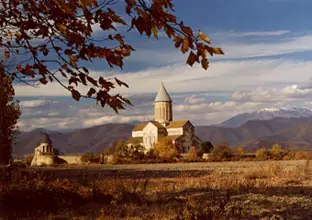
The cathedral of Alaverdi
The lawless Abbas resolved to make Ketevan change her faith. His immorality and insolence went so far that he asked the virtuous queen to marry him, and this happened on the very day the saint learned the fate of her grandsons.
The shah sent word to Imam-Quli Khan: “If Queen Ketevan turns Muslim, do her no harm; and if she does not, torture her and put her to death by punishment.” Undiladze was horrified and sent word by a messenger: “She is an old woman, and now she will not turn Muslim; what will you gain by making her a Muslim? Her death is a disgrace to you.” Shah Abbas grew angry and ordered the khan of Shiraz to carry out the order at once. The former Georgian pleaded with the queen: at least confess Muhammad for others to see, and in your heart remain a Christian. Saint Ketevan put Undiladze’s words far from her and made ready for martyrdom: “O Christ the King, Word of God, it befits not Thy handmaid to deny Thee; give not Thy handmaid over to the devil.”
The revered queen of the Georgians was led out into a square packed with people, accompanied by mourning Georgians. The executioners prepared copper cauldrons, lit a fire, set branding irons in it to heat, and stood the queen, dressed in festal clothes, before the pyre. The holy martyr asked for one thing only: “You too were born of mothers; do not shame me with nakedness.”
The lawless tortured the holy queen of the Georgians with a cruelty beyond words: they clapped a red-hot brass cauldron on her head, tore off her breasts with pincers, drove red-hot spits through her chest into her back, pulled out her nails, tore her flesh, threw her on a board studded with nails and hammered another nailed board down on top of her, and finally split her forehead with a red-hot spade.
The holy soul left the tortured body. The raging executioners threw the holy queen’s body out to be dragged about by wild beasts, but God sent a miracle: a light stood over the saint’s remains.
Franks who had witnessed the martyrdom took away the holy queen’s relics with great honour, wrapped them in cloth soaked with incense and myrrh and laid them in a Catholic monastery; some time later they sent Teimuraz, king of Kakheti, his holy mother’s head together with an arm and other relics, which were kept in the monastery of Alaverdi and were lost in 1723.
“Lives of the Georgian Saints”, Tbilisi, 2004.
The extended version of the life of St Ketevan
“Rich in labours and blessed of the Trinity among women, valiant queen and martyr, all-praised Ketevan, true art thou, who didst make the one faith a thousandfold” (Teimuraz I).
“This a woman does, by nature fearful of afflictions” (Anton I).
Before leaving for Persia, Queen Saint Ketevan prayed in the church of All Saints at Gurjaani.
From a priest’s sermon:
Queen Ketevan went into the house she used for prayer, bent her knees and with fervent heart uttered her supplication:
“Thee, God, the Trinity, one in essence, I confess, inscrutable and invisible, unable as I am to tell Thy wonders. I beseech Thee, O Master and Lord, fearful as I am of the mighty guardians of the air: send me an angel to guard my soul, and receive my soul, and open to me the door of Thy bridal chamber; number me with the band of Thy martyrs. There is no counting my sins, nor has anyone of those who believe in Thee sinned as I have; I confess my sins to Thee. Heal Thou the wounds of my soul; grant victory to my son Teimuraz, and to those who keep my memory grant the everlasting kingdom. O spotless Virgin, have mercy on me, a believer, through the dispensation of Thy Son.”
Since she had no priest, “with her own hand she partook of the incorruptible Mysteries, and so was she with the Lord”; she went out fearlessly, and, lifted up in spirit, declared to “her torturers: “How does he who sent you not know that even ignorant children would receive his counsel and instruction with mockery? How shall he lead me astray, who have been clothed with the power of Christ? He has laid waste my kingdom, driven out my son, put my grandsons to death, laid waste and defiled the churches, and does he want my death too? Let him put me to death: I renounce Muhammad and all his works and all his abominations! I believe in the Father, the Son and the Holy Spirit, the Trinity one in essence and undivided. I beseech our Crucified One and His all-holy Mother to strengthen me in the hour of torment, that thereby I may be made worthy of the martyrs’ crown. Behold, I stand before you; do what you will.”
Queen Ketevan stood in the midst of her torturers like a rock, and prayed quietly and calmly thus: “Lord Jesus Christ, do not delay to receive my soul!”
Prepared by Giorgi Sarajishvili; the newspaper “Sapatriarkos Utskebani”, no. 35, 2004.
Medea Kakhidze — Ketevan
A heavy silence fell, the pyre seethed red; yield, they said, for small is the Georgian land. And when I stood before the fire, they seized my veil; they lay hot irons on my breast — let them cover my nakedness! They cast me, powerless, into the pyre, like a victim offered up to God; my severed breast hurts me, but shame terrifies me more. Long I endure the torment, and the scream pressed back in my throat, for I was built of Georgian earth and lime. They pelt me, the hostage, with curses; I burn and still I do not groan — so of old the Chalybes forged iron in the fire. I trusted in my pride; I wore calm as armour on my body… So, my queen, so — a little more, and heaven begins…
Ana Kalandadze — Queen Ketevan
Merab Kostava — To Ketevan the Martyr, Luminary of Iberia
The sun will set by the lion-coloured ridges, leaving hues aflame; like a distant dream it lies upon the mourning, darkened peaks; it burns like the hearts of the saints, it gleams like the blood of the saints.
The evening grows old in violet, snatches the torches from the vault; supplication bursts from the lips, when it dawns in rose —
And there comes that spirit which mothers carried to the cradles; this heart has groaned in secret, it calls to thee, Agnes of the Georgians, wonderworker of the Iberians, holy luminary Ketevan.
Chosen one in the Parnassus of the blessed, smiling with the look of angels, thou holiness in enamel, thou river of our tears.