
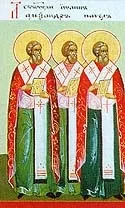
Sts Alexander (+340), John (VI) and Paul the New (+784), Patriarchs of Constantinople
Saints Alexander, John and Paul, Patriarchs of Constantinople, laboured at different times, but all of them had to struggle against heretics who distorted the teaching of the Church. Saint Alexander (325–340) was chorepiscopus in the time of Metrophanes (316–325), the first Patriarch of Constantinople, and because of the patriarch’s great age he took his place at the First Ecumenical Council in Nicaea (325), held against the Arians. Before his death the hierarch Metrophanes left instructions that his chorepiscopus should be chosen for the see of Constantinople. At this time His Holiness Patriarch Alexander had to struggle against the Arians and the idol-worshippers. Once, in a dispute with a pagan philosopher, the hierarch said to him: “In the name of our Lord Jesus Christ I command thee to be silent!” and the godless man lost his power of speech. Then he indicated without words that he acknowledged his error; his speech was restored, and he was baptised together with other pagan philosophers. Through the prayer of the hierarch Alexander God’s punishment fell upon the heretic Arius. He had feigned agreement to enter into communion with the Orthodox, and Saint Constantine the Great had even appointed the day on which he was to be received. The blessed Alexander stood in prayer all night and besought the Lord not to allow the heretic’s false union with the Church. In the morning, as Arius was proceeding solemnly towards the church surrounded by the king’s counsellors and armour-bearers, in the Forum of Constantine he was suddenly seized by illness; his belly burst and his bowels gushed out.
Worn out by many kinds of labour, His Holiness Patriarch Alexander reposed in 340, at the age of ninety-eight.
The hierarch John is glorified in the service of this day for his fasting, his love of the poor and his miracles, and so some identify him with John the Faster (582–595, commemorated 2 September); according to other suppositions he is John of Cappadocia (518–520), or else the Patriarch John Scholasticus (565–577).
The hierarch Paul came from Cyprus. He ascended the patriarchal throne of Constantinople (780–784) in the time of the iconoclast Emperor Leo IV the Khazar (775–780). He was a man richly adorned with virtues and pious, but timid. Seeing the tortures which the faithful endured for their faithfulness to the veneration of icons, the blessed father concealed his Orthodox faith and remained in communion with the iconoclasts. After the Emperor Leo’s death he wished to restore the veneration of icons, but he could not carry out his intention, for the heretics had by then grown very strong. The hierarch understood that he could not lead his flock; he left the see of his own accord, went to the monastery of Saint Florus and put on the schema. He repented of his communion with the iconoclasts and put forward the proposal that the Seventh Ecumenical Council should be convened to condemn this heresy. After Saint Paul, on his own advice, the hierarch Tarasius (784–806), then a counsellor of the king, was enthroned on the patriarchal throne. The patriarch and schemamonk reposed in 784 (he is called “the New” to distinguish him from the holy Patriarch Paul, +350, commemorated 6 November).



