
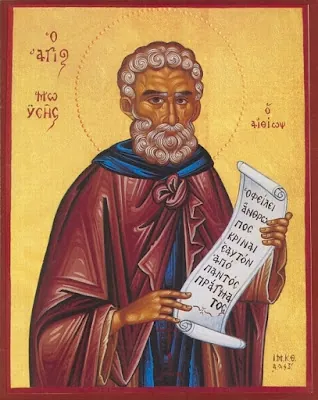
Venerable Moses the Black (+c. 400)
The Venerable Moses the Black lived in Egypt in the fourth century. An Ethiopian, a black man by origin, he received this surname from the colour of his skin. In his youth the saint was the slave of a nobleman and served him faithfully, but later his master drove him from the house for murder. Fleeing justice, Moses joined a band of robbers, and because of his fierce character and great bodily strength they chose him as their leader. Moses the Black with his band committed many evil deeds: he robbed and killed people mercilessly, and the very mention of his name struck terror into everyone. The future saint spent several years in such lawlessness, but later, through God’s boundless mercy, he came to repentance, left the band of robbers and went to one of the monasteries of the desert. For a long time he asked with tears to be received into the brotherhood. The monks did not believe in the sincerity of his repentance, but the former evildoer kept begging them not to drive him away until his request was granted. In the monastery the venerable father lived in complete obedience to the abbot and the brotherhood, weeping over his sinful life. Some time later Moses withdrew into a secluded cell and spent his days in prayer and the strictest fasting. Once four robbers from his former band attacked the saint’s cell. The blessed father, who had not lost his former bodily strength, tied up all four, brought them to the monastery and asked the monks what he should do with them. The brethren told him to set the prisoners free. When the robbers learned that they had fallen into the hands of their former leader, they too became monks. Hearing of Moses the Black’s repentance, the rest of the robbers also followed his example, gave up their lawless life and became zealous monks.
The Venerable Moses was not cleansed of the passions all at once. He often went to the abbot of the monastery, Abba Isidore, and asked him how to be freed from lustful desires. The elder, experienced in spiritual warfare, taught him never to eat his fill, always to remain half-hungry, and to live with the strictest abstinence. The foul demon would not let up: it inflamed the blessed father with dream fantasies; then Abba Isidore advised him to take up the labour of vigil. Saint Moses followed his superior’s blessing and spent whole nights in fervent prayer. The unending struggle for a time plunged the blessed one into despondency, but the elder Isidore strengthened his disciple: he took him up onto the roof of his cell and showed him in the west, in the vault of heaven, a great host of demons prepared for battle. In the east an even larger company of angels could be seen. They too were preparing for battle.
The Venerable Moses took up a new labour: at night he would go round the cells of the desert-dwellers and carry water from the well for the monks. He took special care of the old men, who could not walk a long way and carry water. Once, as Moses was bending over the well, he suddenly felt a violent blow on his back, fell down by the well as if dead, and lay there until dawn. In the morning the brethren carried him to his cell. For a whole year the blessed one was as helpless as a paralytic and suffered greatly. After he recovered he told the abbot that he would continue the struggle. Abba Isidore blessed him and told him to receive the Holy Mysteries and return to his cell. From that time on he was granted great power over evil spirits.
The report of the venerable father’s labours spread far. Then the ruler of the country wished to see him. When he learned of this, Moses decided to hide from the visitors and left his cell. On the way he met the ruler’s servants, who asked for the cell of Moses the Black. “It is not worth going to that false and unworthy monk,” the blessed one answered. The servants returned to the monastery, where the ruler was waiting for them, and told him the ascetic’s words; but the brethren were convinced by the description of the monk’s appearance that this monk had been Moses himself.
After many years of labour in the desert the venerable father was ordained deacon. The bishop clothed him in a white garment and said: “Now Abba Moses has become all white.” The saint answered: “Master, what makes a man pure, the inward or the outward?” Out of humility the blessed one considered himself unworthy of the rank of deacon. Once the bishop decided to test the saint and told the clergy to drive him out of the sanctuary, and then to follow him and hear what he would say.
The clergy did so: when Moses went into the sanctuary, they said to him: “Get out of here, you black man!” They took hold of him and threw him out without ceremony. The blessed father bore the humiliation with wonderful humility and, having been driven out, murmured: “It serves thee right, cur!.. How didst thou dare to enter the Holy of Holies?” When this was reported, the bishop had the saint brought back into the sanctuary and ordained him presbyter. When asked what he had thought when he was driven out and then brought back, he answered: “I compared myself to a cur, which, if driven away, runs off with its tail between its legs, and if called back, at once comes running gladly!” Moses the Black laboured for fifteen years in the priestly rank and gathered seventy-five disciples.
When the venerable father reached the age of seventy-five, he warned the monks that robbers would soon attack the skete and slaughter its inhabitants. The saint gave them his blessing to leave the place in good time and avoid a violent death. The disciples begged the blessed one to go with them, but Moses replied: “I have long been waiting for the time when the words of the Lord Jesus Christ will be fulfilled in me: ‘All they that take the sword shall perish with the sword’” (Matt. 26:52). Only seven monks remained with the holy father, one of whom hid when the robbers approached. The robbers killed Moses and the other six brethren. This took place around 400.



