
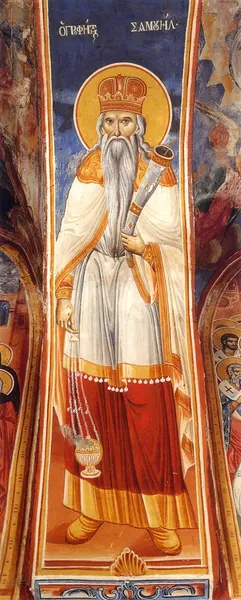
The Prophet Samuel (XI c. before the Nativity of Christ)
The Prophet Samuel, the fifteenth and last judge of Israel, lived more than one thousand one hundred and forty-six years before the Nativity of Christ. He was of the tribe of the Levites. His mother, Anna, long suffered from childlessness. At last the Lord heard His handmaid’s fervent prayer and gave her a son, who was named Samuel, “asked of God”. When the boy was three years old, his parents took him to Shiloh and entrusted him to the high priest Eli, who was at the same time a judge of Israel. “And the child Samuel did minister unto the Lord before Eli the priest” (1 Kings 2:11). At the age of twelve it was revealed to him from on high that God meant to punish the high priest’s whole house “for the iniquity of his sons, because they spake evil of God, and he restrained them not” (1 Kings 3:13).
The prophecy came true when the Philistines, invading the land of the chosen people, killed thirty thousand Israelites in one day, among them Eli’s sons Hophni and Phinehas, and carried off the Ark from the tabernacle. When he learned this, Eli, horrified, fell over, broke his neck and died. Phinehas’s wife, shaken by the fall of Israel, also gave up her spirit in childbirth.
After Eli, Samuel became judge of Israel. For forty years he judged and led the Israelites strictly and impartially, and then, when he had grown old, he appointed his sons Joel and Abijah as judges. The sons did not prove worthy successors of their father. Enslaved to greed, they often decided cases in favour of the wrongdoers. Because of this the elders of Israel demanded that Samuel appoint a king for them too, like the other nations. In this the prophet foresaw the terrible fall of the people, whom until then the Lord Himself had led through His chosen ones. The first king whom the prophet anointed was Saul. After denouncing him for his disobedience to God, he anointed David with chrism. David, persecuted by Saul, often found refuge precisely with Samuel. The holy prophet died in deep old age. His life is described in the Bible (1 Kings; Sir. 46:16–23). In 406 the incorrupt relics of the God-pleaser were translated from Judea to Constantinople.



