
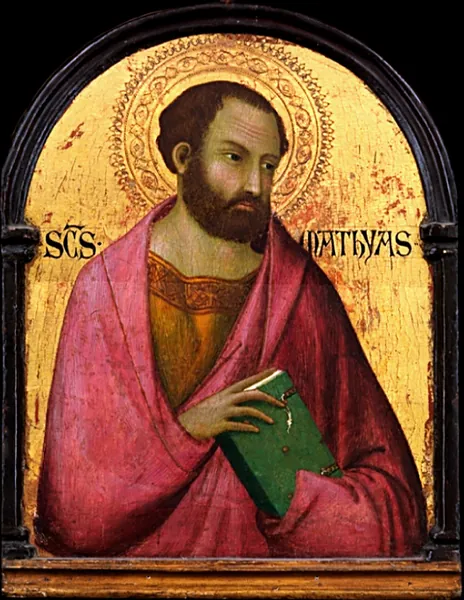
Holy Apostle Matthias (+c. 63)
The holy Apostle Matthias was by descent of the tribe of Judah and was born in the city of Bethlehem. From early childhood he began to study Holy Scripture and the divine Law in Jerusalem, under the guidance of Saint Symeon the God-receiver. From him Matthias learned a pious life: he always lived in a manner pleasing to God and kept the divine commandments exactly, strictly following the path which God had marked out for His righteous faithful…
And then came the day when the Lord Jesus Christ, who had come into the world, thirty years after His birth revealed Himself to the world and began His public ministry for the salvation of men: first He was baptised by John in the river Jordan, then He gathered disciples and began to preach that the Kingdom of heaven was at hand, working at the same time countless miracles and signs.
Together with others Saint Matthias too heard Christ’s teaching and saw His miracles, and he too was filled with boundless love for the Lord: he left his worldly cares and, together with the believing people and the other disciples, followed the Saviour, delighting in the inexpressible joy of beholding the face of God incarnate and hearing His teaching.
The Lord, to whom even the most hidden movements of the human heart are open, chose Matthias from among His disciples and, seeing his burning zeal and purity of soul, prepared him for apostolic service. At first Saint Matthias belonged to the number of the Lord’s seventy holy apostles, who, unlike the Twelve, are called the lesser apostles. Of them it is said in the Gospel: “After these things the Lord appointed other seventy also, and sent them two and two before his face into every city and place, whither he himself would come” (Luke 10:1). After the Lord’s Passion on the Cross, His Resurrection from the dead and His Ascension into heaven, Saint Matthias was numbered among the twelve apostles in place of the Lord’s betrayer, Judas Iscariot. After the latter was cast out of the Twelve, this band of the Lord’s disciples had lost its fullness, for no one had been chosen in place of Judas and the apostles remained eleven. Therefore the chief of the apostles, Saint Peter, addressed the first assembly of Christians in these words: the prophecy of Holy Scripture concerning Judas, the Lord’s betrayer, had to be fulfilled; and in our band, of the twelve apostles, one worthy man must certainly be chosen in place of Judas, one who was always beside the apostles at the time when the Lord was among us. “And they appointed two, Joseph called Barsabas, who was surnamed Justus, and Matthias. And they prayed, and said, Thou, Lord, which knowest the hearts of all men, shew whether of these two thou hast chosen, that he may take part of this ministry and apostleship, from which Judas by transgression fell, that he might go to his own place. And they gave forth their lots; and the lot fell upon Matthias; and he was numbered with the eleven apostles” (Acts 1:23–26), as the twelfth apostle. This choice was soon miraculously confirmed by the Lord Himself through the sending of the Holy Spirit upon the apostles on the fiftieth day after Pascha, for the Spirit of God in the form of tongues of fire rested on Saint Matthias too, together with the other apostles, and bestowed divine grace on him as well.
After the descent of the Holy Spirit the apostles cast lots to decide who should preach the Gospel where, in which country. Judea fell to Matthias by lot, and there he laboured afterwards preaching the word of God: he went round the cities, towns and villages and everywhere proclaimed the salvation of mankind through Jesus Christ. But besides the Jews, Saint Matthias also preached the faith of Christ among the Gentiles. According to church tradition, he preached the word of God to the inhabitants of the second Ethiopia and endured many torments from the pagans there (this means the Ethiopia of Pontus, that is, Colchis): they beat him, dragged him along the ground, hung him on a post and tore his body with sharp irons, burned his flesh with fire, and inflicted many other torments on him. But the holy apostle, strengthened by the Lord, endured these trials bravely and with joy. According to another tradition, Saint Matthias also preached the Gospel in Macedonia, where the wicked pagan Greeks, to test him, made him drink a poison that took away the sight: come, let us see what power thy teaching and the God thou preachest have; let us see how He will help thee. For this poison was very powerful, and everyone who drank it was certainly blinded. But Saint Matthias called on the name of Christ and remained completely unharmed. More than this, by the laying on of hands and calling on the name of the Lord he miraculously healed the people who had been blinded by this poison, and their number exceeded two hundred and fifty. At this the enraged devil, for whom such a destruction of his evil power was unbearable, appeared to the pagans in the form of a youth and ordered them to kill Matthias, saying that this man was destroying the worship of the “gods” (that is, the demons). But when the pagans set out to seize the holy apostle, they could not do it in any way, and for three days they searched for him in vain; then Matthias of his own will went to the pagans who were pursuing him and gave himself up. They bound him and threw him into prison, where on the first night evil spirits appeared to him without ceasing in various forms and gnashed their teeth at him in fury. But on the second night the Lord Himself appeared in the greatest light, encouraged him, freed him from his bonds, opened the prison door for him and led him out to safety. And when day came, the holy apostle again stood before the people and preached the faith of Christ with still greater boldness. Some of the furious pagans, since they did not believe his preaching and raged terribly against the holy apostle for denouncing the idols, wished to kill him on the spot, but suddenly the earth opened and swallowed up those who meant him harm.
Afterwards this apostle of Christ returned again to Judea, the land allotted to him, and converted many of the sons of Israel to the faith of Christ; day after day he preached the word of God to them and confirmed his good tidings with signs and miracles: by calling on the name of Christ he gave sight to the blind, hearing to the deaf, life to the dying; he raised the crippled, healed the lame, cleansed lepers and cast out evil spirits. While calling Moses a holy man and urging the Israelites to keep the law given by God, Saint Matthias at the same time instructed everyone in the faith of Jesus Christ, of whom Moses himself had told them by signs and figures and of whom the prophets of the Old Testament had spoken beforehand, saying that Jesus Christ is the Son of God, sent by God the Father into the world for the salvation of men, incarnate and made man of the Most Holy Ever-Virgin Mary. And he explained to the Jews that all these prophecies about the coming Messiah had already been fulfilled, for this promised Messiah, the anointed Saviour, is our Lord Jesus Christ.
At that time the high priest of the Jews was Ananias, a hater of Christ and a blasphemer of His name; he cruelly persecuted the first Christians in Jerusalem; it was he who ordered the Jews to throw down from the roof of the temple in Jerusalem the holy Apostle James, the brother of the Lord according to the flesh, who was the first bishop of the Christians in Jerusalem. And when Saint Matthias was preaching Christ, the Son of God, in the synagogues of Galilee, the Jews, blinded by unbelief and malice, seized him and took him to Jerusalem, to the high priest mentioned above. The latter convened the Sanhedrin and brought the holy apostle before its tribunal, addressing this evil assembly with these cunning words:
“The whole world and this honourable assembly know what reproach has fallen upon our people, and this has come about not through our fault, but through the perversity of certain men who have gone out from among us, and likewise through the insatiable greed of the Roman governors, because of which our people have suffered greatly. I do not even wish to mention these introducers of new heresies, who have led so many people astray; you know how many of them the Roman soldiers have killed; so perished both the deceivers and the deceived, who brought shame on our nation: Judas of Galilee and Theudas the magician were introducers of heresies of the same kind. With their destruction even the memory of them was wholly rooted out. But among these heretics the most powerful heresiarch was Jesus of Nazareth: he called himself the Son of God and God, amazed many with his sorcerous signs and miracles, drew the hearts of the Jews to himself, and preached the abolition of the divine Law. For this he was justly condemned according to our Law, which he blasphemed. What are we to say of this? Do we not know that God Himself gave the Law to Moses? That the patriarchs kept the Law exactly, and the Prophet Elijah, who was caught up to paradise in a chariot of fire? Who has not heard that a dead man laid on the bones of the Prophet Elisha at once came to life? And even now, in our time, how many miracles have the God-pleasers worked, but not one of them has dared to do what Jesus dared: to claim for himself the honour of God and to introduce a new law! The prophets inspired by God spoke filled with humility, but he (Jesus) proudly spoke his own inventions, and came to such folly that he rebuked the high priests and rulers with reproaches, and called the scribes and Pharisees hypocrites! Has any of our prophets ever done anything like this?! And because of his pride he too met a fitting end, when he received the reward his deeds deserved. Oh, would that his memory had perished and vanished together with him! And would that his teaching had died with him and that no one had brought it to life again! What is especially lamentable is that the temple of God, the holy city and the law of our fathers are still in bondage to the Romans, and no one is seen to pity us or to deliver us from this bondage. We are unjustly dragged before the Roman tribunals, and we endure it! We are led astray, and we give silent consent! We are robbed and stripped of everything, and we do not even raise our voice! And what is most lamentable of all, the Galileans hand us over to the Romans when they shamelessly accuse us and our people of killing Jesus, as though he were innocent!… Better that these few Galileans should perish than that this holy place and the whole people should be wiped out by the hand of the Romans. Of two evils we must choose the lesser, the more bearable and endurable. And this man too, who stands before us today, is one of the disciples of Jesus and fully deserves death! But let him first judge for himself (we will not deny him time to think, for we desire not his destruction but his correction) and choose one of these two things: either to follow and obey the Law which God gave us through Moses, and so preserve his life, or to go on being called a Christian and die for it!..”
In answer to these words of the high priest Matthias raised his hands on high and said:
“Brethren and men of Israel! I do not wish to say much about the charge you have brought against me: to be called a Christian is for me not a crime but a glory! For the Lord Himself tells us by the mouth of His prophet that in those last days, ‘Behold, my servants shall rejoice with gladness, but ye shall cry for sorrow of heart, and shall howl for vexation of spirit; for ye shall leave your house for a surfeit unto my chosen, and the Lord shall slay you; but my servants shall be called by a new name, which shall be blessed upon the earth’ (Isa. 65:14–16).”
To this the high priest answered Saint Matthias:
“Is it not a crime to set the holy Law at naught, not to honour God the Creator, and to listen to empty, groundless tales of sorcery?!”
“If you will hear me,” Matthias replied, “I will explain to you that the teaching we preach is not a groundless invention and sorcery, but the very truth, witnessed and confirmed from of old by the divine Law!”
And when the high priest permitted this, Saint Matthias opened his lips and began to explain the Old Testament figures and prophecies about Jesus Christ: how God gave our forefathers and patriarchs, Abraham, Isaac and Jacob, the promise to raise up from their seed a man in whom all the tribes of the earth would be blessed, of which holy David too, king and prophet, speaks in his psalm: “Let his name be blessed for ever and ever; before the sun his name shall be, and before the moon his throne! In him shall all the tribes of the earth be blessed, and all nations shall call him blessed” (Ps. 71:17); how the bush that was not consumed, which appeared to Moses, prefigured Christ’s incarnation of the Most Holy Virgin (Exod. 3:2); how Isaiah foretold the birth of Jesus of a Virgin: “Behold, a virgin shall conceive, and bear a son, and shall call his name Immanuel,” that is, God is with us (Isa. 7:14). Saint Matthias also told the Jews that Moses too foretold Christ to the Israelites quite clearly when he said: “The Lord thy God will raise up unto thee a Prophet of thy brethren, like unto me; unto him ye shall hearken” (Deut. 18:15); that he too pointed beforehand to the Saviour’s voluntary Passion when he had the brazen serpent lifted up on a pole, of which the Prophet Isaiah also said: “…He was brought as a sheep to the slaughter, and as a lamb before his shearer is dumb, so he openeth not his mouth,” and “…his soul was delivered unto death, and he was numbered with the transgressors; and he bare the sins of many, and was delivered because of their sins” (Isa. 53:7, 12); that the Prophet Jonah too, who was swallowed up for three days in the belly of the whale and afterwards came out of it unharmed, was a figure of the Lord Jesus Christ’s three-day burial and His subsequent Resurrection from the dead.
This lengthy explanation from the books of the Old Testament, which made it plain that they spoke precisely of Jesus Christ, greatly enraged the high priest Ananias, so that he could no longer restrain himself and cried out in wrath to Saint Matthias:
“How darest thou lay hands on the Law?! Dost thou not know the words of Holy Scripture: ‘If there arise among you a prophet, or a dreamer of dreams, and giveth a sign or a wonder of deceit among you, saying, Come, let us go after other gods, which ye have not known, and let us serve them, thou shalt not hearken unto the words of that prophet…, for the Lord your God proveth you… And that prophet, or that dreamer of dreams, shall be put to death’?!”
Saint Matthias answered:
“He of whom I speak is not only a prophet, but the Lord of all the prophets, for He is the true God, the Son of God, as the great miracles He worked clearly declare and bear witness. Therefore I believe in Him and hope to remain unshaken in confessing His all-holy name!”
“If we give thee time to think and to come to thy senses,” asked the high priest Ananias, “wilt thou repent of thy sin?”
“Far be it from me to fall away from the truth!” the holy apostle answered firmly. “For by the grace of God I have already acquired the truth, and I will not give it up for anything! I believe with my whole heart and confess openly that Jesus of Nazareth, whom you rejected and gave up to death, is the Son of God, consubstantial and co-eternal with the Father, and I am His servant!..”
Then the high priest stopped his ears with his fingers and began to shout, gnashing his teeth:
“He blasphemeth! He blasphemeth God! Let him hear the Law!”
At once they opened the book of the Law and read aloud, for all to hear, the place where it is said:
“‘Whosoever curseth his God shall bear his sin. And he that blasphemeth the name of the Lord, he shall surely be put to death, and all the congregation shall certainly stone him’ (Lev. 24:15–17)! Let not your eye pity him, and so you shall put away the evil from the deeds of Israel!”
After these words had been read, the high priest Ananias turned to the holy Apostle Matthias and said:
“Thine own words bear witness against thee! Thy blood be upon thy head!”
The place at Gonio (near Batumi) where, according to some traditions, the holy Apostle Matthias is buried
And he sentenced Saint Matthias to death by stoning, and he was led off at once to be executed. When they came to the place called Bethlascila, which in Hebrew means “the house of the stoned”, Saint Matthias said to the Jews who were there:
“Faithless and hypocrites! Rightly has the holy Prophet David said of men like you: they will hunt the soul of the righteous and condemn innocent blood.”
After these words of the apostle of Christ, two witnesses from among the Jews, as the Law required, laid their hands on his head and testified that Matthias had blasphemed God, the Law and Moses; they also threw the first stones at the holy apostle, and Matthias asked his killers to bury these two first stones with his body, as witnesses and confirmation of his sufferings for Christ. Then the others too began to stone him, and under the stones that came down like hail the holy apostle raised his hands on high and so gave up his blessed soul to the Lord. And the lawless Jews added mockery to this torment: after the martyr had already died, to please the Romans, they cut off Matthias’s head with the sword, as was the Roman custom, as though this holy apostle of Christ had been an opponent of Caesar!...
Thus this holy apostle of the Lord, Matthias, ended his earthly life and his good labours as a martyr (this took place around the year 63). According to some Greek sources, however, Saint Matthias died by crucifixion. But these two accounts may not contradict each other, for the Jews used to stone those bound to posts, and Matthias too may have been bound to a cross and stoned in this way.
According to Saint Epiphanius of Cyprus (IV c.), the Apostle Matthias preached the Gospel in the second Ethiopia (Colchis), died there, and is buried to this day in the fortress of Apsaros (Gonio) near Batumi. That is why the holy Apostle Matthias is depicted together with Saint Andrew the First-called on the icon of the Glory of the Georgian Church.



