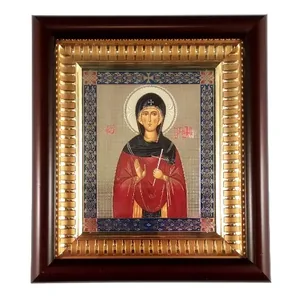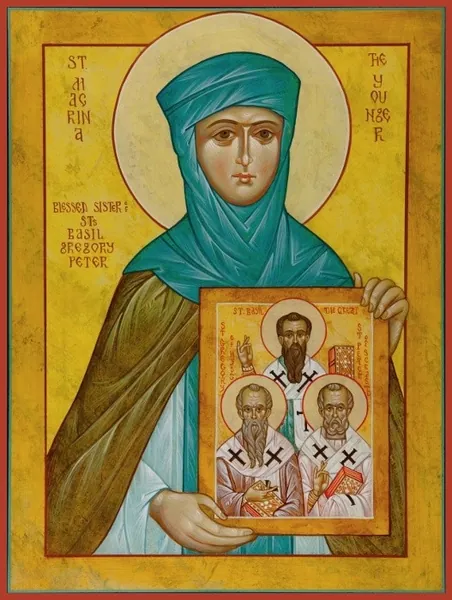
Venerable Macrina, Sister of Basil the Great (+380)
The Venerable Macrina, the sister of the holy hierarchs Basil the Great (commemorated 1 January) and Gregory of Nyssa (commemorated 10 January), was born in Cappadocia at the beginning of the fourth century. Her mother, Saint Emmelia (commemorated 1 January), saw in her sleep an angel of the Lord, who gave the child still in her womb the name of the Protomartyr Thecla. Emmelia fulfilled the Lord’s will and did indeed name her first-born daughter Thecla, but her relatives and friends called her Macrina, in honour of her grandmother, who had been persecuted for confessing Christ in the time of the Emperor Maximian Galerius (305–311).
Her God-fearing mother did not instruct the saint, as was the custom of the time, in ancient Greek mythology and poetry, but taught her passages chosen from the Wisdom of Solomon, the Psalms of David and the other books of Holy Scripture, containing prayers, praise of the Lord and moral teachings. At every hour Macrina offered the appropriate prayers in song; she began and finished no task without prayer, attended the church services morning and evening, and read the divine books; she had also mastered housekeeping and various kinds of handiwork. So there was no time left for childish amusements. The saint was twelve when she was betrothed to a worthy young man, but, by God’s will, the bridegroom died shortly before the wedding. After this the blessed one decided to keep her virginity for ever, though many noble young men asked for her hand.
After her father’s death Macrina faithfully supported her mother: she comforted the widow, ran the household, did every kind of work like the lowest of maidservants, and cared for the upbringing, education and moral perfection of her sisters and brothers. Basil, who had been sent to Athens to study, came home somewhat proud, which troubled Macrina, and she diligently admonished him, urging that every gift and talent is given to us only for the glory of the Lord. His sister’s counsels had a strong effect on Basil; the saint had no less influence on Gregory, who later became Bishop of Nyssa, and likewise on Naucratius, who took up the ascetic life, withdrew into the desert and died young, and on Peter, the youngest (later hierarch of Sebaste).
When Macrina’s sisters had married and her brothers had gone out into their fields of labour, the holy virgin persuaded her mother to renounce the world. Emmelia set free her slaves and maidservants, kept a small amount of property, and went with her daughter to the family estate in Pontus, on the bank of the river Iris, near the place of Basil the Great’s labours. Mother and daughter were followed by some of the maidservants, who would not leave them, and by several pious women. Here they became nuns; they lived modestly, prayed together, worked together, studied Holy Scripture, held everything in common, were in no way distinguished from one another, and zealously obeyed their superior.
Macrina was strict and demanding towards herself and allowed her body no rest. Once a large tumour appeared on the saint’s breast; it gradually grew and might have reached the heart; surgery was needed. But the saint preferred suffering to exposing her body before a physician. The holy virgin asked help of the Lord alone: and God heard her prayer, and she was miraculously healed.
Many other miracles took place through Saint Macrina’s prayers: in time of famine the wheat multiplied, and people were speedily healed of illnesses of soul and body. The saint also had the gift of seeing hidden things and of foresight.
Saint Emmelia died in deep old age. Nine years later the blessed Macrina too was confined to her deathbed. Before her death her brother, Gregory of Nyssa, visited her. The venerable mother lay weakened on the floor, covered with old rags. Her mind was raised to heaven, and a wonderful grace attended her every word… Gregory of Nyssa longed for the day to last a long time, so that the blessedness he felt in talking with his sister would not come to an end.
Quiet and peaceful was Macrina’s repose. Filled with wonderful humility, she besought the Lord: “Remember me, O Lord, in Thy Kingdom, as Thou didst remember the thief who hoped in Thee; forgive me my sins, of deed, of word and of thought,” made the sign of the cross, and commended her soul to the Lord (+380). The sisters’ grief was boundless: all had loved the blessed one like a mother. When Saint Gregory asked whether the departed had any new clothing, the nuns answered that she had kept nothing for the day of her death: “She gave everything to the poor. Here is her old sackcloth; here is her patched cassock and her worn mantle; she had nothing else, but she laid up great treasure in heaven.”