
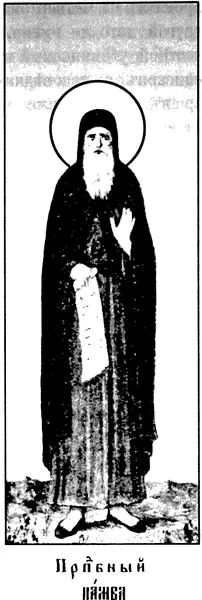
Venerable Pambo the Desert-dweller (IV)
The Venerable Pambo laboured in Egypt, in the Nitrian desert, in the fourth century. Apparently he came from the common people: he received no education in his youth, and when he resolved to renounce the vain life of this world, he asked a monk to help him learn the psalms, since he himself could not read or write. The words of the thirty-eighth psalm, “I said, I will take heed to my ways, that I sin not with my tongue,” so shook the blessed one that from that time on the love of silence became one of the holy father’s chief virtues.
Saint Pambo soon became famous for his holy life. All day long he was occupied with handiwork, weaving mats and baskets. While he worked, his mind was continually occupied with prayer and contemplation of God’s providence, and it was more and more enlightened with divine wisdom. The venerable father received warmly those who wished to receive his counsel, and tried to instil in them mercy and love for their neighbour. The humble ascetic did not trust his own mind. It often happened that he would say to those who came: “I do not yet know the answer to your question,” and would withdraw to pray, and sometimes only several days later would satisfy the wishes of those who had come.
Once Pambo had to stay in a nearby city. Here the blessed one met a sinful woman, richly dressed. At the sight of her the saint wept. “Why art thou weeping, father?” the monks asked him. The ascetic answered: “For two things: one is the ruin of this woman, and the other is myself. I do not take such care to adorn my soul as this woman takes to deck and adorn her body. I do less to please the Lord than she does to please men.”
Shortly before his end the Venerable Pambo was visited by a rich and God-loving Roman woman, Melania, who brought him a generous offering: three hundred pounds of gold. The holy father was weaving a basket. He did not even glance at the money, and only after his guest’s fervent entreaty did he order a disciple standing nearby to distribute this wealth among the monks labouring in Libya and on the islands, since their lands, unlike those of the Egyptians, were barren. “Father,” said Melania, “know that there are three hundred pounds of gold here!” “My child,” the ascetic replied, “nothing is hidden from the Lord… If thou hadst offered this gold to me, then truly thou shouldst have told me the amount as well; but thou art giving it to God, who did not despise even the widow’s two mites, but accepted them as the most precious gift.”
The Venerable Pambo urged lay people to treat with respect the monks, who converse with the Lord more often.
The venerable father spent seventy years in this world. In the words of Poemen the Great (commemorated 27 August), three things were remarkable in his life: constant fasting, silence and handiwork. In spite of his tireless zeal and his ascent to the summit of the spiritual life, before his repose the blessed one said to his disciples: “I go to the Lord as though I had not yet even begun to serve Him.”



