
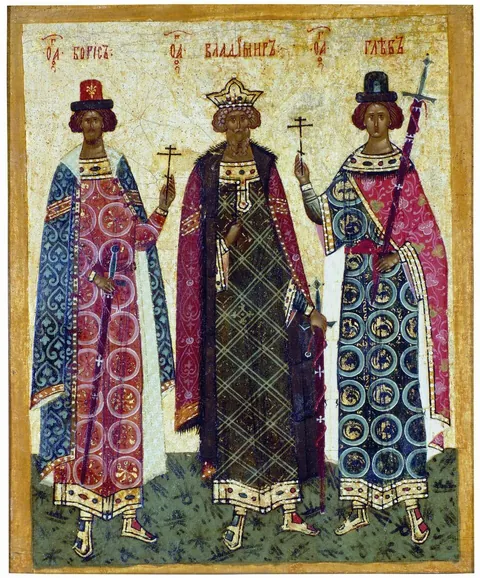
Vladimir, Equal to the Apostles, in Holy Baptism Basil (+1015)
Vladimir, Equal to the Apostles (in holy baptism Basil), was the grandson of the blessed Olga (commemorated 11 July) and the youngest son of Svyatoslav, Prince of Kiev. His mother, Malusha, the captive daughter of an executed Drevlian prince, served before her marriage as Olga’s housekeeper. Angered that the heir to the throne had married a servant, Olga removed her daughter-in-law from the palace and sent her to her own homeland, near Vybuty. It was here that the future enlightener of the country was born, around 960.
Before his baptism Vladimir, a valiant warrior, was distinguished by cruelty and mercilessness. In 978 he seized the principality of Kiev by cunning and put his brother Yaropolk to death. The lawless prince gave full rein to his passions and was, besides, a zealous idol-worshipper: on a high hill near his palace he had a new statue of Perun set up, with a silver head. It was by Vladimir’s order that Theodore the Varangian and his son John were offered as a sacrifice to Perun (the Russian Church keeps their memory on 12 July). But, in the words of the apostle, “where sin abounded, grace did much more abound”: the Lord chose the prince enslaved to evil as His chosen vessel. Vladimir came to doubt the might of the gods made with hands and began to seek the true God.
When the rumour spread that the Russian prince was thinking of changing his faith, preachers of various religions set out to him. A Greek monk made an especially deep impression on the prince.
Prince Vladimir finally decided to be baptised according to the Orthodox rite, but, as a pagan, he considered it humiliating to approach the Byzantines with a request; so a year later he marched against Greece and sent word to the Greek emperors, Basil and Constantine, that if they did not give him their sister Anna in marriage, he would take Constantinople.
For the royal family a marriage alliance with a barbarian was neither lawful nor desirable, but for a country shaken by the revolts of the rebel commanders Bardas Sclerus and Bardas Phocas, war with Vladimir posed so great a danger that Basil and Constantine were forced to yield to Vladimir’s proposal, and as a condition they offered him the acceptance of Christianity. Vladimir answered that he had liked their faith for a long time already, and told them to send the princess.
Soon the Princess Anna arrived in Kherson, accompanied by nobles and clergy; after a great inner struggle, for the love of God and of her people, she had been able to take this step. Here she learned that a few days earlier Vladimir had gone blind; he attributed this to the wrath of the gods and, seized by fear, his desire for baptism had faded. The pious bride sent word to the pagan prince: “Be baptised, and thy eyes of soul and body will be opened!” He followed her advice and summoned the bishop of Kherson. A few days later the solemn baptism took place in the church standing on the city square. The godfather, in absentia, was the Emperor Basil. The newly baptised was given his name. As soon as he came up out of the font, Vladimir’s sight was restored, and, carried away with joy, he cried out: “Now I have come to know the true God!”
Now a Christian, the prince married Anna and returned to Kiev. With him came to Kiev a metropolitan sent from Byzantium, six bishops and clergy. Burning with the love of God, the prince parted from his many wives and persuaded his twelve sons to be baptised. Many boyars followed their example. Then Vladimir called all the inhabitants of the city to baptism: “Whoever does not come to the river tomorrow, rich or poor, commoner or slave, shall be my enemy!” The next day a countless multitude came to the banks. The metropolitan blessed the water of the river and began the baptism… This took place in 988.
After this the prince, Equal to the Apostles, laboured tirelessly to spread the Orthodox faith in the country. The grace of the Holy Spirit completely transformed his nature: the rough and cruel pagan became a God-fearing and merciful Christian. The poor who came to his palace received generous alms. Carts loaded with food for the infirm were sent to the villages and towns; on the great feasts three tables were laid at the prince’s court: for the clergy, for the poor, and for the prince and his retinue. Once his warriors complained that at table they were given wooden spoons and not silver ones. When he heard this, Vladimir, without the least offence, ordered silver spoons to be handed out: “With gold and silver thou canst not win a faithful retinue, but with a faithful retinue thou wilt win both gold and silver!” At such feasts it was the custom to read Holy Scripture: the holy prince cared for the spiritual growth and renewal of his subjects, who loved pagan carousing. In Vladimir’s time, it is said, crimes increased, because, for fear of committing sin, he greatly lightened the punishments. The hierarchs pointed out to the blessed one: “God has appointed princes to punish the evil and to show favour to the good; thou too art bound to punish wrongdoers, but justly and with discernment.”
Sad was the end of the life of the blessed prince, Equal to the Apostles: while still alive he divided the principality among his sons. Strife broke out among them, and outside enemies too besieged the country… and, left completely alone, the prince finished his earthly “course”, likened to the life of the Apostle Paul, on 15 July 1015.
Saint Vladimir’s body was buried beside his wife Anna in the church of the Most Holy Mother of God, which he himself had built on the place of the martyrdom of Theodore and John. In 1635 his incorrupt relics were uncovered.



