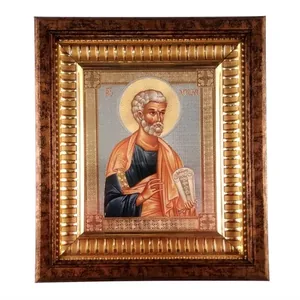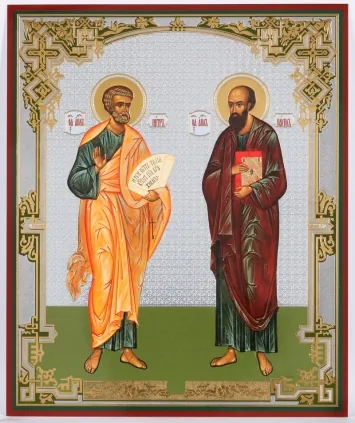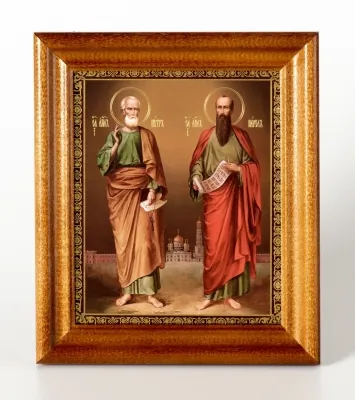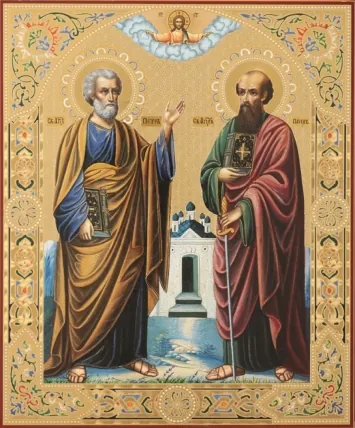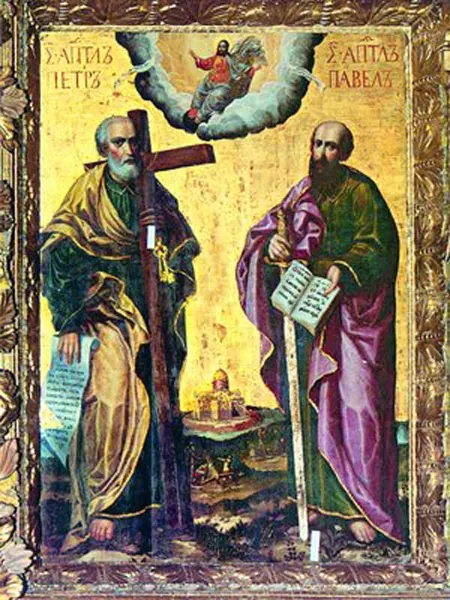
The Holy, Glorious and All-praised Chief Apostles Peter and Paul (+67)
The holy Apostle Peter (Simon) was the son of Jonah, a fisherman of Galilee. His brother, Andrew the First-called, brought him the good news of the appearance of the incarnate Lord and led him to Jesus (John 1:41–42).
Once Peter was fishing on the lake of Gennesaret with James and John. The Lord advised Simon, weary and troubled after a whole night of fruitless fishing, to cast his net into the lake once more. He obeyed the blessing and saw a miracle: “they inclosed a great multitude of fishes: and their net brake.”
Shaken by this wondrous sight, Peter, against the background of great spiritual light, clearly felt his own sinfulness and fell at Christ’s feet: “Depart from me; for I am a sinful man, O Lord.” Jesus answered: “Fear not, Simon; from henceforth thou shalt catch men.” Coming ashore, the Lord’s chosen one, together with the sons of Zebedee, forsook all and followed the Messiah (Luke 5:1–11).
Once Christ asked His disciples: “But whom say ye that I am?” Peter answered: “Thou art the Christ, the Son of the living God.” To this the Lord replied: “Blessed art thou, Simon Barjona: for flesh and blood hath not revealed it unto thee, but my Father which is in heaven. And I say also unto thee, That thou art Peter, and upon this rock I will build my church; and the gates of hell shall not prevail against it. And I will give unto thee the keys of the kingdom of heaven: and whatsoever thou shalt bind on earth shall be bound in heaven: and whatsoever thou shalt loose on earth shall be loosed in heaven” (Matt. 16:15–19). (By these words “the keys” and the power “of binding and loosing” were given to the one universal Church founded on the “chief corner stone”, Christ, and not to one man.) Because of his fiery character and great zeal, Peter often showed human weaknesses as well.
At the Last Passover the incarnate God told His disciples: “All ye shall be offended because of me this night: for it is written, I will smite the shepherd, and the sheep of the flock shall be scattered abroad.” Peter declared: “Though all men shall be offended because of thee, yet will I never be offended.” The Lord answered: “Verily I say unto thee, That this night, before the cock crow, thou shalt deny me thrice” (Matt. 26:31–34).
The Lord, sold for thirty pieces of silver, was indeed seized that same night in the garden of Gethsemane and brought to Caiaphas. The apostles scattered. Only Peter and John followed Christ into the high priest’s court. Those gathered there recognised Peter and said: “This fellow was also with him,” but he swore: “I know not the man.” When he had denied the Saviour for the third time, “immediately the cock crew. And the Lord turned, and looked upon Peter.” The disciple remembered his Teacher’s words; repentance seized him, and he “went out, and wept bitterly.” This feeling of repentance did not leave Peter until the day of his death.
The Lord did not abandon His beloved disciple: after His Resurrection from the dead He appeared on the Sea of Tiberias to Peter, who had gone out fishing with Thomas and Nathanael, and said to him: “Simon, son of Jonas, lovest thou me more than these?” Peter answered: “Yea, Lord; thou knowest that I love thee.” “Feed my sheep,” Christ told him. The Lord repeated the question three times, and three times the holy apostle confessed the Saviour. By this the Teacher showed the disciple that He forgave his faint-heartedness, and by the words “Feed my sheep” He pointed to the labour by which he would be able to please the Lord especially and atone for his fall (John 21:1–23).
From then on Peter became an ardent preacher of the word of God and a faithful shepherd of the rational sheep. On the day of Pentecost his grace-filled words converted three thousand people to the true faith; in Joppa the Lord miraculously showed Peter that He sanctified the Gentiles too, after which the apostle preached among the Gentiles gathered in the house of Cornelius the centurion, witnessed the descent of the Holy Spirit upon them, and enlightened with the grace of baptism those whom God had accepted (Acts 10:1–48). At various times Peter was in Antioch, in Rome, and in the cities of Asia Minor, Egypt, Greece, Spain and Britain; everywhere he sowed the seeds of Christ’s teaching and founded churches. His preaching was accompanied by many miracles: the sick were healed even by Peter’s shadow.
The holy apostle died a martyr in the reign of Nero, the bloody emperor of Rome. The Christians warned Peter beforehand of the danger that awaited him and begged him to leave Rome. He yielded to their entreaties, but as he was leaving the city he saw Christ “coming into Rome.” Peter asked: “Lord, whither goest thou?” The Saviour answered: “I go into Rome to be crucified.” The apostle was astonished: “Art Thou crucified again, my Lord?” When he came to himself from his amazement, the Lord was already ascending into heaven. Peter took this vision as a sign that “his hour was come,” and turned back.
The tormentors resolved to crucify the saint. Peter asked: “This I beseech you, men of the people: crucify me thus, head downward, and not otherwise, that I may not be like my Lord.”
Nailed to the cross head downward, the Lord’s chosen one did not cease preaching until he gave up his spirit.
The saint’s body was taken down by his disciple Mark, who washed it with milk and wine, anointed it with fragrant ointments, laid it in a marble coffin filled with choice honey, and buried it in his own tomb (at that time the custom of preparing one’s own tomb in advance was very widespread).
The Apostle Peter left us two epistles, which are included among the books of the New Testament. The Gospel of Peter’s disciple Mark was also approved and blessed by him.
The holy Apostle Paul was an Israelite of the tribe of Benjamin, by law a Pharisee. He was born in Tarsus, a city of Cilicia, and was a Roman citizen; before his calling as an apostle his name was Saul. He mastered the secular sciences in his native city, and then, to study the Law better, went to Jerusalem to Gamaliel, the celebrated rabbi of the time. The perceptive young man was thoroughly instructed in the Law of Moses and, as a Pharisee, became its strict observer.
Saul hated the Christians so much that he “made havock of the church, entering into every house, and haling men and women committed them to prison” (Acts 8:3).
Because of the persecution raised in Jerusalem, the Christians fled to various places in Palestine. Many took refuge in Damascus. Full of wrath, Saul asked the high priest for permission to take Christians captive and set out for Damascus, so that whether they were “men or women, he might bring them bound unto Jerusalem” (Acts 9:2). As he drew near to Damascus, Saul saw a light coming down from heaven; stunned and frightened by the heavenly vision, Saul “fell to the earth, and heard a voice saying unto him, Saul, Saul, why persecutest thou me?” To the question “Who art thou, Lord?” there came from the light: “I am Jesus whom thou persecutest” (Acts 9:3–5). Jesus commanded Saul to go into the city, where the rest would be revealed to him. Saul got up, but he could no longer walk by himself: he could see nothing. His astonished companions led Saul into Damascus. Three days later, by the Lord’s blessing, Ananias, a disciple of the apostles, baptised Saul, and his sight was restored to him.
After this the former Pharisee and cruel persecutor of the Christians became a firm confessor and a chosen apostle of the Lord. After his baptism he went to Arabia, where, according to tradition, for three years the Saviour Himself appeared to him, taught him the Law and prepared him to preach Christianity. From Arabia Saint Paul went to Jerusalem to the Apostles Peter, James and John, and from there to the city of Tarsus, where with the Apostle Barnabas he spent a whole year setting the affairs of the Church in order.
At the command of the Holy Spirit the Apostle Paul, accompanied by Mark and Barnabas, set out to preach the law of Christ among the Gentiles. He went through Seleucia and the island of Cyprus. The truth of the law he preached was confirmed by many miracles. This was the first journey of the holy Apostle Paul. After this, accompanied by Luke and Silas, he set out again to spread the teaching of Christ. He passed through Syria, Cilicia and Lycaonia, crossed over into Europe too, to Macedonia, and was in Greece as well. Paul lived for a year and a half in Corinth, and then turned back, stopping on the way at Ephesus and Caesarea. After a short rest the holy apostle set out to preach a third time: he founded new churches and strengthened the old ones. This journey of the holy apostle was his last. None of Christ’s disciples endured so many sufferings, torments and afflictions as this chosen vessel of the Lord. He himself writes: “Of the Jews five times received I forty stripes save one. Thrice was I beaten with rods, once was I stoned, thrice I suffered shipwreck, a night and a day I have been in the deep; in journeyings often, in perils of waters, in perils of robbers, in perils by mine own countrymen, in perils by the heathen, in perils in the city, in perils in the wilderness, in perils in the sea, in perils among false brethren” (2 Cor. 11:24–26).
Burdened with pains and trials, Paul by God’s will was made worthy, while still in this world, of an indescribable blessedness as well: he was caught up to the third heaven, tasted the sweetness of paradise, “and heard unspeakable words, which it is not lawful for a man to utter” (2 Cor. 12:2–4).
The tormentors seized the God-pleasing apostle in Caesarea, and from there sent him to Rome, where in 67, by order of the Emperor Nero, he was beheaded: “Saint Paul stretched out his neck to the swordsmen with joy. And as the swordsman cut off his head, straightway by the grace of God milk flowed out instead of blood from the neck of Saint Paul.” Those who witnessed this miracle glorified the Lord. In Rome to this day they show the place where the holy apostle was put to death.
The Apostle Paul left us fourteen epistles, which are included among the books of the New Testament. Luke too, the author of one of the Gospels and of the Acts of the Apostles, was his disciple.
The God-pleasers Peter and Paul were so distinguished among Christ’s other disciples by their labours that the Church called the saints the chief apostles and appointed one day for their commemoration.