
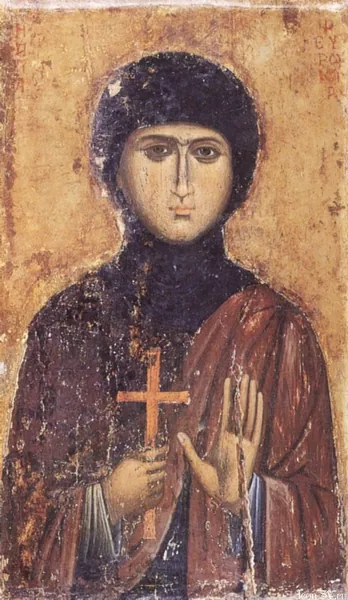
Venerable Martyr Febronia the Virgin (c. 304)
The Venerable Martyr Febronia the Virgin shone forth by her martyr’s end in the reign of Diocletian (284–305). She was brought up in a monastery in the city of Sibapolis (in the region of Assyria), whose superior was the abbess Bryaena, Saint Febronia’s aunt. Caring for her salvation, the abbess laid down for her niece a stricter rule than for the other nuns. According to the rule of the monastery, on Fridays the sisters set aside their obediences and spent the time in prayer and the reading of Holy Scripture. Usually the superior entrusted the reading to Saint Febronia.
When word of the blessed virgin’s pious life spread through the city, a noble pagan widow, Hieria, began to visit her. Febronia showed the troubled young woman the way of salvation, after which she was baptised and brought her parents and relatives too to the light of Christ.
The ferocious Diocletian sent a detachment of soldiers under the command of Lysimachus, Selenus and Primus to wipe out the Christians in Assyria. Selenus, Lysimachus’s uncle, was distinguished by a furious hatred of the Orthodox, while Lysimachus himself, brought up by a God-loving mother, sympathised with them. The prudent commander agreed with his kinsman Primus to protect the Christians as far as they could from the violence of the tormentors. When the detachment drew near to the monastery, the nuns went into hiding. Only the abbess Bryaena, her assistant Thomais, and Saint Febronia, who was gravely ill, remained in the monastery. The abbess was deeply distressed that her niece was falling into the hands of the godless, and fervently besought the Lord to protect her and strengthen her in the Christian faith. Selenus ordered all the nuns to be brought to him, but Primus and the soldiers found no one in the monastery except the two aged mothers and Saint Febronia. Even the sight of them grieved him greatly, and he urged the nuns to leave the monastery. The sisters would not leave the place of their labours.
Primus described Saint Febronia’s wonderful beauty to Lysimachus and advised him to take her as his wife. But Lysimachus answered that he did not wish to tempt virgins betrothed to Christ, and asked him to hide the remaining nuns somewhere so that they would not fall into Selenus’s hands. One of the soldiers overheard this conversation and carried the news to Selenus. Saint Febronia, with her hands bound and a chain on her neck, was brought to the lawless commander. He urged the virgin to offer sacrifice to the pagan gods, promising her in return honour, rewards and marriage to Lysimachus. The blessed mother answered firmly that she had an eternal Bridegroom and would not exchange Him for any earthly good. For this Selenus tortured her terribly. The saint prayed fervently: “My Saviour, forsake me not in the hour of this terrible trial!” The martyr was beaten for a long time; blood streamed from her wounds. To intensify Saint Febronia’s sufferings, they hung her on a tree and lit a fire beneath her. The torture was so unbearable that the people cried out, demanding that it be stopped. But Selenus went on mocking and deriding the lamb of Christ. Febronia was silent. In her exhaustion she could not even utter a word. The enraged tormentor ordered her tongue to be torn out, her teeth knocked out, her breasts cut off, and her hands and feet cut off. The onlookers could not bear this dreadful sight and left the place cursing Diocletian and his gods.
In the crowd stood the nun Thomais, who afterwards described Febronia’s martyrdom in detail, and the holy virgin’s disciple Hieria. At last the holy martyr was beheaded.
In 363 the saint’s incorrupt relics were translated to Constantinople.



