
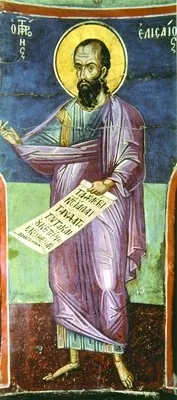
Prophet Elisha (IX c. BC)
The Prophet Elisha was the disciple and successor of the Prophet Elijah the Tishbite. God called him to His service while he was still young. He grew up in the family of Shaphat, a farmer. Once Elijah came up to Elisha as he was working in the field and cast his mantle over him, which signified his calling to be a prophet. Elisha at once slaughtered two oxen and held a farewell meal. This act symbolically signified the breaking of worldly ties for the sake of the highest service of God. After this he followed Elijah and ministered to him.
When the time came for Elijah to be taken up to heaven, the prophet folded his mantle, struck the Jordan with it, and when the water parted he went across with his disciple. Elijah promised to fulfil Elisha’s last wish, and he asked this: “Let a double portion of thy spirit be upon me.” His teacher answered: “Thou hast asked a hard thing: nevertheless, if thou see me when I am taken from thee, it shall be so unto thee; but if not, it shall not be so.” As they were talking, “there appeared a chariot of fire, and horses of fire, and parted them both asunder; and Elijah went up by a whirlwind into heaven.” Elisha cried: “My father, my father, the chariot of Israel, and the horsemen thereof!” (4 Kings 2:9–12). The prophet taken up to heaven threw down his mantle to his disciple. He struck the Jordan with it, “and the water did not part.” He struck it a second time, “and the waters parted hither and thither, and he went over on dry ground.”
The Prophet Elisha laboured for more than sixty-five years in the time of the kings of Israel Ahab and Josiah. He fearlessly denounced their lawlessness and their leaning towards idol-worship. In the time of Elisha’s ministry schools of faith and learning multiplied in Israel. In these schools young men were trained under the guidance of prophets chosen by God and made wise by the experience of life; these are the young men mentioned in Holy Scripture as “the sons of the prophets”. In Jericho Elisha worked a miracle: with salt he made harmless the water that caused barrenness and death. From Jericho Elisha set out for Bethel. As he came near the city, children met him on the road and began to mock him. A terrible punishment befell the wicked children: forty-two of them were torn apart by two bears that came out of the forest. After this the prophet went towards Mount Carmel, and from there returned to Samaria.
When Jehoram, king of Israel, Jehoshaphat, king of the Jews, and the king of the Edomites gathered to fight against the Moabites, the Prophet Elisha too was with the allied army. Because of the hardship of the march through the desert and the lack of water the army found itself in a very grave situation. The prophet worked another miracle: he supplied the army and the cattle with water that sprang miraculously from the earth.
Among the miracles worked by Elisha, the miraculous multiplication of oil for a widow is also notable. On Elisha’s advice the widow, who was harassed by creditors threatening to sell her children as slaves if she did not pay her debt, filled the empty vessels she had borrowed from her neighbours from her own vessel of oil. The oil thus multiplied proved so plentiful that the widow both paid her debts and fed her children. After this the prophet went to the city of Shunem of the tribe of Issachar, where a devout woman received him into her house. The woman set aside a room in her house for Elisha, which he could use as he wished. Elisha’s hosts were childless, which among the Hebrews was considered the heaviest punishment sent by God. According to the prophet’s word, the woman and her husband had a son. Once, at harvest time, the boy went to his father in the field and suddenly felt a pain in his head. When he was brought to his mother, he died on her lap. The woman herself went to the prophet on Mount Carmel. Elisha saw her from afar and told his servant Gehazi to go and meet her and greet her: “Is it well with thee? is it well with thy husband? is it well with the child?” (4 Kings 4:26). These words of Elisha show that the prophets did not see everything, but only what the Holy Spirit revealed to them. The prophet went with the woman, and after his fervent prayer life returned to the boy. This was a village near the river Jordan, where he stopped very often. The prophet’s disciples often came here. They gathered with Elisha to hear his teaching and counsel. At one such gathering, when there was famine in Gilgal, the prophet told his servant to prepare a pottage of fruit. The servant went out into the field, gathered wild gourds there and put them in the pot. When the disciples tasted the food made from these fruits, they noticed that there was poison in the pot and cried out in fear: “O thou man of God, there is death in the pot” (4 Kings 4:40). At Elisha’s command meal was thrown into the pot, and no one was poisoned. To this time also belongs Elisha’s feeding of a hundred men with twenty loaves.
Elisha also miraculously healed Naaman, the commander of the king of Assyria, of leprosy. All the means the commander had tried to be healed of this disease proved useless. At last a servant, a captive Israelite girl, advised him to go to Samaria. Naaman asked the king for permission to go to Israel. The king agreed, and sent with him a letter to the king of Israel asking that his commander be healed. The king of Israel, who had no gift of healing, took so strange a request as a pretext for war. He tore his clothes, which among the Hebrews was an outward sign of mourning, and said: “Am I God, to kill and to make alive? Wherefore consider, I pray you, and see how he seeketh a quarrel against me” (4 Kings 5:7). When Elisha heard of this, he ordered Naaman to be brought. The commander came with his chariots to the prophet’s house. Elisha sent word to him by his servant: “Go and wash in Jordan seven times, and thy flesh shall come again to thee, and thou shalt be clean” (4 Kings 5:10). The prophet’s manner and the simplicity of the cure angered the Assyrian noble, and he decided to go back. Nevertheless, on the advice of his servants, he did what Elisha had said, washed seven times in the Jordan, and was healed. Amazed by the miracle, Naaman offered the prophet gifts, but Elisha accepted nothing. Gehazi, however, made use of his name and asked Naaman for two talents of silver and two splendid garments, for which he was severely punished: Naaman’s leprosy passed to him.
When there was war between the Assyrians and the Israelites, the prophet gave the king of Israel information about the enemy’s cunning plans. The enraged king of Assyria sent a whole army to seize Elisha. The heavenly host, which had been sent with chariots and horses of fire to encourage the prophet, was seen by one of his disciples too. Here Elisha worked another miracle. The soldiers sent to seize him were suddenly struck blind; but when they had been brought to Samaria, to the king of Israel, Elisha by prayer opened their eyes again and sent them back to their king.
After this King Ben-hadad besieged Samaria and brought the city to the utmost extremity of famine. King Jehoram saw the cause in Elisha and sent soldiers to seize the prophet, and then came to him himself. Elisha promised the king, in the name of God, that the famine would end the next day. And indeed, that very day the enemy, struck with sudden fear, raised the siege and fled, while the king’s noble who had not believed Elisha, according to the prophet’s words, “Behold, thou shalt see it with thine eyes, but shalt not eat thereof” (4 Kings 7:2), was trampled by the people at the city gate.
To the Shunammite woman whose son he had raised from the dead Elisha foretold a coming famine and advised her to take refuge for that time in the land of the Philistines. Her temporary move to a neighbouring country resulted in the Shunammite’s house and lands passing into the possession of another owner. The woman was forced to go to the king to complain. At that time people were telling the king about the prophet’s miracles. King Jehoram, no doubt softened by this conversation, listened attentively to the woman and granted her request. At that time Ben-hadad, king of Assyria, fell gravely ill. As soon as the king learned of the prophet’s arrival, he at once sent Hazael to him. Elisha foretold to Hazael that the king would soon die and that he himself would become king, but forbade him to tell Ben-hadad this.
The Prophet Elisha died in deep old age, at about a hundred years. His tomb, in the opinion of blessed Jerome, was near Samaria. The miracles the prophet worked were not confined to his earthly life. A year after his death people were carrying a dead man for burial near Elisha’s tomb. At that moment a band of Moabites appeared. The people took fright and laid the dead man in the nearest cave, the very cave in which the prophet was buried. At the touch of Elisha’s bones the dead man came to life. By this miracle the Lord glorified His faithful servant even after his death.



