
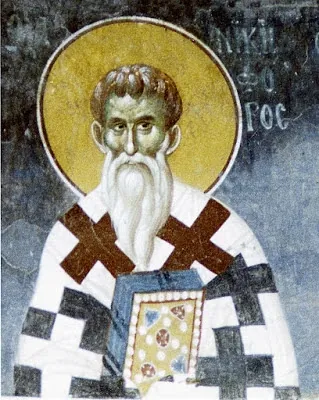
St Nicephorus, Archbishop of Constantinople (+828)
Saint Nicephorus the Confessor, Patriarch of Constantinople (+828), was born in the second half of the eighth century. For confessing Christ his parents endured much persecution and oppression from the iconoclast Emperor Constantine Copronymus (740–775). Saint Nicephorus received a good secular education, but studied Holy Scripture most deeply of all. He loved very much to read spiritual books.
In the time of Leo IV (775–780) Nicephorus became a counsellor of the king. While serving at court he continued to lead a sober, pious life, kept the Orthodox faith undefiled, and ardently defended the rule of the veneration of icons. In 787, after the death of Leo IV, in the reign of Constantine VI (780–797) and his mother, Saint Irene, the Seventh Ecumenical Council was held in Nicaea, which condemned the iconoclast heresy. The deeply learned Nicephorus spoke at the council in the name of the emperor and defended Orthodoxy.
After this Nicephorus stayed at court for some years more, but the life full of vanity became more and more unbearable to him. At last, filled with the love of God, he gave up serving the powerful of this world and withdrew to the shore of the Bosporus, where he spent his time in silence, fasting and prayer. Through his labours several churches were built and a monastery founded.
In the reign of the Emperor Nicephorus I (802–811), after the death of the holy patriarch (784–806), Saint Nicephorus was chosen to steer the Church. He was first tonsured a monk, then ordained priest, and at last, on 12 April 806, on the radiant feast of Pascha, he was enthroned on the patriarchal throne.
In the reign of the iconoclast emperor Leo V the Armenian (813–820) the persecution of Christians began again. The emperor recalled from exile the bishops and clergy excommunicated by the Seventh Ecumenical Council, convened a heretical council made up of them, and summoned the patriarch to debate questions of faith. Saint Nicephorus refused to take counsel with the heretics, for the iconoclast heresy had already been anathematised. Nicephorus was first sent to a monastery in Chrysopolis, and then exiled to the island of Proconnesus in the Sea of Marmara, where thirteen years later he died, tormented and oppressed.
On 13 March 847 the incorrupt relics of the holy patriarch were translated with honour to Constantinople, to the church of Saint Sophia.



