
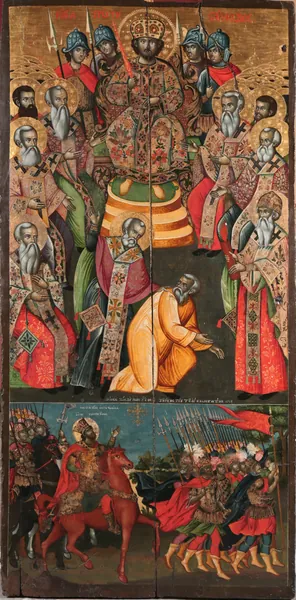
Commemoration of the First Ecumenical Council, Held at Nicaea (325)
Commemoration of the First Ecumenical Council, held at Nicaea (325). The Church has celebrated the memory of this council since the most ancient times. The Lord Jesus Christ gave us a very great promise: “I will build my church; and the gates of hell shall not prevail against it” (Matt. 16:18). In this promise it is prophetically announced that, although the Church of Christ would have to endure many battles, victory would always be on her side.
From the fourth century the persecution of Christians ceased, but within the Church itself heresies arose, the most dangerous of which was Arianism. Arius, a presbyter of Alexandria, an extremely proud and ambitious man, denied the divinity of Jesus Christ and His equality with God the Father. A local council convened at the request of Alexander, Patriarch of Alexandria, condemned the false teaching of Arius, but the heretic did not submit to the council’s decision and went on spreading his ruinous teaching throughout the East. To put an end to the unrest that had arisen, the holy Emperor Constantine, Equal to the Apostles (commemorated 21 May), asked Hosius of Cordoba to explain to him the essence of Arianism. When the emperor was convinced that the false teaching was directed against the chief dogma of Christianity, he decided to convene an ecumenical council. At his invitation 318 bishops, representatives of the whole Christian world, gathered at Nicaea in 325. Among those gathered were confessors who had endured terrible torments during the persecution of Christians: Paphnutius of the Thebaid, Potamon of Heraclea, Paul, Bishop of Mesopotamia. The pillars of the Church were also present at the council: Saint Nicholas the Wonderworker, Archbishop of Myra in Lycia (commemorated 6 December and 9 May), Saint Spyridon of Trimythous (commemorated 12 December), and others.
Alexander, Patriarch of Alexandria, came with the deacon Athanasius, who later became Patriarch of Alexandria and for his labours in defence of Orthodoxy was called “the Great”. The holy emperor, Equal to the Apostles, was present at the sessions of the council. In reply to the greeting of Eusebius of Caesarea he said: “With God’s help I have overthrown the power of the persecutors, but heavier to me than any war or bloodshed is the strife that has broken out within the bosom of the Church of Christ.”
The council condemned the heresy of Arius and excommunicated the false teacher himself. Saint Athanasius the Great, in his speech, finally demolished the blasphemous ideas of Arius. The council confirmed the Symbol of the Orthodox faith, in which the holy fathers set out the teaching on the divine nature of the second Person of the Trinity, Jesus Christ.
Having settled the main dogmatic question, the council confirmed canons of church government and discipline. It was also decided that the feast of Pascha should be celebrated after the Jewish Passover, on the Sunday following the full moon.



