
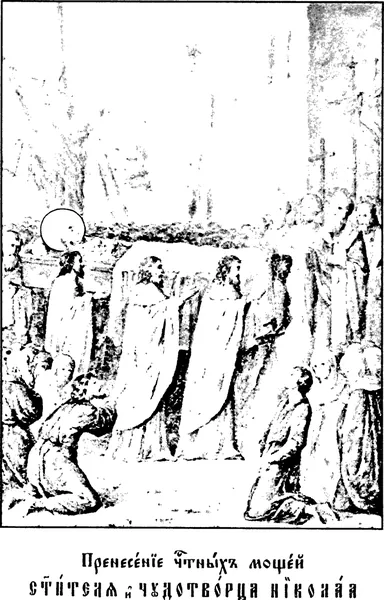
Translation of the Precious Relics of St Nicholas the Wonderworker from Myra to the City of Bari (1087)
Saint Nicholas was born in the city of Patara in the region of Lycia (on the peninsula of Asia Minor), into a well-to-do family. His God-fearing parents besought the Lord for a long time to grant them a child. God heard the prayer of Theophanes and Nonna and gave them a son, whom they named Nicholas.
While still young Saint Nicholas became deeply learned in Holy Scripture. The Bishop of Patara made the God-fearing youth a reader, and later ordained him priest.
Saint Nicholas’s life was marked by many miracles. For his faith he endured persecution and imprisonment too.
In 325 he took part in the First Council of Nicaea, at which the Symbol of Faith, the Creed, was adopted. Together with the other 318 holy fathers of the council he denounced uncompromisingly the false teaching of Arius, then widely spread.
Saint Nicholas departed to the Lord in deep old age. His holy relics were long kept incorrupt in the local cathedral church.
In the eleventh century a hard time came upon the Greek Empire. The Turks laid waste its possessions in Asia Minor, plundered its towns and villages, slaughtered the inhabitants, and desecrated the holy churches, the relics of the saints, the icons and the books. The Muslims tried to destroy the relics of Nicholas the Wonderworker, honoured by the Christians, as well.
The Caliph Harun al-Rashid sent Humeid, commander of a raiding fleet, to plunder the island of Rhodes. From this island Humeid then went to Myra in Lycia intending to sack the tomb of Saint Nicholas, but by mistake broke open the tomb beside it. As soon as the blasphemers boarded their ships, a terrible storm arose and all the ships sank.
The desecration of the holy things outraged not only Eastern but Western Christians too. The inhabitants of the city of Bari, on the shore of the Adriatic Sea, decided to rescue the saint’s holy relics.
In 1087 merchants of Bari and Venice set out for Antioch to trade. They wished on their way back to carry the saint’s remains to Italy. The men of Bari were the first to reach Myra. Two men sent ahead brought word that the city was quiet, and that in the church where the great holy thing lay only four monks were praying. Forty-seven armed men went to the church of Saint Nicholas. The monks suspected nothing and calmly showed the travellers the platform under which the sarcophagus of Saint Nicholas was hidden. One of the monks told the newcomers of a revelation that had taken place in those days. Saint Nicholas had appeared to one monk and urged him to guard his holy relics more carefully. The merchants told the monks of their decision and offered them three hundred gold coins as ransom. The guardians refused the money and ran to warn their fellow citizens, but the visitors caught them at the door, bound them, and broke up the platform under which the tomb lay. A young man, Matthew, worked with particular zeal. In his impatience he broke the lid of the coffin, and the men of Bari saw that the sarcophagus was full of fragrant myrrh. The priests Lupus and Drogo served a litia. Matthew took the holy relics out of the myrrh-filled sarcophagus. This happened on 20 April 1087.
The priest Drogo wrapped the saint’s relics in a cloak and reverently carried them onto the ship. The monks, freed from their bonds, told the city the sad news; the people poured down to the shore, but it was too late.
On 8 May the ship reached the city of Bari. The next day, 9 May, the myrrh-flowing relics of Saint Nicholas were solemnly carried into the church of Saint Stephen. During the translation of the relics many miraculous healings took place. A year later a church dedicated to Saint Nicholas was built, which was consecrated by Pope Urban II.



