
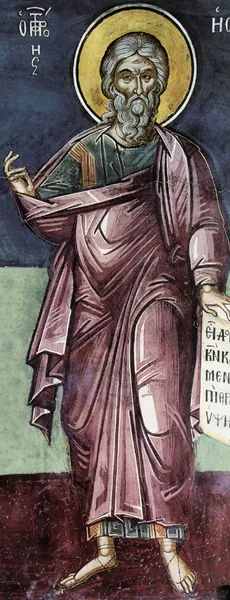
Prophet Isaiah (VIII c. BC)
The Prophet Isaiah (VIII c. BC) was descended from the royal line. His father Amoz brought up his son in the fear of God and faithfulness to the Law. On coming of age Isaiah married a pious woman (Is. 8:3) and had a son (Is. 8:18).
Isaiah began his prophetic ministry in 759 before the Nativity of Christ, in the reign of Uzziah.
The Lord called Isaiah by a special miraculous vision. Isaiah saw the Lord “sitting upon a throne, high and lifted up, and the house was full of His glory.” Around the Lord stood six-winged seraphim, who sang: “Holy, holy, holy, is the Lord of Sabaoth: the whole earth is full of His glory.” This glorious sight made him say: “Woe is me! for I am undone; because I am a man of unclean lips, and I dwell in the midst of a people of unclean lips: for mine eyes have seen the King, the Lord of Sabaoth.” Then one of the seraphim took a live coal with tongs from the heavenly altar, touched his lips with it, and said to him: “Lo, this hath touched thy lips; and thine iniquity is taken away, and thy sin purged.” After this he heard the voice of God: “Whom shall I send, and who will go to this people?” Isaiah answered: “Here am I; send me.” The Lord sent the prophet to denounce and to call the Jews to leave their idol-worship and depravity and to put on repentance. To the repentant the Lord promised mercy and forgiveness of sins, while punishment and the wrath of God awaited the disobedient. The idol-worshipping King Ahaz did not like Isaiah, who denounced his lawlessness. But King Hezekiah treated the holy prophet with love and honoured him. Through Isaiah’s prayer King Hezekiah was healed of his sickness, and through his prayer too an angel slew the enemy army that had come up to the walls of Jerusalem.
Isaiah foretold the carrying away of the Jews into captivity in Babylon and their return by King Cyrus, and the destruction and restoration of Jerusalem and of Solomon’s temple. Besides this, he foretold the future of the peoples neighbouring the Jews.
Especially remarkable are Isaiah’s prophecies about the Messiah: “Behold, a virgin shall conceive, and bear a son, and shall call his name Immanuel” (7:14); that He would be perfect God and man: “For unto us a child is born, unto us a son is given: and his name shall be called the mighty God and Ruler, the Prince of Peace” (9:6); that the Spirit of God would rest upon Him: “And there shall come forth a rod out of the stem of Jesse, and a Branch shall grow out of his roots: and the Spirit of God shall rest upon him” (11:1–2); that He would work miracles: “Strengthen ye the weak hands, and confirm the feeble knees. Be comforted, fear not: behold our God. He will come and save us. Then shall the lame man leap, and the tongue of the dumb shall speak plainly” (35:3–6); “The dead shall arise, and they that are in the tombs shall be raised up, and they that are in the earth shall rejoice” (26:19); that He would suffer and die for the sins of men and rise from the dead: “He is brought as a sheep to the slaughter, and as a lamb before her shearers is dumb, so he openeth not his mouth.” “And he was numbered with the transgressors; and he bare the sin of many, and was delivered up because of their iniquities.” For the precision and clarity of his prophecies Isaiah is called the evangelist of the Old Testament.
The Prophet Isaiah also had the gift of wonderworking: during the siege of Jerusalem, through his prayer a spring came forth from Mount Zion, which was called Siloam, that is, “sent by God”. With the water of this spring the Saviour healed the man born blind.
According to tradition, the idol-worshipping King Manasseh wished to kill him and ordered him to be seized. Isaiah hid in the hollow of a tree, but his tormentors found him, began to saw the tree, and sawed the prophet in half together with the tree. Isaiah was buried by the pool of Siloam. Later the Emperor Theodosius the Younger translated his relics to Constantinople. Today a portion of the head of Saint Isaiah is kept on Athos, in the monastery of Hilandar.



