
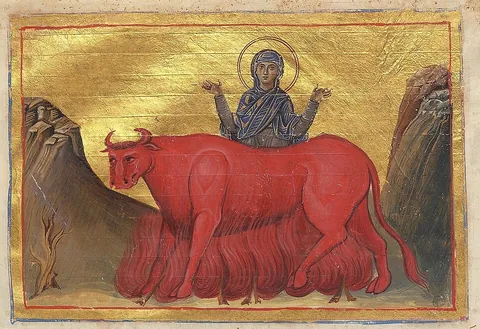
Holy Virgin Martyr Pelagia of Tarsus (+c. 290)
The holy Virgin Martyr Pelagia of Tarsus (+c. 290) was the daughter of pagan nobles. When she heard the preaching about Jesus Christ, she believed in the true God and took a vow of virginity. The heir of the Emperor Diocletian, his adopted son, saw the virgin, was captivated by her beauty, and decided to marry her. The holy virgin told the young man that she was betrothed to an immortal Bridegroom, the Son of God, and refused an earthly marriage. Pelagia’s answer angered the emperor’s heir, but he decided to do the virgin no harm. Saint Pelagia asked her mother to let her go to her nurse, while in her heart she was thinking of seeking out Clinon, Bishop of Tarsus, who had taken refuge in the mountains because of the persecution of Christians, and receiving baptism. The bishop appeared to Saint Pelagia in her sleep, and the virgin remembered his face exactly. Once, at her mother’s command, the holy virgin went to her nurse in a rich carriage with a large retinue. By God’s will Bishop Clinon came out to meet her. Pelagia recognised him at once, fell at his feet, and asked to be baptised. Through the bishop’s prayer a spring gushed out of the ground. Clinon baptised Saint Pelagia. As the Mystery was performed, angels covered God’s chosen one with a garment of light. After she had received Holy Communion, the bishop prayed with Saint Pelagia and dismissed her. Returning to the servants waiting on the road, Pelagia preached the Saviour to them and converted many of them to the law of Christ. The holy virgin wanted to warm her mother too with the grace of the Gospel, but the enraged woman told the emperor’s adopted son that Pelagia was a Christian and did not want to marry him. The young man understood that Pelagia was lost to him; he did not wish to see her coming tortures, and fell on his own sword. Pelagia’s mother, fearing the emperor’s wrath, bound her daughter and brought her to Diocletian as a Christian and as guilty of the death of his son. The emperor was captivated by the girl’s beauty and with a thousand promises tried to turn her to paganism. The holy virgin rejected the emperor’s offer and answered: I will not do thy bidding, for I have a heavenly Bridegroom, Christ; I do not want a vain crown, for the Lord has prepared three crowns for me in the Kingdom: for faith, for virginity and for martyrdom. Diocletian ordered Pelagia to be thrown into a red-hot bronze bull. The holy virgin did not let the executioners touch her; she made the sign of the cross and herself entered the glowing furnace. In the fire her body melted like wax and filled the whole city with fragrance, while her bones were preserved unharmed. The pagans threw the holy relics out of the city. Lions that came out of the desert guarded them until Bishop Clinon came. The hierarch gathered the bones and buried them with honour. In the time of the Emperor Constantine (306–337), when the persecution of Christians had ceased, a church was built over the tomb of Saint Pelagia.



