
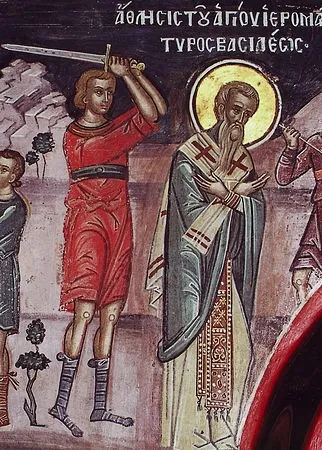
Hieromartyr Basil, Bishop of Amasea, and the Righteous Virgin Glaphyra (+c. 322)
The holy Hieromartyr Basil, Bishop of Amasea (+c. 322), and the righteous Virgin Glaphyra (+322). Basil, Bishop of Amasea, lived at the beginning of the fourth century in Amasea of Pontus. He sympathised with and stood by the Christians persecuted by the pagans. At that time the East of the Roman Empire was ruled by Licinius (312–324), brother-in-law of the holy Constantine the Great, Equal to the Apostles (306–337; commemorated 21 May). Licinius hypocritically signed the Edict of Milan (313), which granted Christians freedom to confess their faith, but in reality he hated the Christians and went on persecuting them.
Licinius was seized with passion for the righteous Virgin Glaphyra, a servant of his wife Constantia. The holy virgin told the empress of this and asked for her protection. The empress dressed the virgin in men’s clothing, gave her money, and had her smuggled out of the city with a faithful servant. On her way to Armenia Glaphyra stopped in Amasea, where the local bishop Basil gave her shelter.
The bishop was building a church in the city. The righteous Glaphyra gave the hierarch the money she had received from the empress for building the church, and sent a letter to Constantia asking for more money to finish the building. The empress granted her request, but the letter fell into the emperor’s hands. The enraged Licinius demanded that the governor of Amasea send him the bishop and the servant. Before the order reached Amasea, the righteous Glaphyra died (+322). Saint Basil was taken to the emperor. The deacons Parthenius and Festimus went with him. They settled not far from the prison where the holy bishop was held captive.
A pious Christian, Elpidiphorus, bribed the jailers, and every evening, with Parthenius and Festimus, visited the bishop. On the day of the trial Saint Basil prayed as usual, and three times, with tears, repeated the words of the psalm: “If I take the wings of the morning, and dwell in the uttermost parts of the sea; even there shall Thy hand lead me, and Thy right hand shall hold me” (Ps. 138:9–10). The deacons wondered whether fear had crept into the bishop, but Saint Basil calmed them.
At the trial Basil rejected the emperor’s offer to become high priest, and prepared for death. Elpidiphorus bribed the guards and asked them to let the bishop finish his prayer. After the prayer Saint Basil said to the executioner: “Friend, do what thou hast been ordered,” and calmly bowed his head to the sword.
After the execution Elpidiphorus tried to ransom the saint’s remains, but the soldiers were afraid of the emperor and threw Basil’s body into the sea.
Three times an angel of the Lord appeared to Elpidiphorus and told him: “Bishop Basil is in Sinope and is waiting for you.” Elpidiphorus and the deacons went to Sinope and asked the fishermen to cast their net into the sea. The net brought up the remains of Saint Basil. The head had grown back onto the body, and only a scar showed the trace of the sword. The saint’s remains were taken to Amasea and buried in the church he had built.



