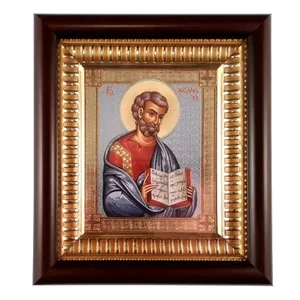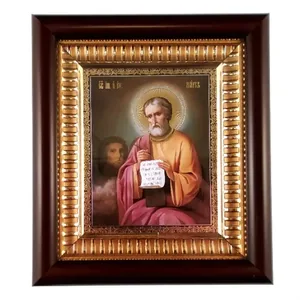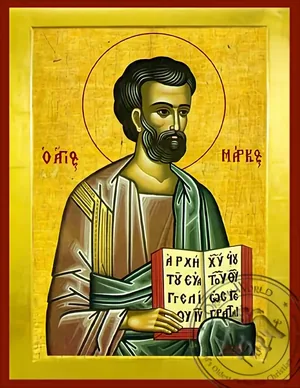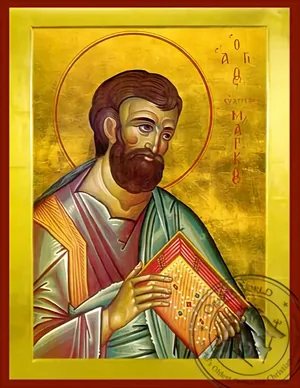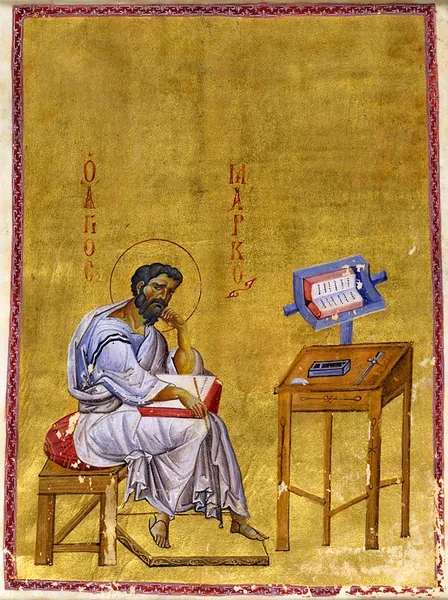
Holy, Glorious, All-praised Apostle and Evangelist Mark (I)
The holy Apostle and Evangelist Mark (+63) was born in Jerusalem. He was one of the Seventy apostles and a nephew of the Apostle Barnabas (commemorated 11 June). The house of his mother Mary adjoined the garden of Gethsemane. According to church tradition, on the evening the Saviour was taken, Saint Mark, wrapped in a linen cloth, followed the Lord and fled from the soldiers who wanted to seize him (Mark 14:51–52). After the Lord’s Ascension the house of Saint Mark’s mother Mary became a meeting place and refuge for Christians (Acts 12:12).
Saint Mark was a fellow labourer of the Apostles Peter, Paul (commemorated 29 June) and Barnabas. With the Apostles Paul and Barnabas Saint Mark was in Seleucia; from there he went to the island of Cyprus and travelled through it from east to west. In the city of Paphos he witnessed how the Apostle Paul struck the sorcerer Elymas with blindness (Acts 13:6–12).
After labouring with Saint Paul, Saint Mark returned to Jerusalem, travelled with the holy Apostle Peter to Rome, and from there, at the apostle’s command, went to Egypt, where he founded the Church.
Saint Mark met Saint Paul in Antioch during his second missionary journey; from there he set out with Saint Barnabas for Cyprus, and then went again to Egypt and with the holy Apostle Peter founded many churches. Saint Peter mentions Saint Mark lovingly as his spiritual son (1 Pet. 5:13).
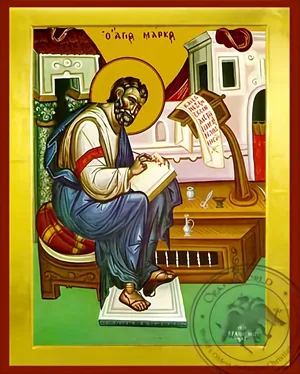
When the Apostle Paul was held captive by the Romans, Saint Mark was in Ephesus with Saint Timothy (commemorated 4 January); then he came to him in Rome and there wrote his Gospel (around 62–63).
From Rome the holy apostle went again to Egypt; in Alexandria he founded a Christian school and composed the order of the Liturgy for the Christians of Alexandria.
Then the blessed Evangelist travelled through the inland regions of Africa preaching the Gospel.
During this journey the apostle was told by the Holy Spirit to go to Alexandria to preach among the pagans. There he settled in the house of the shoemaker Anianus, whose injured hand he healed. The shoemaker joyfully received the holy apostle, believed his account of Christ, and was baptised. After Anianus many Alexandrians living in that part of the city were baptised. This roused the anger of the pagans, and they decided to kill the holy apostle. When the saint learned of this, he consecrated Anianus bishop, and ordained Malchus, Sabinus and Cerdo presbyters.
The pagans attacked Mark during a service, beat him, dragged him through the city, and threw him into prison. The Lord Jesus Christ Himself appeared to the saint and strengthened him. The next day, before he could be brought to the tribunal, the saint died.
The pagans wanted to burn Mark’s body, but when they lit the pyre the earth shook. The frightened haters of God fled, while the Christians took up the holy apostle’s remains and buried them in a stone sarcophagus. This happened on 4 April 63. The Church celebrates the saint’s memory on 25 April.
In 310 a church was built over the tomb of Saint Mark. In 820, when the Arabs had gained dominion in Egypt and begun to persecute the Christians, the apostle’s holy relics were translated to Venice and laid in the church dedicated to him.
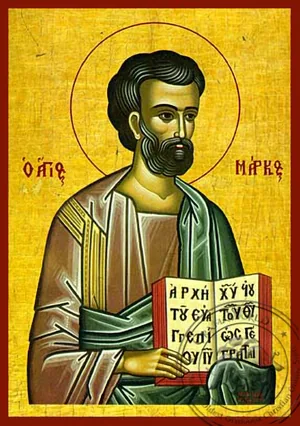
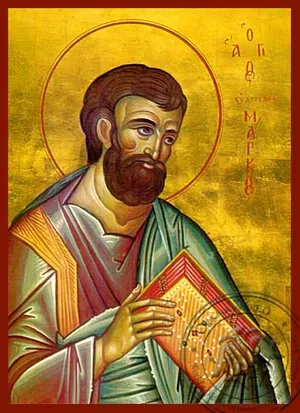
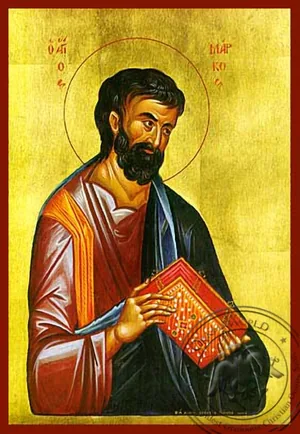
In the ancient iconographic tradition the holy Evangelist Mark is depicted with a lion, which points to the might and royal dignity of Christ (Rev. 5:5). Saint Mark wrote his Gospel for Christians who had come from among the pagans, and so he describes mainly the words and deeds of the Saviour in which His divine almighty power is seen. Many peculiarities of his narrative can be explained by his closeness to the Apostle Peter. All the ancient writers confirm that the Gospel of Mark is a brief record of the sermons and accounts of Peter, the chief of the apostles.