
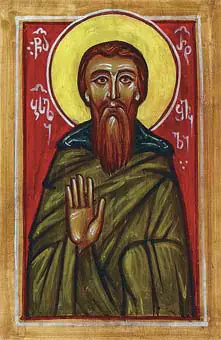
Our Venerable Father Basil (Ratishvili) (XIII)
The Venerable Basil was the uncle of Euphemius (Eqvtime III), catholicos of Georgia. Made radiant by the grace of foresight, Basil laboured on the holy mountain of Athos.
In the reign of Saint Demetrius the Self-sacrificing (commemorated 12 March) Georgia was engulfed in general lawlessness. For the sake of the country’s vital interests the king was forced to carry out the wishes of the Mongols and to fight side by side with the lawless. The blood of the Georgians was sacrificed to endless wars. To this was added God’s punishment sent down for our sins: a terrible earthquake which ruined all Samtskhe and Kartli.
The country was impoverished and laid waste, civil wars began, and the Georgians surpassed even their enemies in immorality and disobedience. King Demetrius again had to make sacrifices, which his contemporaries counted against him as apostasy and weakness. At fifteen the king was married, for political reasons, to the daughter of Komnenos, the holder of the throne of the kingdom of Trebizond. Then, again for the country’s interests, he was married to Solghar, the daughter of a Mongol noyan, and as his third wife he himself took Natela, the daughter of Beka Jakeli. So the king, distinguished by every spiritual virtue, a builder of churches and a helper of the poor, became the husband of three wives. His most beloved sister Tamar he gave to Arghun Khan as a daughter-in-law, and afterwards the decrepit Sadun Mankaberdeli ransomed her and took her as his wife; and his little daughter Rusudan he married to the son of Buqa, the great noyan of the Mongols.
For such conduct the king was rebuked by Nicholas, catholicos of Georgia, and when he could not make him listen, he himself laid aside the honour of the head of the Church.
To rebuke the king, who had mingled with the pagans, the Venerable Basil came down from the holy mountain of Athos. He came before the king and, like an apostle, rebuked him for his sins and called on him to forsake his “lawless marriages”, promising in return: “I will be thy surety that thy reign shall prosper.”
Together with the king the Venerable Basil also rebuked the lords and laid bare their hidden thoughts. Demetrius and his suite disregarded the words of the monk who shone with virtue. Then the holy elder foretold the king’s future: “By an evil and dishonourable death shalt thou be slain by the mighty, and thou shalt be bereft of thy kingdom, and thy children shall be scattered, and another shall take hold of thy kingdom, and they shall plunder thy riches. And behold, lo, I say it to thee and to the lords, and I trust in the all-holy Theotokos that my word shall be fulfilled and come to pass, if thou abide in this lawlessness. Behold, I depart.”
The stunned king listened to the elder’s words in silence and bowed his head, for he honoured holy men.
Soon the prophecy of Basil the Athonite came true. A trial came down upon the king of Georgia and his nation. Because of the intrigues stirred up at the Mongol court, King Demetrius was summoned to the Horde. The king beloved of Christ was slain “by an evil and dishonourable death” by the mighty; “another took hold of” his kingdom — the son of David Narin was called from Imereti and Demetrius’s throne was given to him; “his children were scattered”: the daughter of the king of Trebizond took refuge in the mountains with her children, Vakhtang, Lasha and Manuel; Solghar took her children, Baadur, Iadgar and Jigda-Khatun, to her own family; and the youngest son, George (the future George the Brilliant), together with Natela, was sheltered and brought up by his grandfather, Beka Jakeli.
Thus “from time to time” the Lord sent to Georgia, to rebuke it and bring it to its senses, saints whose names are written in heaven.



