
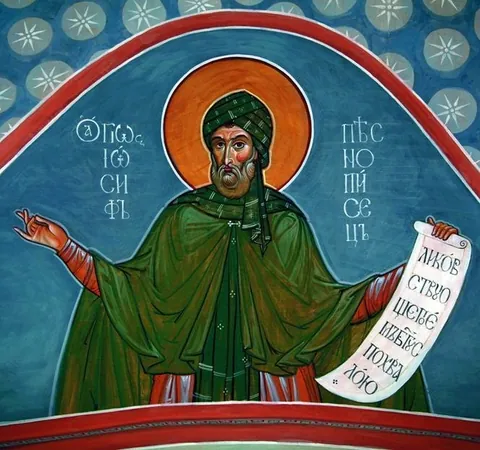
Venerable Joseph the Hymnographer (+883)
Saint Joseph the Hymnographer (+883) was born in Sicily into a pious Christian family. His parents, Plato and Agatha, fleeing the raids of barbarians, moved to the Peloponnese. At fifteen Joseph went to Thessalonica and settled in a monastery. Distinguished by piety, love of labour and humility, the Venerable Joseph was ordained presbyter.
Once the Venerable Gregory of Decapolis (commemorated 20 November) came to the monastery. He noticed the young monk and took him with him to Constantinople. This was the reign of Leo the Armenian (813–820), the time of the rise of the iconoclast heresy. The Venerable Gregory and Joseph fearlessly defended the veneration of the holy icons. They preached in the city squares, went to the Orthodox and strengthened their faith. The Church of Constantinople was in the gravest state: both the emperor and the patriarch were iconoclasts.
At that time the bishops of Rome were in unity with the universal Church, and Pope Leo III, who did not depend on the Byzantine emperor, could hold out a helping hand to the Orthodox. The monks chose the Venerable Joseph to be sent to the pope. The Venerable Gregory blessed the holy father.
On the way Joseph was seized by Arab robbers bribed by the iconoclasts, carried off to the island of Crete, and handed over to the heretics. The captive was thrown into prison. Through the Venerable Joseph’s prayer and example one fainthearted bishop was so strengthened that he met a martyr’s death.
The Venerable Joseph spent six years in prison. On Christmas night in 820 Saint Nicholas the Wonderworker appeared to him and announced the death of the iconoclast emperor Leo the Armenian and the end of the persecution of the holy icons. Saint Nicholas handed the venerable father a scroll on which was written: “Make haste, O Merciful One, and help us.” Joseph swallowed the scroll and said: “How sweet are Thy words unto my taste! yea, sweeter than honey to my mouth!” (Ps. 118:103). After this chant Saint Joseph’s fetters fell away, the prison doors opened, and a wind caught the holy father up into the sky and set him down near Constantinople. The Venerable Gregory of Decapolis had died, and only his disciple, the blessed John (commemorated 18 April), remained. He too soon died. The Venerable Joseph built a church of Saint Nicholas the Wonderworker and translated there the holy relics of the Venerable Gregory and John. Later a monastery grew up on this spot.
The Venerable Joseph received from a pious man a portion of the holy relics of the Apostle Bartholomew; he built a church in the name of the holy apostle and decided to compose a hymn in his honour. For forty days, with prayer, fasting and tears, the Venerable Joseph prepared for the feast of Saint Bartholomew. At Vespers the apostle appeared to him, laid the holy Gospel on his breast, and gave him his blessing to compose church hymns. After this miraculous appearance the Venerable Joseph wrote canons in praise first of Saint Bartholomew, and then of the Most Holy Mother of God and of Saint Nicholas the Wonderworker.
When the iconoclast heresy was renewed, in the time of the Emperor Theophilus (829–842), the Venerable Joseph suffered persecution from the heretics a second time: for eleven years he was in exile in Cherson; in 842, by order of the holy Empress Theodora (commemorated 11 February), he was set free, but for denouncing the empress’s brother Bardas he was exiled again, and was brought back only after the death of Bardas, in 867.
Patriarch Photius (857–867, 877–886) restored the saint to his former rank and rights and appointed him confessor of the Christians of Constantinople.
In deep old age the Venerable Joseph fell ill. On Great Friday the Lord revealed to him that he would soon fall asleep with the sleep of the righteous. The venerable father made an inventory of the treasures of the church of Saint Sophia and sent it to Patriarch Photius; for several days he prepared for death. He received Communion, blessed those who were with him, and at last joyfully commended his soul to the Lord.



