
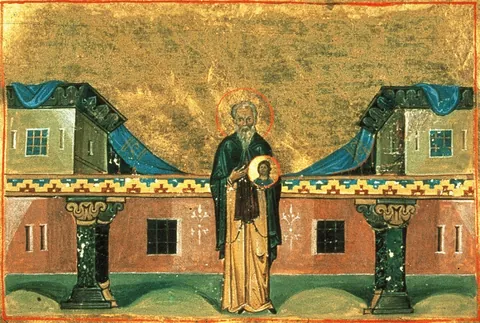
St Nicetas the Confessor, Abbot of the Medikion Monastery (+824)
Saint Nicetas the Confessor, abbot of the Medikion monastery (+824), was born in Caesarea of Bithynia into a pious family; his mother died on the eighth day after his birth, and his father became a monk. The infant was brought up in the Christian spirit by his grandmother. From childhood Saint Nicetas served in the church and was the disciple of Stephen, a monk living in seclusion. With his blessing he went to the Medikion monastery, whose abbot was Saint Nicephorus (commemorated 13 March).
Seven years later the Venerable Nicetas was ordained presbyter. The Venerable Nicephorus, being infirm, entrusted him with the care of the monastery.
The Venerable Nicetas began to care unsparingly for the flourishing and good order of the monastery, and by his own strict way of life gave the brethren an example of monastic life. A few years later the number of monks in the monastery grew to about a hundred.
After the death of the Venerable Nicephorus the brethren unanimously chose Nicetas as abbot.
The Lord rewarded Saint Nicetas with the gift of wonderworking. Through his prayer many were healed: a deaf-mute began to speak, a madman had his reason restored, and two possessed women were healed.
In the time of Leo the Armenian (813–820) the iconoclast heresy was renewed. Orthodox bishops were persecuted and exiled. In 815 a council of heretics was held in Constantinople, which deposed the holy Patriarch Nicephorus (806–815, +828) and chose in his place the heretic layman Theodotus. Heretics were appointed in place of the exiled and imprisoned Orthodox bishops. The emperor summoned the abbots of all the monasteries and tried to turn them to the heresy. Among those summoned was the Venerable Nicetas, who firmly defended Orthodoxy. Following his example, all the abbots remained faithful to the rule of the veneration of the holy icons. For this they were seized. The Venerable Nicetas bore the trial courageously and encouraged the others too.
The emperor and the false patriarch Theodotus decided to seduce the confessors of the true faith: the emperor promised that he would give all of them freedom and the right to venerate the holy icons on condition that they took communion with the false patriarch Theodotus. Nicetas hesitated for a long time, while the other prisoners begged him to accept the emperor’s offer. The Venerable Nicetas went to the church, where icons had been set out to throw dust in people’s eyes, and Saint Nicetas received communion. When the holy father returned to the monastery and saw that the persecution of Christians did not stop, he went again to Constantinople and fearlessly denounced the iconoclast heresy. Saint Nicetas was seized again and tormented in prison for six years, until the death of Leo the Armenian. While he was in captivity miracles were worked through his fervent prayer. In 824 Saint Nicetas reposed in God. His body was buried with honour in the monastery. Miracles were worked at the saint’s tomb.



