
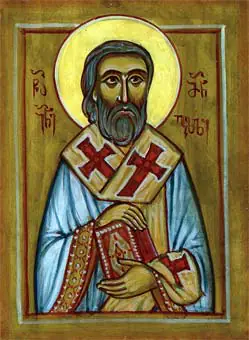
Saint John of Manglisi (+1751)
In the Sioni cathedral of Tbilisi, in the south-east, by the entrance to the diaconicon, beneath a slab of white marble, rest the remains of Saint John of Manglisi. Among us, unhappily, many know nothing not only of this grave but of the saint himself. And yet our great forefathers had great hope in him. That is why they buried his myrrh-streaming body in the Sioni cathedral: that it might guard the royal city and all Georgia.
Saint John was born in 1666 into the family of Prince Giorgi Saakadze (this is another Giorgi — do not take him for the Great Mouravi). In the world he was called Ioseb. His believing parents sowed a good seed in Ioseb’s soul, and he went away into the desert to make it grow.
Ioseb was brought up in the Bertubani monastery of David Gareja. There he was tonsured a monk and named John. “Many years he spent among the rocks of Bertubani.” He watered his dwelling with tears. He had a very tender heart. He was greatly merciful to the poor and the sick. Later, when already a hieromonk, he brought up many poor children and orphans “by his own means and labour”. Some he brought to the rank of priesthood; others remained laymen.
Saint John’s judgement too was impartial. The shah of Iran sent Iese, who had turned Muslim, as ruler to Georgia, and he ascended the throne in 1714. The king who had changed his faith tried to suppress Christianity and to spread a foreign faith in its place. He grew so insolent that he took away the wife of his maternal uncle, Kaikhosro Amirejibi. “The catholicos and the bishops, and above all John Saakadze” rebuked him sternly, but Iese set the holy fathers’ admonitions at nought. He said: I am a Muslim, and among us this is the custom. Then Bakar, the son of Vakhtang VI, became king in Kartli and put Iese in prison.
Bakar noticed John’s gifts, his authority and his learning, and had him consecrated bishop to the see of Manglisi. The diocese of Manglisi was soon ravaged by the Ottomans, and Saint John was forced to take refuge in the monastery of Khirsa. And then…
He lost his diocese, but found a better field for the harvest; he armed himself with the Gospel and the cross and set out on the road. First he went round Kakheti preaching, then crossed into Daghestan. By his life and miracles he soon drew the attention of the Leks. In 1724 in Derbent he first set up a wooden chapel, and then built on its site a stone church dedicated to the Dormition of the Theotokos. In Daghestan eleven clergy accompanied him, all brought up by him. Here many Leks were added to his flock. The holy hierarch won such a name that word of him reached Peter the Great himself. The emperor and Vakhtang VI also gave the venerable father material help.
In 1737 John left disciples in Daghestan and settled in Astrakhan, in the monastery of the Trinity. At that time Vakhtang VI and Georgian émigrés were living there. Life beside the holy father brought them great consolation. In Astrakhan too Saint John built a church and consecrated it to Saint John the Theologian. Later the Russian government made this church into a monastery.
In Astrakhan he learned that many Georgians had settled in Kizlyar but had no church. The holy father took pity on Christ’s little flock and hastened to help them. Soon he built in Kizlyar a church of the Exaltation of the Cross and opened a school there, where preachers and missionaries were trained. The venerable father laboured especially for the conversion of the Ossetians and the Ingush. Together with Ioseb Samebeli (Kvabulidze) he drew up a plan which was put before the Holy Synod. In 1746 the Synod approved the plan. Thus was founded the commission for the restoration of Christianity in Ossetia, whose members were given a salary and the means of living and preaching. The mission consisted mainly of Georgian clergy. They knew the Ossetian language and the people’s ways well. Saint John led the mission until his death.
Many souls turned to Christ. Through the venerable father’s prayer many were granted healing from sicknesses of body and soul. The Lord glorified His servant with signs and wonders even in his lifetime. His spiritual children used to tell: once, at the Liturgy, when the clergy stood before the holy altar and the “Holy God” was being sung, a priest was to take the cross from the altar and bring it to the hierarch to be kissed; but the priest had not yet finished his prayer, so Saint John stretched out his own hand to take the cross. Everyone saw the precious cross rise a span’s height above the holy altar and come to meet “the hand of that holy hierarch… and he blessed the faithful people”.
The holy father laboured much for the conversion of foreign peoples… Yet the weary old man still thought of his homeland and longed for it. He left instructions that he be buried at Gareji, in the desert of Saint John the Forerunner.
On 28 March 1751, at the age of 85, Saint John died and was buried in Kizlyar, in the monastery of the Exaltation of the Cross that he himself had built. Because of the difficulty of the road they could not manage to bring his remains to Georgia. A year later, according to tradition, the holy hierarch appeared to the Empress Elizabeth and asked to be sent back to his homeland. Then the saint’s brother, Prince Nikoloz Saakadze, a retired lieutenant of a hussar regiment, was permitted to bring the saint’s remains to Georgia. With the blessing of the Synod and by order of Teimuraz II the body was buried in the Sioni cathedral; “they honoured him with many lamps and a procession. By the mercy-seat of the Theotokos they built for him a goodly shrine.”
King George XII twice had Saint John’s tomb opened. The first time was when his son Ilia fell ill of a fever. The physicians judged the sickness incurable. Then by the king’s command a moleben was served, and the saint’s finger, taken out of the shrine, was laid on the sick boy’s mouth and eyes. That very moment, to the amazement of those who saw it, Ilia rose up safe and sound. The second time the shrine was opened was when the king’s daughter Tamar fell ill. After venerating the saint’s relics she too was healed. Because of these two miracles King George offered for his tomb an icon of Saint John set in silver.
Once a hieromonk fell so ill that none of the physicians would undertake to cure him. The old monk lay down on his bed and wept without consolation. He fell asleep and in his sleep saw that he was standing in the porch of the Sioni cathedral with bowed head, praying to the Theotokos. At that moment Saint John appeared before him, standing in his mantle by the icon of the Theotokos. Light came from the icon of the all-holy Virgin and was poured out upon the hierarch. Saint John was pointing out to the Theotokos the sick man standing behind and entreating mercy for him. And the Mother of God “looked upon that sick man and enlightened his heart and his mind”.
The old monk awoke feeling better, even asked for food, and a little while later was entirely healed.
Two and a half centuries have passed since Saint John of Manglisi became a dweller in the heavenly Georgia and an intercessor for his earthly homeland. What does he, whom God has glorified, still lack, but our honour and love, the love of his children! Holy Father John, glorified by God and forgotten by us the unworthy, help us sinners!



