
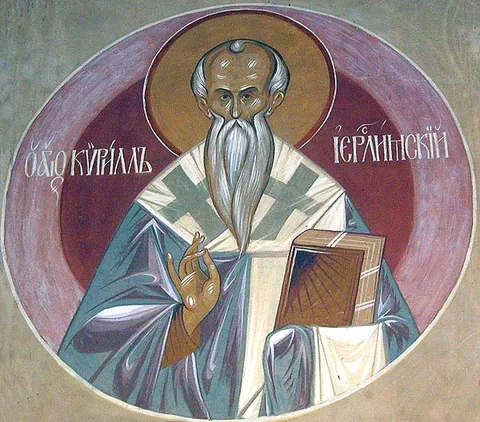
St Cyril of Jerusalem (+386)
Saint Cyril of Jerusalem was born in Jerusalem in 315. Brought up in strict Christian piety, Cyril was tonsured a monk, and in 346 he was ordained presbyter. In 350 Archbishop Maximus died. Holding the rank of Patriarch of Jerusalem, Cyril fought courageously against the heresies of Arius and Macedonius. By this he earned the wrath of the bishops who followed Arius. The Arians managed to have Cyril thrown from his throne and driven out of Jerusalem.
On the day of Pentecost in 351 a divine sign appeared in Jerusalem: a radiant cross appeared in the sky, stretching from Golgotha to the Mount of Olives. Cyril reported this sign to the Arian Emperor Constantius (337–361) and tried to turn him to Orthodoxy.
The heretic Acacius, former Metropolitan of Caesarea, who had been deposed by the Council of Sardica, decided to drive out Saint Cyril with the emperor’s help. When famine began in Jerusalem, Cyril gave away all his property to the needy, and then began to sell church objects to help the starving. Saint Cyril’s enemies spread a rumour that a dancing woman had been seen in the city wrapped in hierarchal vestments. Because of this slander the heretics drove Saint Cyril out of Jerusalem.
The hierarch took refuge with Bishop Silvanus in Tarsus. After this a local council gathered in Seleucia, attended by 150 bishops. Among them was Saint Cyril too. Metropolitan Acacius, it is true, did not want him admitted, but the council did not agree with him. Then Acacius himself left the council and denounced Cyril before the emperor and the Arian Patriarch Eudoxius. The emperor sent the hierarch into exile.
The Emperor Julian the Apostate (361–363), as if out of piety, reversed all of Constantius’s decisions directed against the Orthodox. Saint Cyril returned to his flock. A little later, when Julian was secure on the throne, he openly denied Christ. He allowed the Jews to rebuild the temple of Jerusalem destroyed by the Romans, and even granted money from the state treasury for it. Saint Cyril preached that the Saviour’s word about the destruction of the temple (Luke 21:6) would be fulfilled and that Julian’s blasphemous design would not come to pass. One night there was such an earthquake that even the remaining ruins of Solomon’s temple collapsed, and what had newly been built turned to dust and ashes. When the Jews nevertheless went on building, fire came down from heaven and destroyed their tools. A dreadful fear seized everyone. The next night crosses appeared on the clothing of the Jews, and they could in no way get rid of them.
After this divine sign Saint Cyril was driven out again. The see of Jerusalem was taken by Saint Cyriacus, who soon met a martyr’s end (+363, commemorated 28 October).
After the death of the Emperor Julian Saint Cyril returned to his see once more, but in the reign of the Emperor Valens (364–378) he was exiled for the third time. Only in the time of the pious king Theodosius the Great (379–395) did Saint Cyril return to his work as hierarch. In 381 Saint Cyril took part in the work of the Second Ecumenical Council, which condemned the heresy of Macedonius and confirmed the Niceno-Constantinopolitan Creed.
Of Saint Cyril’s works the most famous are his twenty-three instructions and two homilies on Gospel themes: “On the Paralytic” and “On the Turning of Water into Wine at Cana of Galilee”.
Saint Cyril died in 386.



