
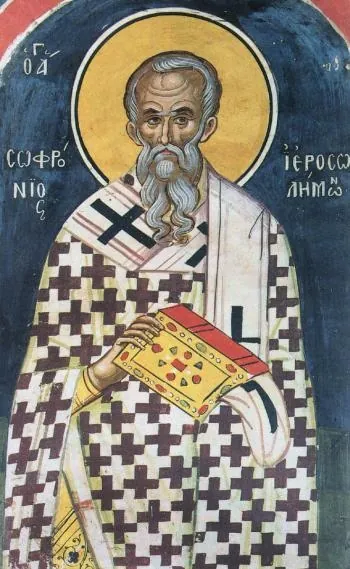
St Sophronius of Jerusalem (+638–644)
Saint Sophronius of Jerusalem was born in Damascus. From his youth Sophronius stood out for piety and love of learning, and he was called the Wise. The future patriarch sought the highest wisdom in the monastery, in conversations with the desert-dwellers. He went to Jerusalem, to the monastery of Saint Theodosius, and became close to John Moschus. Soon Sophronius became John’s spiritual son and disciple. Together they went round the monasteries and wrote down the lives of the fathers. From these notes the famous book the “Limonarion” was compiled, which the Seventh Ecumenical Council held in high esteem.
Because of the Persian invasions Saints John and Sophronius left Palestine and went first to Antioch and then to Egypt. In Egypt Sophronius fell gravely ill. He decided to become a monk, and John Moschus tonsured him. After Saint Sophronius recovered, the teacher and disciple stayed in Alexandria. The holy Patriarch John (commemorated 12 November) received them with love. Saints John and Sophronius firmly defended Orthodoxy against the onslaught of the Monothelite heresy. In Alexandria Saint Sophronius wrote the life of the holy Unmercenaries Cyrus and John (commemorated 31 January).
When barbarians invaded Alexandria, the holy Patriarch John set out for Constantinople with Saints Moschus and Sophronius, but died on the way. Saints John and Sophronius, with eleven monks, came to Rome. In Rome the Venerable John Moschus also died (+622). Saint Sophronius carried his body to Jerusalem and buried it in the monastery of Saint Theodosius.
In 628 Zacharias, Patriarch of Jerusalem (609–633), returned from Persian captivity. After his death Saint Modestus (633–634; commemorated 18 December) ascended the patriarchal throne, and after Modestus Sophronius was elected patriarch.
At the end of his life Saint Sophronius endured with his flock the hardship of the two-year siege of Jerusalem. The Christians, worn out by hunger, decided to open the city gates on condition that the enemy would not lay hands on the holy places. The Muslims did not keep this condition. Saint Sophronius died in deep sorrow over the desecration of the Christian holy places.
Patriarch Sophronius’s dogmatic treatise, his commentary on the Liturgy, the life of the Venerable Mary of Egypt (commemorated 1 April), nearly 950 troparia and a Paschal sticheron have come down to us. While still a hieromonk, Sophronius checked and corrected the Typikon of the monastery of Saint Sabbas. Saint Sophronius’s triodia are included in the present-day Triodion.



