
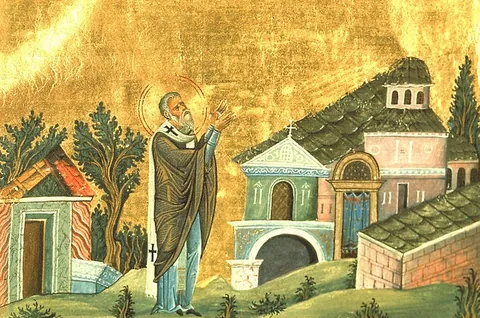
St Tarasius, Archbishop of Constantinople (+806)
Saint Tarasius came of a noble family. He was born and brought up in Constantinople and was educated there too. The deeply learned young man soon rose at the court of Constantine VI Porphyrogenitus (780–797) and his mother, the Empress Irene (797–802; commemorated 7 August), and attained the rank of senator. At that time the heresy of the iconoclasts was troubling the life of the Church. The holy Patriarch Paul (780–784; commemorated 30 August) did not sympathise with the heretics, but because of his wavering character he could not take decisive measures against them either, and so he voluntarily resigned from the throne, went to a monastery and took the schema. When the Empress Irene visited the former patriarch together with her son, Paul declared that his only worthy successor was Tarasius. Tarasius, at that time still a layman, refused for a long time, for he considered himself unworthy of so high a rank, but at last he yielded to the wish of those who besought him, on one condition: that an Ecumenical Council be convened to condemn the iconoclast heresy. In a short time the saint passed through all the degrees of the hierarchy, and in 784 was enthroned on the patriarchal throne. In 787, under the presidency of Tarasius, the Seventh Ecumenical Council was held in the city of Nicaea, attended by 367 bishops. The fathers of the council confirmed the rule of venerating the holy icons. Those hierarchs who repented of iconoclasm the Church received back into her bosom.
For twenty-two years Saint Tarasius governed his flock wisely. He lived a strict ascetic life; he spent all his property on works of charity: he fed and gave rest to the elderly, the poor, orphans and widows, and on the radiant feast of Pascha he arranged a meal for them, at which he himself served. The holy patriarch fearlessly denounced the Emperor Constantine when he slandered his wife Maria in order to shut her up in a convent and marry a kinswoman. Saint Tarasius firmly refused to allow the emperor’s divorce, for which the emperor’s terrible wrath fell upon him; but soon Constantine was overthrown from the throne by his mother Irene. The hierarch Tarasius died in 806. At the hour of his end demons approached the saint, reminded him of his whole life from childhood, and tried to charge him even with sins he had never committed. “You slander me; you have no power whatever over me!” the venerable father rebuked the evil spirits, and committed his soul to the Lord in peace. His flock mourned their beloved hierarch with fervent tears. Many healings took place at his grave.



