
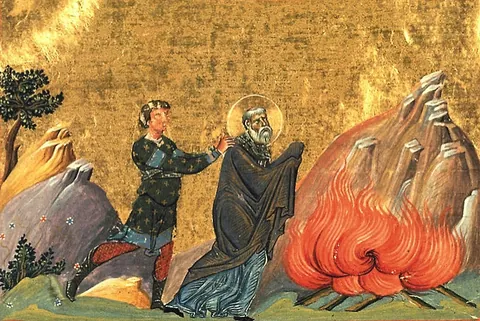
Hieromartyr Polycarp, Bishop of Smyrna (+167)
The Hieromartyr Polycarp, Bishop of Smyrna, was born around the year 80 and lived in the city of Smyrna in Asia Minor. Orphaned early, the saint was brought up, at an angel’s direction, by a pious widow, Callista. After his foster mother’s death Polycarp gave away all his property as alms and took on the service of the infirm and the sick. Bucolus, Bishop of Smyrna (commemorated 6 February), came to love the saint greatly and brought him close. He ordained Polycarp deacon and charged him with preaching the word of God in church.
At that time the holy Apostle John the Theologian was still alive. Polycarp was very close to him and accompanied him on his apostolic journeys. The hierarch Bucolus ordained the saint presbyter, and shortly before his death asked that the see of Smyrna be entrusted to Polycarp. Saint Polycarp governed his flock wisely. Saint Ignatius the God-bearer treated him warmly and paid him great honour.
When the Emperor Marcus Aurelius (161–180) ascended the throne, one of the most terrible persecutions of the Christians began. The pagans demanded that the judge search out Saint Polycarp, “the father of all Christians” and “the deceiver of all Asia”. At that time, at the insistent demand of his flock, the saint was staying in a small village near Smyrna. When soldiers came to take him away, the hierarch went out to meet them and ordered the soldiers to be fed, while he himself prayed before the martyrdom that awaited him. His sufferings and death are described in one of the most ancient monuments of Christian literature, “The Epistle of the Church of Smyrna to the Other Churches”. Brought before the tribunal, the saint courageously confessed Christ, for which he was sentenced to be burned. The executioners wanted to nail the courageous confessor of Christ to a stake, but Polycarp reassured them that he would not come down from the pyre. The flames surrounded the saint and joined in the air above his head. The pagans and Jews saw that the fire did God’s chosen one no harm, and demanded that he be killed with the sword. When Polycarp was pierced with a dagger, the blood that poured from the wound put out the fire. The hieromartyr’s body was burned. The Christians of Smyrna reverently gathered and kept his holy relics.
To Saint Polycarp belong several letters to his flock and to private persons. His Epistle to the Philippians has come down to us, which, according to the blessed Jerome, was read during divine services in the Churches of Asia Minor.



