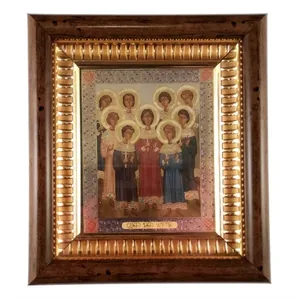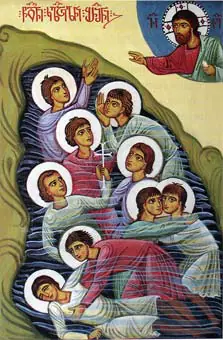
The Nine Brothers of Kola: Guaram, Adarnase, Bakar, Vache, Bardzim, Dachi, Juansher, Ramaz and Parsman — Stoned at Kola, at the Source of the Mtkvari (VI)
The holy martyrs, the nine children of Kola, ended their lives as martyrs in the sixth century. They were stoned at the source of the river Mtkvari by their own parents for confessing Christ.
The village of Kola lay at the source of the river Mtkvari. Christians and pagans lived here side by side. Most were idol-worshippers.
The children of the Christians and of the pagans played together for whole days. In the evenings, when the bells of the village church rang for Vespers, the Christian children left their play and went into the church to pray. The pagan boys went along with their companions as far as the church, but they could not enter it. “You are the children of idol-worshippers, and it is not right for you to enter the house of God,” they were told.
Little by little the boys became more and more interested in the Christian teaching, and at last they decided to join the Christians. “If you wish to come into the church with us, believe in our Lord Jesus Christ and be baptised in His name, and partake of His mysteries, and join the Christians,” their friends explained to them.
The boys joyfully promised the Christians that they would be baptised. The Christians of Kola went to the village priest and told him of the boys’ wish. He was not afraid of the wrath to be expected from the pagans, and on a freezing winter night he took the children to the river to be baptised. The priest led the children down into the frozen river and baptised them. During the baptism a miracle took place: the water grew warm, and the boys saw angels of light. Strengthened by the angels, the children no longer wished to return to their pagan parents and stayed with the Christians. Soon the parents learned of their sons’ baptism, took them out of the church by force and brought them home with beatings and curses.
The children bore every insult and torment with wonderful patience; for seven days and nights, hungry and thirsty, they kept repeating one and the same thing: “We are Christians, and it is not right for us to eat and drink what has been offered to idols.” Neither caresses nor the promise of other good things could charm the boys who had put on Christ. “We are Christians and we need nothing from you; only let us go, and we will go to the Christians,” they begged.
Angered by their sons’ stubbornness, the parents went to the ruler and told him everything. The ruler said to them: “They are your children; you have power over them; do with them what you will.” The pagans asked the ruler for permission to stone the children; at the source of the river, where the boys had been baptised, they dug a great pit and threw the children into it. “We are Christians, and for Him in whose name we were baptised we will perish and die” — these were the boys’ last words. The lawless parents took up stones first; then the crowd that had gathered followed their example, and soon the pit was filled with stones. The pagans also brought the village priest to the point of death, robbed him and divided the plunder among themselves.
This took place in southern Georgia, in historic Tao.