
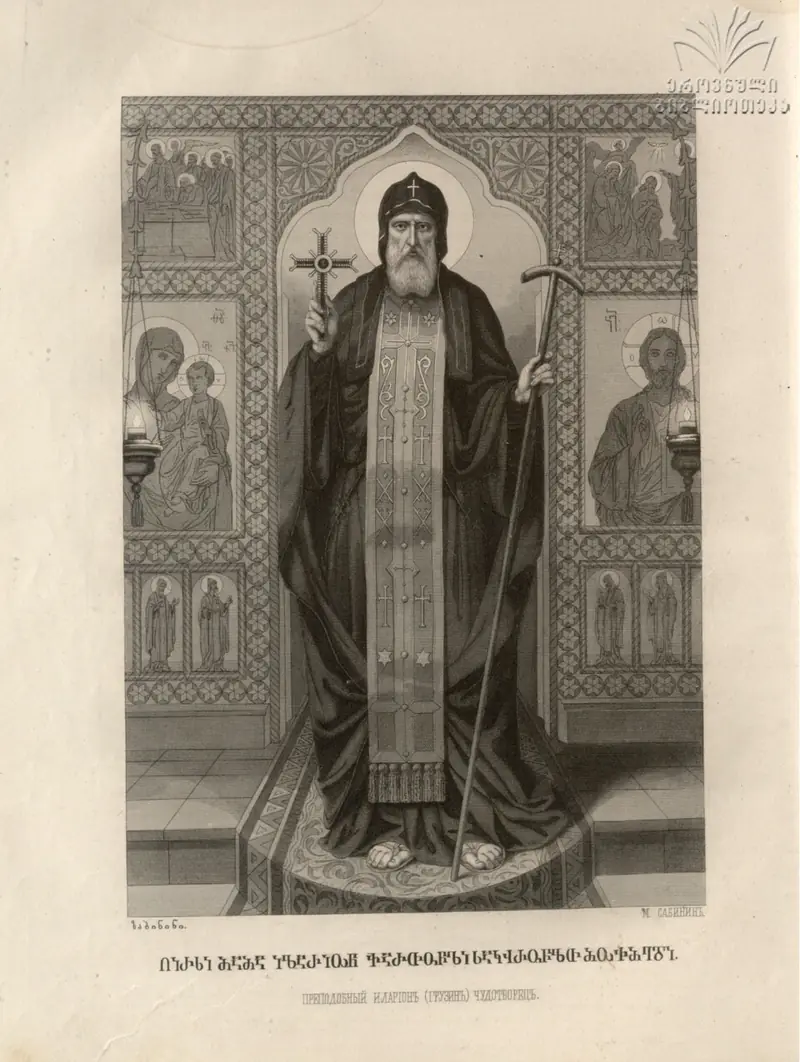
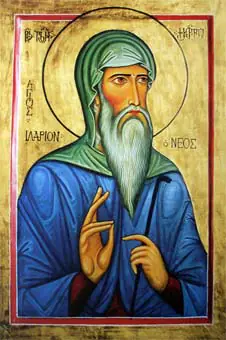
Saint Ilarion the Georgian (Kanchaveli) — the New
Saint Ilarion the Georgian (in the world Iese Kanchaveli) was born in 1776 in the village of Losiatkhevi in the Shorapani district of the Kutaisi province, into the family of the devout nobles Khakhuli and Mariam Kanchaveli. When Iese was six his uncle, the monk-deacon Stephane, took him to live with him in a monastery.
After Father Stephane’s repose Iese moved to the monastery of Tabakini, but when he learned of the opening of a theological school in Tbilisi he hastened towards Kartli. On the way he called on the Bishop of Nikozi for a blessing. The bishop, gladdened by Iese’s grace-filled prayer, advised him: “My son, at the school they will teach you nothing that you have not learned in the desert. So go back to your home. The Lord God, who has taught you prayer, and the prayers of your elder too, will bring you to a state in which you will be of use to the Church of God and to your nation.” When the young man returned home, his father soon took him to the palace in Kutaisi and entrusted him to the royal court to be brought up. The king decided to have Iese, who was distinguished for purity and piety, ordained priest, so as to have in him a trustworthy confessor and counsellor.
Iese married a prince’s daughter named Mariam. Soon the saint was ordained priest and appointed to the court church of the king.
In 1801 the kingdom of Kartli-Kakheti was joined to the Russian Empire, and the Russian government began to correspond with the King of Imereti about joining his kingdom to Russia.
Against the background of the tense political situation in the country, envy, greed and treachery, caused by the shaking of the royal throne and by various circumstances, showed themselves. King Solomon had two choices before him: either to live in Russia in an “honourable” position, for which very large sums had been set aside by Russia, or to flee to Turkey and from there to seek the return of his kingdom. After a great inner struggle the king decided to go over to Turkey. Protopresbyter Iese Kanchaveli did not abandon the king in this trial either: after a short while he too hastened to Arzrum and shared all the troubles and pains of Solomon II. Solomon II reposed in Turkey in 1814. His remains were committed to the earth of Trebizond.
Father Iese was able to obtain from the Russian tsar mercy for the nobles who had been in the king’s suite: all had their former ranks and estates restored to them. Iese himself intended to live in seclusion in his native region. But Queen Mariam called him to Moscow, where she had been taken after Solomon went over to Turkey. He brought to Moscow the particle of the Life-giving Cross of the Lord that King Solomon had taken with him to Turkey. The queen placed it in the palace church. The luxury and ease that reigned at the imperial court weighed heavily on Father Iese’s God-loving soul. He exchanged his silk clothes for a beggar’s rags and in 1819 set out for the Holy Mountain of Athos.
To the monks of Athos the saint was known as a poor Georgian who had come on pilgrimage. First he venerated Iviron, and then moved to the monastery of Dionysiou.
In 1821 the saint was tonsured a monk with the name Ilarion.
Father Ilarion carried out his obediences with love. He was troubled only that, not knowing Greek, he was deprived of hearing the word of God, and so he asked the abbot’s blessing to go to Iviron to ask for Georgian books. Father Ilarion was recognised by a Greek archimandrite who had known him in Moscow. Soon word spread over all Athos that the king’s confessor was hiding in the monastery in the habit of a simple monk. From then on universal respect followed him everywhere. Troubled by such treatment, Father Ilarion moved to the desert near the monastery of Dionysiou.
At this time terrible bloodshed was raging throughout Greece: the Turks were mercilessly slaughtering the Greek Christians who had risen in revolt. In 1822 Abdul Robut Pasha encamped with a large army at the border of Athos and ordered the abbots of all the monasteries to appear before him. In place of the abbot of Dionysiou, Father Ilarion, burning with the desire for martyrdom, appeared before the lawless one together with two other monks. When the pasha learned that Father Ilarion was a Georgian he was glad: it turned out that he himself was a Georgian. As a child he had been abducted by the Turks and made a Muslim. He urged the saint to leave Athos, offering him in exchange his own palace in Thessalonica. Father Ilarion answered with a firm refusal and rebuked the denier of Christ.
Having returned to Athos, Father Ilarion grieved that he had not attained the martyr’s end he longed for. He asked the abbot’s blessing and went again before the pasha.
For three days in succession the saint went to the pasha and rebuked his lawlessness. On the fourth day Father Ilarion began to speak to the pasha about the falsehood of Islam and of its founder, Muhammad himself. The pasha asked, laughing: “Where do you think we shall go?” Before the great crowd of people of various confessions gathered round, Father Ilarion boldly declared that only the true believers born in the bosom of the Orthodox Christian Church would be saved. Then all who stood around cried out together: “Death to him!” and Abdul Robut Pasha too was forced to give the order for his execution. Father Ilarion joyfully followed the frenzied crowd towards the place of execution, but two soldiers of Georgian origin obtained from the pasha permission to free him again: we should be put to shame, what would they say of us — we met one fellow countryman, and him too we killed.
The saint was ordered to return to Athos, but out of love for his neighbour he took upon himself the labour of serving the prisoners: for six months he served with self-sacrifice the prisoners shut up in the prison of Thessalonica. Father Ilarion saved many captives from certain death, and at last, by God’s inspiration, he left Thessalonica and set out on the road to Athos.
Having returned to the Holy Mountain, Father Ilarion lived in caves for three years. Here his rule of life was this: on Fridays he ate nothing; on other days he took from crumbled rusks put into a narrow-necked jar as much as would come out in one handful, and was content with that. He drank little water too — one cup a day. Demons often appeared to the saint in hideous forms.
Pilgrims often broke Father Ilarion’s stillness; one day the monk left his cave and hid in the forest. His severe ascetic labours weakened the saint so much physically that he was forced to give up the labour of seclusion. Under the care of his friend, the Georgian monk Benedict, the saint gradually recovered. After this he laboured at Iviron, at the monastery of Dionysiou, at the Russikon...
At Iviron he took charge of the library. He compiled a catalogue, then made extracts from the books and manuscripts, which he prepared in twelve volumes under the title “The Flower Garden”. The books described mainly the lives of saints; this collection was handed to the abbot of Zographou, who was travelling to Russia. He published all twelve volumes in the Georgian language, without naming the compiler.
At the end of his life Saint Ilarion fell gravely ill, for which he gave thanks to God. “Glory to the Lord! I desired martyrdom, but God did not count me worthy; and now He has sent me illness. It is equal to martyrdom, if you bear it with patience and faithfulness to God’s will.”
Before his death Father Ilarion asked his disciple, Father Saba, to bury his remains in secret. He reposed on 12 February 1864.
Father Saba was forced to reveal the place of Father Ilarion’s grave. In 1867, during the vigil before the Ascension, the monks brought up Father Ilarion’s holy relics, which gave off a wonderful fragrance.
By the decision of the Holy Synod of the Apostolic Church of Georgia of 17 October 2002 the priest-schemamonk Ilarion (Kanchaveli) was numbered among the saints and named Ilarion the Georgian, the New.



