
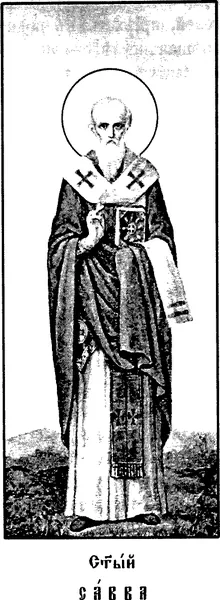
St Sava, Archbishop of Serbia (+1237)
The holy Archbishop Sava, in the world Rostislav (Rastko), was the third son of the Serbian autocrat Stefan Nemanja and Anna, the daughter of a Greek emperor. His parents saw their son’s remarkable gifts and thought of making him ruler of Herzegovina at the age of fifteen; but God was preparing His chosen one for another field: from childhood Rostislav was strongly drawn to fasting, prayer and divine service, and he avoided idle talk, laughter and amusements.
Once a lavish feast was in full swing in the palace, where the king’s son felt very ill at ease. In the company of merry young people sadness often weighed on his heart; his soul asked for something else and was drawn elsewhere. At that moment the young man heard that a Russian monk had come to them as a guest; he quietly slipped away from the revellers, took the guest to his room, and for a long time listened eagerly to his account of the life of monks. That day, there, he found what he had been seeking; joy filled his whole being, and he decided to devote himself wholly to the Lord. He told his father that he was going hunting for a long time, then sent his servants off in different directions, and himself set out for Athos, to the Russian monastery of Saint Panteleimon. At that time the future saint was nineteen years old. When his father learned where his son was, he quickly gathered an army under the command of a faithful general and sent word to the governor of the region that included Athos: either return my son to me, or prepare for war. On arriving at the monastery the commander ordered his soldiers to watch Rostislav closely, but they drank a great deal of wine, got drunk and fell asleep. The prince took advantage of the chance, secretly made his monastic vows and was tonsured a monk with the name Sava (1186). The newly tonsured monk sent his lay clothes, his cut hair and a letter to his parents. King Stefan sent a great quantity of gold to Athos to adorn the monasteries and for the poor, but his God-loving son wanted more: he longed to see his father too at his side, among the monks labouring for the salvation of their souls. The Lord heeded His chosen one’s supplication, and soon Sava’s pious parents also became monastics: his father was named Symeon, and his mother Anastasia. At first father and son laboured in the Vatopedi monastery, and then, by God’s will, they restored the Hilandar monastery and secured it for their homeland. Saint Symeon soon reposed. Once he appeared to his son in his sleep and foretold that, in the rank of hierarch, he would enlighten his country. Until this prophecy was fulfilled Sava continued his usual labours: he comforted the hermit monks and cared for the poor; he managed to restore their monastery to the hegumen and brothers of the Karakallou monastery, who had been carried off captive. The monks of Xeropotamou and Philotheou also felt Saint Sava’s compassion and generosity.
In the Hilandar monastery Sava was ordained first deacon and then priest. In Thessalonica the saint was made archimandrite, and in 1219, on the feast of the Dormition of the Theotokos, Patriarch Germanus consecrated the blessed father the first Archbishop of Serbia. Through Sava’s efforts the Greek emperor granted the Serbian Church the right to elect its archbishop, which was of the greatest importance during the fierce wars between East and West at that time. Coming from Nicaea to Athos, the father went round the monasteries of the Holy Mountain for the last time, venerated all the churches, and took leave of the blessed desert fathers. He found it very hard to leave this place; he was so heavy-hearted that he could hardly put one foot before the other. The Theotokos appeared to the despondent father in his sleep and said: “Why do you grieve, when you have me as intercessor before the Lord of all, the King and my Son?!” In gratitude, and in remembrance of this vision, the saint ordered two large icons of the Saviour and the Theotokos in Thessalonica.
In Serbia the holy father’s work was accompanied by many signs and miracles. During the all-night vigils and the Liturgy Sava would cense his father’s incorrupt body. Fragrant myrrh flowed from his shrine.
Once Vladislav, King of Hungary, declared war on Serbia. Negotiations with him were entrusted to Saint Sava, who not only won the longed-for peace for his people, but even converted the Hungarian monarch to Orthodoxy. The holy archbishop, who laid the foundation of the autocephalous Church of Serbia, also laboured to strengthen Serbian statehood. To strengthen the country’s independence he crowned his brother Stefan king, and after his death Radoslav, Stefan’s son. After this Sava went on pilgrimage to the holy places of Jerusalem. On returning to his homeland he now crowned Vladislav king, and to strengthen the Serbian throne married him to the daughter of the Bulgarian ruler Asen. The hierarch went round the whole of Serbia, corrected the rules of the monasteries according to the typika of the monasteries of Athos and Palestine, built and consecrated many churches, and strengthened his flock in the Orthodox faith. After this he consecrated the hieromonk Arsenius bishop, blessed everyone, and left his native country, for he wished to spend the rest of his life in stillness. He travelled in Palestine, Syria and Persia, Babylon, Egypt and Anatolia, visited the holy places and the great fathers labouring there, and also gathered incorrupt relics of saints.
The first Archbishop of the Serbian Church ended his life in Bulgaria, in Tarnovo, in the palace of his kinsman Asen (+1237). Soon Sava’s holy relics were translated to Serbia. During the translation so many miracles took place that the Bulgarians were offended with their king for giving up such a treasure. The saint’s body was laid in the church of Mileševa. Here too many healings took place. Miracles also took place at the parts of Sava’s coffin that remained in Tarnovo.
Great is the importance for the Slavs of the legacy of the holy hierarch Sava of Serbia. With his name is connected the introduction of the Jerusalem rule into Slavic monasticism; the Hilandar monastery on Athos lives to this day by the typikon he established; Sava’s redaction of the Nomocanon, with the commentaries of Alexius Aristenus, became very widespread. Sava’s redaction also underlies the printed Nomocanon, published in 1653, by which the Russian Church is still guided today.



