
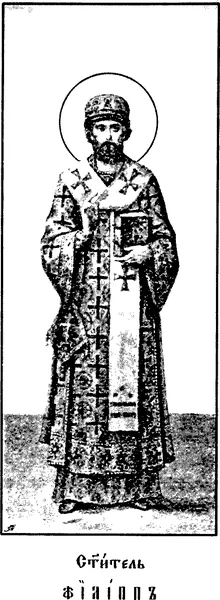
St Philip the Wonderworker, Metropolitan of Moscow and All Russia (+1569)
The hierarch Philip of Moscow (in the world Theodore) was born in 1507. He came of the Kolychev family, which had risen high at the court of the Moscow princes for its faithful service. The saint’s father, the boyar Stephen Ivanovich, an educated man full of military spirit, diligently prepared his son for state service. His mother, the pious Barbara, sowed the seeds of sincere faith and the fear of God in his soul (Barbara was later tonsured a nun with the name Barsanuphia). The young man showed remarkable diligence in studying Holy Scripture and the works of the holy fathers. The Grand Prince of Moscow Vasily III Ivanovich, the father of Ivan the Terrible, invited the young Theodore to the royal court. The future saint was not attracted by court life, full of vanity and weighed down with sins. He went still deeper into spiritual literature and went to church more often. The stifling atmosphere of Moscow oppressed the saint; his soul longed for monastic labour and solitary prayer. The saint secretly left Moscow. For a good while he lived on the shore of Lake Onega, in the village of Khizhi, earning his living as a shepherd, and then the desire for spiritual labour brought him to the Solovki monastery on the White Sea. Here the saint carried out the heaviest obediences: he chopped wood, worked the land, and worked in the mill. After a year and a half Theodore Kolychev, at his own wish, was tonsured a monk by Hegumen Alexis and named Philip.
In 1546 Archbishop Theodosius installed Philip as hegumen of the Solovki monastery. The new superior laboured much for the monastery: he composed a new rule and built two splendid churches, dedicated to the Dormition of the Theotokos and to the Transfiguration of the Lord. He himself worked among the builders like an ordinary labourer. By the north gate of the Transfiguration church he dug a grave with his own hands beside the grave of his teacher Jonah. Spiritual life flourished in the monastery.
For eighteen years the holy father led the Solovki monastery, and he laboured so much in this rank that he is rightly counted together with the Solovki wonderworkers Zosimas and Sabbatius as a founder of this monastery. Then the Lord called Philip to another service: Ivan the Terrible remembered the Solovki hermit and decided to make him helmsman of the Russian Church. The king hoped that the hierarch Philip would become his faithful fellow labourer, teacher and adviser, who would have nothing in common with the disobedient and rebellious boyars.
Philip refused for a long time: he felt no spiritual closeness with Ivan. He asked the king to abolish the oprichnina, a force created to strengthen royal power, which dealt cruelly with the boyars, the great landowners, and in general with anyone suspected of ill will towards the king, and on this pretext committed many injustices; while Ivan maintained that its existence was necessary for the state. At last the Terrible king and the holy metropolitan decided that Philip would not interfere in the oprichnina and in affairs of state, would not leave the metropolitan see, and would be the king’s adviser and support, like the metropolitans before him. On 15 June 1566 Philip became hierarch of Moscow.
Ivan the Terrible, one of the greatest and most contradictory figures of Russian history, lived an intense life: he was a gifted writer and bibliographer, took part himself in compiling chronicles and himself suddenly broke off the chain of Moscow chronicle-writing, knew monastic rules well, and more than once thought of abdicating the throne and becoming a monk. Ivan the Terrible regarded every step of his activity, the cruel measures by which he tried to transform the life of the Russian state and society at its roots, as a manifestation of God’s will in history. His favourite saints were Michael of Chernigov (commemorated 20 September) and Saint Theodore the Black (commemorated 19 September), men whose lives were hard and contradictory, but who boldly overcame difficulties on the path of serving their homeland and the Church and pressed firmly towards their cherished goal. The thicker the black gloom gathered around Ivan, the more his soul demanded cleansing by repentance. Once, having come to a service at the monastery of Saint Cyril, the king expressed before the hegumen and the brotherhood his wish to become a monk and fell at the superior’s feet, and he gave the repentant autocrat a blessing for monasticism. From that day on, all his life, “it seems to me, accursed as I am, that I am already half a black-robed monk,” Ivan the Terrible wrote. He conceived even the oprichnina itself in the form of monks: after doing their service with weapons and military exploits, the oprichniki were to put on monastic garments and attend long church services, which lasted from four in the morning until ten; on a “brother” who did not appear at the service at four in the morning the king-hegumen imposed a penance. Ivan himself prayed with his sons and sang in the church choir too. From the church the oprichniki went to the refectory, and during the meal the king watched over them. The warriors gathered the leftover food from the table and, as soon as they came out of the refectory, distributed it to the poor. Ivan the Terrible, in imitation of the great fathers, tried to wash away with tears his own sins and those of his companions in arms. He assured himself that even his most terrible and cruel acts were done for the good of Russia and the glory of Orthodoxy. Shortly before his death, by the king’s order, a complete list was drawn up of those killed by his oprichniki and by himself personally, and sent to the monasteries of Russia. Ivan the Terrible took the whole weight of the sin committed before the people upon himself, and besought the holy monks to pray for the relief of his tormented soul.
Ivan’s false monasticism, which lay on Russia’s neck like a grim yoke, disturbed Philip. He considered that the earthly and the heavenly must not be confused, that one cannot serve both the sword and the Cross at once. All the more so since Saint Philip saw how much unrepented malice and hatred hid under the black garments of the oprichniki. Among them were professional murderers, extortioners and robbers.
The hierarch Philip decided to stand against the Terrible autocrat.
In 1567 a new conspiracy was uncovered: traitors intended to seize the king and hand him over to the Poles, who had come up to the Russian border. Ivan the Terrible dealt cruelly with his enemies at home. It was very hard for Philip, but as the spiritual father of the people he considered himself bound to intercede for those put to death. The final break between the king and the hierarch came in 1568. On the Sunday of the Veneration of the Cross, when the king, as usual, entered the Dormition Cathedral with his oprichniki, the hierarch refused to bless him and boldly denounced the lawlessness of the oprichniki. Ivan said to him in wrath: “You have set yourself against us? We shall see how firm you are!” And he added: “I have treated you too gently!”
The king became still crueller towards his opponents, and the bloodshed increased. The fate of the confessor hierarch too was decided, but Ivan the Terrible wished everything to be done with the observance of outward order. The Boyar Duma obediently passed sentence on the helmsman of the Russian Church. Then a public trial of Metropolitan Philip was held. Two false witnesses also appeared: monks of the Solovki monastery, boundlessly loved by Philip, his former disciples, ordained by him. Saint Philip was accused of many things, among them sorcery. “I, like my forefathers, am a wanderer in this world; I am ready to suffer for the truth!” the hierarch answered calmly. He rejected all the accusations and voluntarily renounced the office of metropolitan. New humiliation awaited the saint: after he had been sentenced to imprisonment until death, Saint Philip was made to celebrate the Liturgy in the Dormition Cathedral. This happened on 8 November 1568. In the middle of the service the oprichniki burst into the church, publicly read out the sentence of the tribunal, which slandered the hierarch, tore the archbishop’s vestments from him, dressed him in old rags, drove him out of the church, and took him on a simple sledge to the Theophany monastery. Then he was tortured for a long time in the cellars of Moscow monasteries; he was bound in fetters, and a heavy block lay on his neck. At last the chief of the oprichniki, Malyuta Skuratov, smothered the saint with a pillow. Three days before his death the hierarch foresaw it and received the Body and Blood of Christ. Philip’s holy relics were first translated to the monastery there (11 August 1591), and at last to Moscow (3 July 1652).
The holy hierarch Philip worked many miracles both in his lifetime and after his death.



