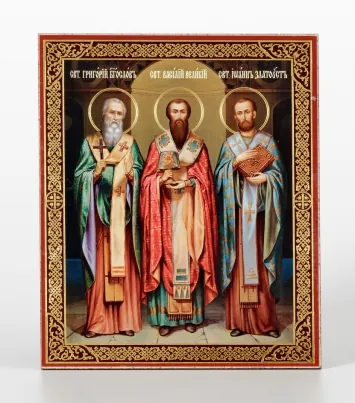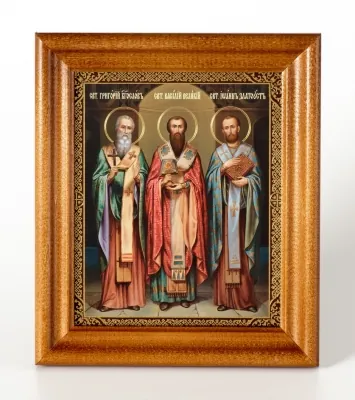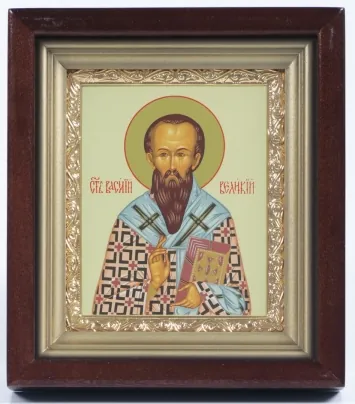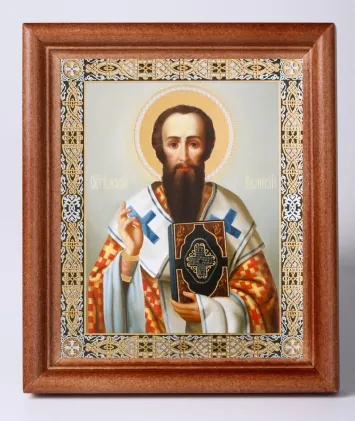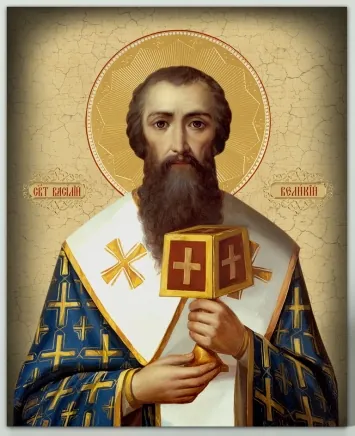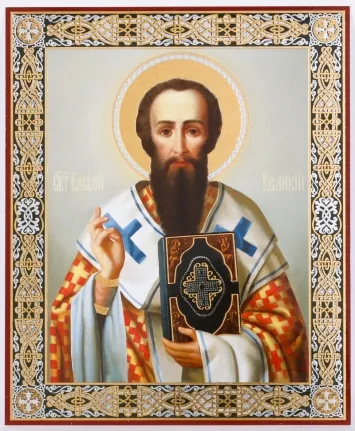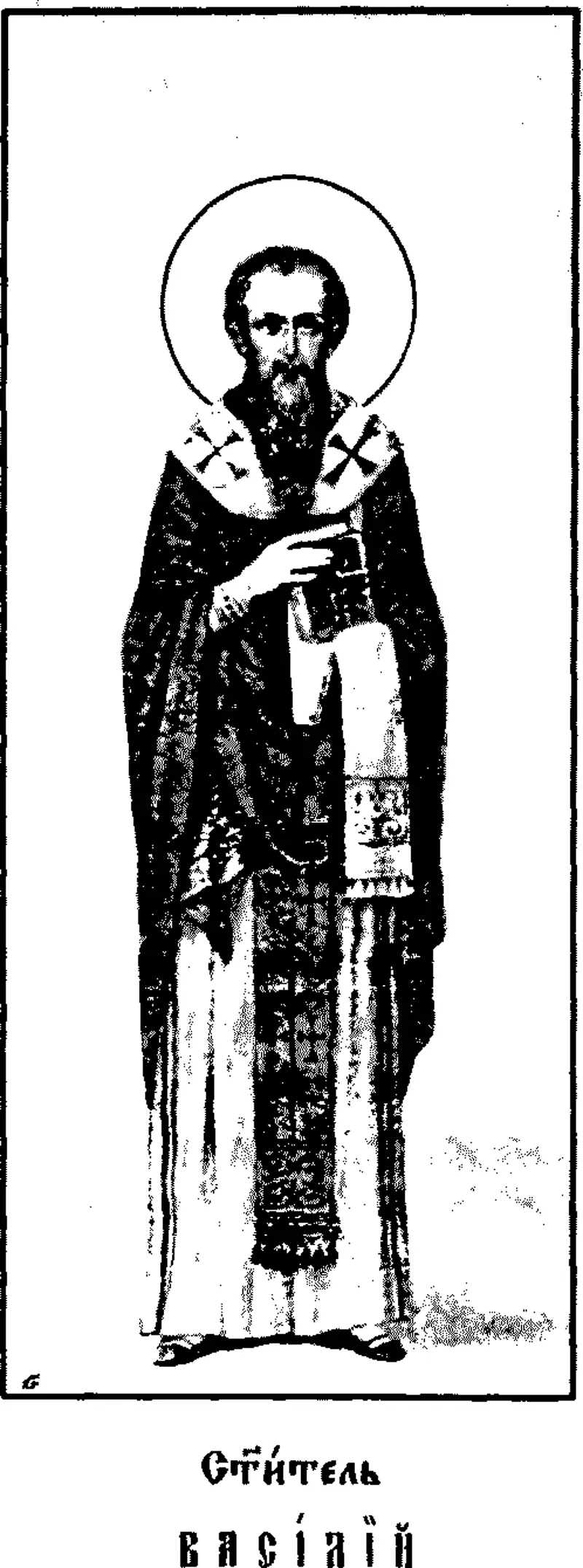
Our Father among the Saints Basil the Great, Archbishop of Caesarea in Cappadocia (+379)
The venerable father Basil the Great was born around 330 in Caesarea, the capital of Cappadocia. He came of a family famous for its nobility, wealth, gifts and divine zeal. The saint’s grandfather and grandmother hid in the forest for seven years during the persecution in Diocletian’s time. Saint Basil’s mother, Emmelia, was the granddaughter of a martyr, and his father, Basil the Elder, was an advocate of Neocaesarea and a well-known teacher of rhetoric.
Ten children were brought up in the family, five sons and five daughters. Five of them were afterwards numbered among the saints: Basil, Macrina (commemorated 19 July), Gregory of Nyssa (commemorated 10 January), Peter of Sebaste (commemorated 9 January), and the Venerable Theosebia the deaconess (commemorated 10 January).
Basil spent his childhood on the family estate; he received his elementary education under his father’s guidance, and then studied with the best teachers in Caesarea of Cappadocia. Here the saint filled everyone with admiration. Gregory of Nazianzus wrote: “He was an orator among orators before his study of philosophy; and, to say what is higher, he was a priest of the Christians.” From Caesarea Basil went to Constantinople and studied rhetoric with the famous Libanius. The future bishop continued his education in Athens, a city rich in traditional schools of philosophy. In Athens the Venerable Basil became friends with Gregory the Theologian. Their friendship lasted their whole lives. Around 357 Saint Basil returned to Caesarea. At the insistent request of the city’s inhabitants he spoke in public several times and delighted his hearers with his art as an orator. At the age of twenty-five he became an advocate and a teacher of rhetoric, but soon, filled with love for God, he withdrew from worldly cares and took the path of the monastic life.
To learn the monastic way of life he travelled in Egypt, Syria and Palestine and visited ascetics of great labours, and after returning to Cappadocia he tried to imitate them. The saint gave away all his wealth as alms. According to their letters, Basil and Gregory were distinguished by boundless abstinence: in their cells there was no hearth for lighting a fire, and their food was very scant. They cut stones, planted and tended trees, and carried loads. Because of the heavy physical labour their hands were never free of calluses. Withdrawn from worldly vanity, Basil and Gregory studied Holy Scripture and became acquainted with its commentaries, in particular the works of Origen, from whose writings they compiled the collection “Philokalia” (“Love of the Beautiful”). At the same time the Venerable Basil, at the monks’ request, wrote a manual of rules for the moral life. By the example of his life and his preaching Basil the Great led the Christians of Cappadocia and Pontus towards spiritual perfection. Many were drawn to him as to an experienced and God-inspired teacher. So two monasteries were founded, one for men and one for women, which were governed by the typikon of Basil the Great.
In the reign of the Emperor Constantius (337–361) the false teaching of Arius spread, and the defence of the Church’s purity required the service of both saints. Basil the Great returned to Caesarea. In 362 Meletius of Antioch ordained him deacon, and then in 364 Eusebius of Caesarea ordained him priest. Basil became famous for his wisdom and holiness. He was honoured and praised, and all this, because of human weakness, kindled jealousy in Eusebius. He began to oppress the venerable father. The monks rose up to defend Saint Basil. To avert the danger of a schism in the Church, the saint returned to his desert and set about ordering the monasteries. When the Arian Emperor Valens (364–378) came to power, a hard time came for Orthodoxy. Before the great struggle to come, at Bishop Eusebius’s request, Basil hurried back to Caesarea. From this time on the governance of the Church passed in effect into the hands of Basil the Great. He preached every day, often twice a day, morning and evening. At this time he composed the order of the Divine Liturgy, and also the homilies “On the Six Days”, commentaries on sixteen chapters of the prophecy of Isaiah and on the Psalms, a second collection of the rules of monastic life, the “Asceticon” (in the translation of Ephrem Mtsire, “The Book of Ascetic Labour”), and three books against the Arian teacher Eunomius.
The valiant champion of the purity of Orthodox teaching was at the same time a compassionate and God-loving Christian: he fed the poor, gave shelter to wanderers and the homeless, cared for virgins, and gave rules to monks in writing and by word of mouth.
After the death of Eusebius of Caesarea in 370, Saint Basil took his see. As Bishop of Caesarea he had fifty bishops of eleven provinces under him. Saint Athanasius the Great, Archbishop of Alexandria (commemorated 2 May), thanked God that He had granted the Church of Cappadocia such a bishop as Basil.
To the holy hierarch belong many letters to churches, bishops, clergy and private persons. The tireless activity of Basil the Great strengthened the heretics’ hatred of him.
The Emperor Valens persecuted and exiled Orthodox bishops and spread Arianism by cruel methods. For this same purpose he came to Cappadocia and sent the prefect Modestus to Saint Basil, who threatened him with confiscation of his property, banishment, torture and even death. “Your threats do not frighten me,” the saint answered. “He cannot lose property who has nothing but an old, threadbare garment and a few books; the danger of exile does not exist for me, for I am bound to no place: the place where I now live is not mine, nor will the place be mine where they drive me. Better to say, every place is the Lord’s. And what will torture take from me? I am so weak that I shall feel only the first blow; and death is a mercy to me: it will bring me near to the Lord, for whom I live and labour, and to whom I have long been hastening.” The governor listened dumbfounded. “You have probably never met a bishop before,” the saint went on, “or you would certainly have heard the same words from him. We are harmless and the most obedient servants of every authority; but when it concerns God and men dare to rise up against Him, we set ourselves above everything and obey God alone. Then fire, sword, raging beasts and instruments of torture are blessedness to us, and by these they cannot frighten us.”
When the prefect told the emperor of Basil the Great’s steadfastness, he added: “The head of the Church has defeated us, O king!” The saint showed the same firmness before the emperor himself, and made such a strong impression on Valens that he did not support the Arians, who were demanding the bishop’s exile. On the feast of the Transfiguration of the Lord, when a great multitude of people had gathered in the church, Valens too mingled with them, to show his unity with the Church. The singing of the psalms sounded to the emperor like a clap of thunder. He saw the beautifully adorned ambo and sanctuary, the clergy standing still in fear and awe, and Basil the Great standing at the altar, celebrating the service with angelic holiness.
The Venerable Basil strictly watched over the keeping of the church canons. In his time no one unworthy could slip into the clergy. He tirelessly visited his churches and punished breakers of church discipline impartially. In Caesarea Basil the Great built two monasteries, for men and for women, by the church of the Forty Martyrs, where their holy relics were kept. The clergy of the metropolis under the hierarch, imitating the monks, lived very poorly, in holiness and piety. Basil the Great obtained the exemption of the clergy from taxes. He spent all his own means and the income of his churches on the poor; he founded shelters for the infirm and built a hostel for wanderers in Caesarea. The illnesses that had pursued the saint from his youth, his strict and abstinent life, his care for his flock and his struggle with opposition drained Saint Basil’s bodily strength. On 1 January 379 the venerable father died at the age of forty-nine. Shortly before his death he blessed Gregory the Theologian to take the see of Constantinople.
This greatest father of the Church was numbered among the saints immediately after his repose.