
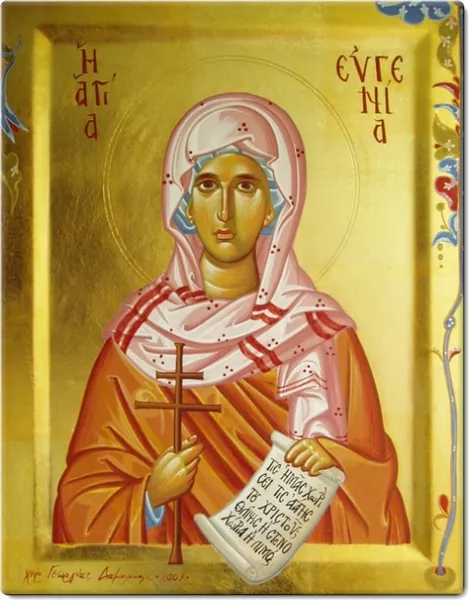
Venerable Martyr Eugenia and the Martyrs with Her: Protus, Hyacinth and Claudia (+c. 262)
The Venerable Martyr Eugenia was a Roman by birth, but lived in Alexandria, where her father Philip had been appointed eparch of Egypt by the Emperor Commodus (180–192). The saint received a fine education, and was also distinguished by virtue and beauty. Many noble young men sought her hand, but the blessed one did not wish to marry. Once the epistles of the Apostle Paul fell into Eugenia’s hands; after reading them she believed in Christ and burned with the desire to offer her life to Him; she put on men’s clothing and, together with the slaves Protus and Hyacinth, was baptised by the hand of Bishop Elias, to whom it had been revealed beforehand about Eugenia in a divine vision. The hierarch blessed the holy woman to labour disguised in men’s clothing under the name Eugene; this gave Saint Eugenia the chance to hide from her father, who wished to marry her off.
Through her tireless ascetic labours the Lord’s chosen one gained the gift of healing. Once a young widow, Melania, turned to her for help. The widow Melania was captivated by Eugene’s beauty and kindness and tried in every way to seduce the saint. Desires were stirred in her, but when she was rebuffed, she flew into a rage and accused the saint of trying to use force on her. Eugenia stood trial before her father, the eparch of Egypt, and was compelled to reveal her secret. The finding of the maiden, long mourned for, filled her family with joy, and some time later they were all baptised. When the emperor heard of this, he removed her father from the office of eparch. The Christians of Alexandria chose Philip as their bishop. The new governor of Egypt, fearing popular unrest, did not dare to put his predecessor to death publicly, and sent hired murderers after him. The assassins fell upon the hierarch during prayer and wounded him mortally, as a result of which he died three days later. The widowed Claudia returned with her daughter and servants to her estate near Rome. Here Eugenia converted many maidens to Christianity, while Claudia set up a shelter for the infirm and served widows. After several peaceful years the Emperor Gallienus (260–268) again began to persecute the Christians, and many of them found refuge with Claudia and Eugenia.
An orphaned young Roman woman of royal descent, Basilla, heard of Saint Eugenia, wished to meet the blessed maiden, and wrote her a letter. In answer Eugenia sent her friends and fellow ascetics, Protus and Hyacinth, to her. The saints instructed her, who was sincerely seeking the way, in the true faith, after which she believed in Christ and was baptised. Basilla’s maid told her mistress’s bridegroom, Pompey, that his bride had become a follower of Christ, and Pompey denounced to the emperor the Orthodox, as supposed preachers of celibacy. Summoned before the tribunal, Basilla refused to marry Pompey, for which she was run through with a sword. Protus and Hyacinth were taken to a pagan temple to offer sacrifice, but no sooner had they set foot inside than the idol fell down and was shattered. After this the holy martyrs were beheaded. Saint Eugenia too was taken by force towards the temple of Diana, but no sooner did the blessed one approach the idol-temple than it fell into ruins. After this a stone was tied round the neck of the Lord’s chosen one and she was thrown into the River Tiber, but the rope holding the stone broke and the martyr was saved. The saint remained unharmed in the fire too. Then she was thrown into a pit and kept in it for ten days. During this time the Saviour Himself appeared to her and told her that she would enter the Kingdom of heaven on the day of the Nativity of Christ. And indeed, in 262, on that radiant feast, the executioner beheaded the lamb of Christ. Very soon Saint Claudia too met her end as a martyr. The Venerable Martyr Eugenia had told her beforehand the day of her death.



