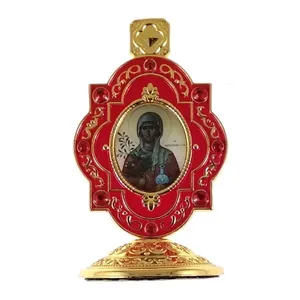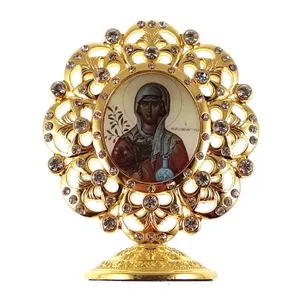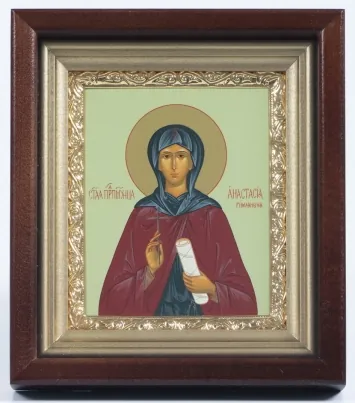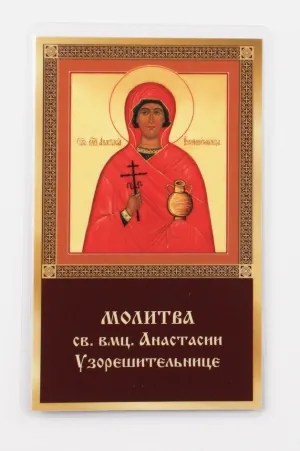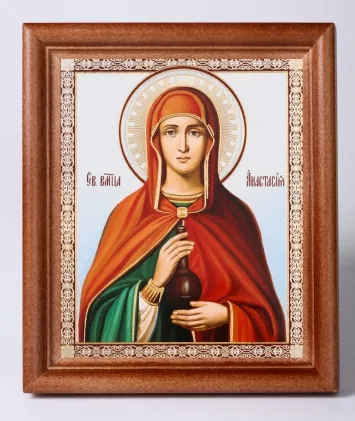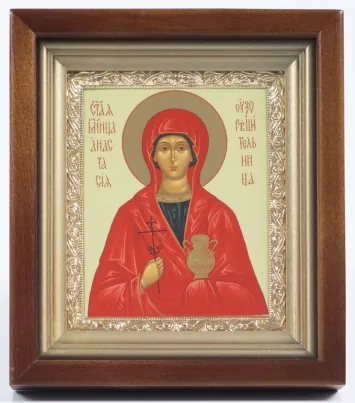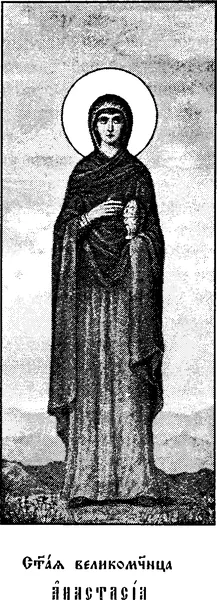
Great Martyr Anastasia (+c. 304); Holy Martyrs Chrysogonus, Theodotia, Evodus, Eutychian and Others (+c. 304)
The Great Martyr Anastasia suffered for the true faith during the persecution of the Orthodox by Diocletian (284–305). Her father was a pagan, and her mother a secret Christian. The child Anastasia was given to a well-known wise man, Chrysogonus, to be brought up. Together with various virtues and sciences the teacher planted love of the Christian faith in Saint Anastasia’s heart.
Anastasia came to know sorrow while still young: her mother died early, and her father, against her will, married her to a rich and noble but lawless and hard-hearted Roman, Pomplius. By pretending to be ill the saint managed to preserve her virginity. Poorly dressed, accompanied by a maid, she used to visit the Christians shut up in prison. When the maid told Pomplius of this, he was terribly enraged and locked his wife up in the house. Anastasia secretly wrote a letter to her tutor Chrysogonus, who was shut up in prison for confessing Christ, and asked him for the help of his prayers. Chrysogonus encouraged Saint Anastasia and also foretold that her husband would soon perish. And indeed, some time later Pomplius, on his way to Persia with an embassy, drowned at sea. After being widowed Saint Anastasia distributed her property generously to the poor.
At that time the prisons of Rome were full of Christians. The Emperor Diocletian gave orders for all of them to be slaughtered in a single night, and for Chrysogonus to be sent to him in Aquileia. Saint Anastasia followed her tutor and teacher at a distance.
The emperor questioned Chrysogonus in person, but could not win him over, and ordered the blessed one to be beheaded and then thrown into the sea. The waves cast up on the shore the martyr’s severed head and body. By a divine vision the presbyter Zoilus found them, placed them in a chest and hid it in his house. Then Chrysogonus appeared to Zoilus, revealed to him that the martyrdom of the young Christian women living nearby, Agape, Chionia and Irene (commemorated 16 April), was drawing near, and commanded him to send Saint Anastasia to them. To Zoilus himself the blessed martyr foretold the approach of his peaceful end.
Anastasia came to know a pious young widow, Theodotia, and in her found a faithful companion. Soon the pagans began to persecute them both. The godless seized Saint Anastasia in Illyria. After all the imprisoned Christians had been slaughtered in one night by Diocletian’s order, the blessed woman went to one of the prisons and, finding no one there, wept aloud. The prison guards realised that she was a Christian, arrested her and brought her to the governor of the region. And he handed her over to the priest Ulpian. The scheming priest set out gold, precious stones and clothing on one side, and terrible instruments of torture on the other. The bride of Christ chose the instruments of torture. Captivated by Anastasia’s beauty, the priest decided to use force on her, but as soon as he made to lay a hand on the blessed one, he was struck blind. Beside himself with pain, the servant of the devil ran towards the pagan temple to beg help from the idols, but fell on the way and gave up the ghost. Saint Anastasia was freed, and with Theodotia again gave herself to serving the suffering Christians. Soon Saint Theodotia and her three sons (the name of only one of them is known, Evodus) met their end as martyrs (see the reading for 29 July). Saint Anastasia was seized a second time and sentenced to death by starvation. She spent sixty days in the prison without food or drink. Every night Saint Theodotia appeared to the martyr and strengthened her. When the judge saw that hunger had done Anastasia no harm, he ordered her to be drowned at sea together with criminals condemned to death. Among them was Eutychian, who was being persecuted for Christ.
When the ship had gone out into the open sea, the soldiers bored holes in it in several places and themselves got into a boat. Theodotia appeared to the prisoners and guided the ship to the shore. Having reached land, the hundred and twenty men who had been miraculously saved believed in Christ and were baptised. Soon all of them were seized and tortured to death. Saint Anastasia was hung on a post above a blazing fire. After the Lord had received the martyr’s soul, purified by suffering, her precious body was buried in a garden by a pious woman, Apollinaria. In the fifth century the incorrupt relics of Saint Anastasia were translated to Constantinople, where a church dedicated to her was built. Later the head and arm of the handmaid of Christ were translated to the monastery of the holy Great Martyr Anastasia founded near the Holy Mountain of Athos.